

Skydiving in New Zealand: 8 Things to Know Before You Jump + The Best Places to Go
Skydiving in New Zealand is about more than just the jump – it’s about throwing yourself into some of the most dramatic landscapes on earth. From jagged mountain ranges and deep-blue lakes to rugged coastlines and rolling farmland, every freefall here comes with a seriously impressive backdrop. New Zealand’s strong safety culture and highly trained instructors mean you can relax into the experience, knowing you’re in expert hands.
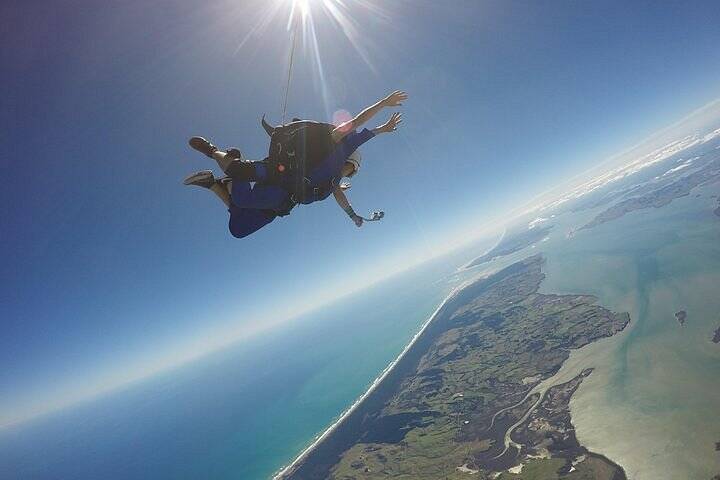
If it’s your first time, a tandem skydive is the perfect way to start. You’ll be securely harnessed to an experienced instructor who takes care of the technical side, leaving you free to focus on the rush of the exit, the roar of the wind, and the views opening up beneath you. Tandem jumps are offered by major skydiving operators all over the country, with different altitude options, photo and video packages, and drop zones to suit your travel plans.

This blog may contain affiliate links. Read our disclosure policy for more info
Skydiving in NZ at a Glance
Best for: Adrenaline lovers, first-timers, and anyone chasing a big “I did it!” moment
Popular altitudes: 9,000 ft, 12,000 ft, 15,000 ft (varies by operator)
Typical freefall time: 25–60 seconds, depending on altitude
Season: Year-round, with clearer views in winter and long daylight in summer
Good to know: Most first-time jumps in NZ are tandem skydives, where you are securely harnessed to a professional instructor.
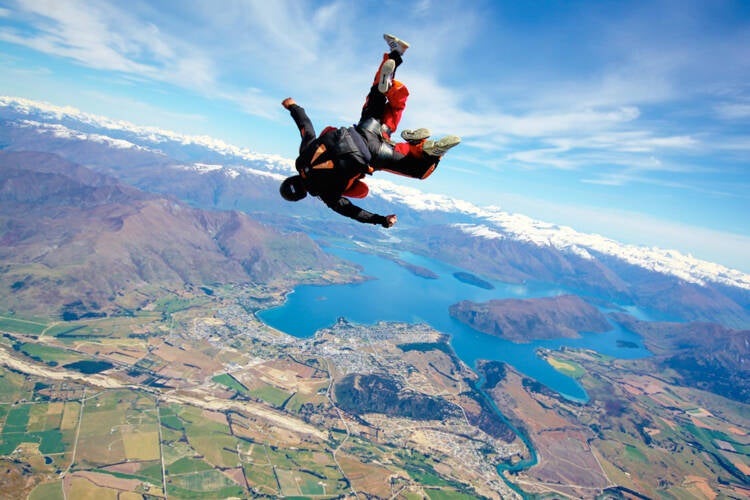
New Zealand is an unfair place to go skydiving — unfair because the views are ridiculous. Mountains, volcanoes, alpine lakes, coastlines… it’s like the country was designed to be seen from the sky.
If you’re thinking about doing a tandem jump (first-timers: you should), this guide will save you time, money, and a few avoidable mistakes. I’ll cover what to expect, who can jump, what it costs, when to go, and the best drop zones across both islands.
Quick facts before we get into it
-
You can skydive year-round in New Zealand, but it’s always weather-dependent and operators will reschedule if conditions aren’t safe.
-
Tandem skydives commonly hit around 200 km/h in freefall.
-
Prices vary by altitude and location — from budget-friendly lake jumps to premium glacier jumps. For example, Taupō lists 12,000 ft from $329 NZD, while Franz Josef’s 18,000 ft jump is listed from $799 NZD.
1) Is skydiving in New Zealand safe?
Yes — when you choose a reputable operator and follow instructions.
Tandem skydiving is designed for beginners: you’re attached to a highly experienced instructor, and they control the jump, the parachute deployment, and the landing approach. Your job is simple: listen, breathe, enjoy.
If you have medical concerns, don’t guess. Most operators are clear that they are not medical professionals and advise speaking with a doctor if you’re unsure.
My advice: don’t bargain-hunt blindly. Pick a well-reviewed operator, read the restrictions, and be realistic about weather delays.
2) Who can go skydiving in NZ? (Age, weight, and common restrictions)
Most travelers can do a tandem jump, but eligibility is based on harness fit, size, and safety assessment, not bravado.
Examples from real NZ operators:
-
Queenstown (NZONE) lists minimum weight 40 kg and minimum height 1.2 m, and notes children are assessed on the day.
-
Skydive Auckland notes no age limit, but a 30 kg minimum weight restriction and parental consent for under-18s.
-
Taupō’s 16,500 ft option has an age limit of 14+.
Common “no-go” areas tend to include pregnancy and serious heart/back conditions — and again, if in doubt, get medical clearance first.
3) Can you skydive year-round?
Yes — New Zealand skydiving runs throughout the year, but it’s always “weather permitting.” Even in summer, wind or low cloud can ground planes.
The smart move is to schedule your jump early in your trip so you have flexibility if you need to rebook due to weather.
4) What does it cost to skydive in New Zealand?
Price is driven mostly by altitude and location.
Real examples:
-
Taupō: 12,000 ft listed at $329 NZD, and 16,500 ft listed at $529 NZD.
-
Franz Josef: 18,000 ft listed from $799 NZD.
-
Tauranga: 15,000 ft listed at $764 NZD (example product listing).
Photos/video are usually extra, and policies vary by operator.
5) How high can you jump from in NZ?
New Zealand offers some seriously high jumps. You’ll commonly see options around:
-
9,000 ft (great starter option)
-
12,000–15,000 ft (the sweet spot for most people)
-
16,500–18,000 ft (longer freefall, higher price)
For example:
-
Taupō lists jumps up to 16,500 ft.
-
Skydive New Zealand’s Franz Josef product highlights 18,000 ft.
My opinion: if it’s your first time and you can afford it, go at least 12,000–15,000 ft. It gives you enough freefall to actually process what’s happening (instead of “blink-and-it’s-over”).
6) Best places to skydive in New Zealand
Here are seven excellent options, with the “why” explained:
Auckland (North Island) – Coastline and islands
Auckland jumps are popular for first-day arrivals and give you a big-picture view of the region. Skydive Auckland notes a 30 kg minimum weight and under-18 parental consent.
Taupō (North Island) – Lake + volcano views
Taupō is a classic: lake views plus central North Island landscapes. Taupō Tandem lists 12,000 ft at $329 and 16,500 ft at $529, with the higher jump set at 14+.
Queenstown (South Island) – Mountains, lake, and pure drama
Queenstown is famous for adventure for a reason. NZONE’s published requirements include 40 kg minimum weight and 1.2 m minimum height, plus harness fit checks.
Franz Josef (South Island) – Glaciers and wild West Coast scenery
If you want the “pinch me” landscapes, Franz Josef is hard to beat. Skydive New Zealand lists an 18,000 ft experience from $799 NZD.
Aoraki / Mt Cook region (South Island) – Big alpine views
Skydive New Zealand’s Mt Cook 13,000 ft page states a 100 kg max weight (sometimes up to 105 kg at tandem master discretion).
Tauranga / Bay of Plenty (North Island) – Beaches and Mount Maunganui
Tauranga operators commonly run 12,000–15,000 ft options, and at least one operator sets its minimum age at 7 years old (company policy).
Abel Tasman (South Island) – Golden coastlines and national park views
Skydive Abel Tasman notes parental/guardian consent for under-18s and that children under 12 should be evaluated case-by-case.
7) What should you wear skydiving?
Keep it simple:
-
Closed-toe shoes you can move in (trainers/sneakers are perfect)
-
Comfortable clothes you can lift your legs in
-
A warm layer if it’s cool (it’s colder at altitude)
-
Avoid loose items (scarves, dangling jewellery)
Most operators provide overalls if needed.
8) Should you do it?
Yes. If you’re even considering it, you’ll regret skipping it more than you’ll regret doing it.
If you’re nervous: that’s normal. The fear is loud on the ground and strangely quiet in the air. Once you’re out, it becomes pure sensation and pure scenery.
My “best first jump” recommendation
-
Pick a place with views you genuinely care about (lake, mountains, glacier, coastline).
-
Choose 12,000–15,000 ft if your budget allows.
-
Book early in your trip so weather can’t ruin the plan.
Best Places to Skydive in New Zealand

Aoraki/Mt Cook — Lake Pukaki (10k / 13k / 15k ft)
Big-mountain drama where the ice meets the sky.
From the moment you see Lake Pukaki’s electric turquoise, you know the photos will look unreal. Climbing through the Mackenzie Basin, Aoraki and the Tasman Glacier fill half the horizon. Door slides open; alpine air hits your face; you tip out into a vertical postcard. The freefall here feels extra crisp—blue lake, white ice, brown ranges, all in one frame.
Why go: New Zealand’s most cinematic alpine backdrop—no contest.
Who it suits: First-timers who want “peak NZ” shots; photographers; couples on a South Island roadie.

Franz Josef & Fox Glaciers (13k / 16.5k ft)
Glacier to ocean in one dizzying panorama.
This is the West Coast at full volume: jagged icefields behind you, wild Tasman Sea in front, rainforest threading the valleys below. On bluebird days the horizon curves forever; on moody days the clouds part like theatre curtains. The freefall feels fast and cinematic, and the canopy ride is a glide over a living geology lesson.
Why go: Nowhere else gives you ice + sea in one look.
Local tip: Weather is changeable, book early in your itinerary to keep buffer days.

Queenstown (9k / 12k / 15k ft)
The brand-name New Zealand skydive.
Lake Wakatipu snakes below like a river of blue steel, the Remarkables slice the skyline, and Queenstown looks toy-sized as you roll into the wind. It’s the “I came to NZ to feel alive” leap, with the bonus of every other bucket-list activity within 20 minutes.
Why go: The classic “adventure capital” jump with iconic scenery and slick ops.
Who it suits: First-timers, groups, anyone pairing with bungy/jet boating.

Wānaka (9k / 12k / 15k ft)
Crystal lakes, Mt Aspiring National Park, often the smoother ride.
Wānaka trades Queenstown’s bustle for big-space serenity. Lakes Wānaka and Hāwea mirror the sky, braided rivers sketch patterns on the flats, and Mt Aspiring sits like a crown. Many travelers say the canopy ride here feels extra peaceful.
Why go: Immense space, painterly colours, often kinder winds.
Who it suits: Photo-focused couples, chilled first-timers, anyone staying Lakeside.
How to stack the day: Sunrise at the lake, mid-morning skydive, vineyard lunch, bike Glendhu or stroll the Outlet Track.
Local tip: Late afternoon light over Aspiring is magic for a video.

Taupō (12k / 15k / 18.5k ft)
North Island hero: huge altitudes, friendly prices.
From 12k you get the big grin. From 15k you get the full-body whoop. From 18.5k you get a long, glorious freefall with Lake Taupō, the Central Plateau, and on clear days the Tongariro volcanoes in the frame. Operators here are dialled, efficient, upbeat, and brilliant at settling nerves.
Why go: Best price-to-altitude in NZ, with classic North Island scenery.
Who it suits: Budget-savvy travellers, road-trippers, friend groups.
How to stack the day: Sunrise lakeside, skydive, Huka Falls Jet, soak at the hot pools, dinner by the marina.

Bay of Islands (9k / 12k / 16.5–18k ft)
Island-studded blues that look painted on.
On a bluebird day the BOI looks tropical, turquoise shallows, white sand crescents, yachts leaving brushstrokes behind them. Freefall feels like air-swimming over a 100-island atlas, and the canopy ride is a lazy swoop over coves.
Why go: The prettiest coastal palette in the North Island.
Who it suits: Summer road-trippers, beach lovers, photographers.
How to stack the day: Morning jump, lunch in Russell, afternoon island cruise or paddleboard, sunset at Paihia.
Local tip: Sea breezes can pick up, aim for earlier slots.

Auckland / Parakai (13k / 16.5–18k ft)
Big-city access with wild west-coast horizons.
Thirty-five minutes from the CBD and you’re jumping over patchwork farmland with the Tasman surf stacking lines on the horizon. On clear days you can clock both coasts and the Sky Tower in the distance—very “only in Auckland.”
Why go: Highest altitudes near the country’s biggest city; easy car-pool or Uber from town.
Who it suits: Time-poor travellers, cruise visitors, business-trip thrill seekers.
Local tip: Weekday mornings are typically calmer and quieter.

Abel Tasman / Tasman Bay (9k / 13k / 16.5–18k ft)
Golden beaches, aquamarine water, and a coastline you’ll want to trace with your finger.
The approach flight alone is worth it: tidy orchards give way to turquoise bays, then your door opens and you’re a speck above summer itself. Under canopy, the Abel Tasman Coast Track looks like a ribbon between native bush and hot-sand beaches.
Why go: Coastal colour palette meets Great Walk coastline.
Who it suits: Couples, summer holidaymakers, anyone pairing skydive + sea kayak.

Tauranga / Mount Maunganui (12k / 15k ft)
Bay of Plenty beaches, The Mount, and blue horizons for days.
Take off over surf-washed sandbars and cruise to altitude with Mauao (The Mount) standing sentinel. On clear days you’ll spot Matakana Island and the long arc of coastline—bright, beachy, and very holiday-feels.
Why go: East-coast beach views + easy access from Tauranga/Mt Maunganui.
Who it suits: North Island road-trippers, beach-town weekenders, cruise passengers docking at The Mount.
Stack the day: Morning jump → brunch at The Mount → walk the Mauao summit/base track → sunset swim at Main Beach.
Local tip: Summer books out—grab early slots for the calmest air and best ocean colour.


Skydiving in New Zealand: essential tips
When planning a skydiving adventure in New Zealand, book in advance, especially during peak season. Check the weather forecast, wear comfortable, close-fitting clothing, and listen carefully to the pre-jump briefing. Ensure that the skydiving operator is certified and has a strong safety record.

Hidden skydiving gems
While popular spots like Taupō and Queenstown offer incredible skydiving experiences, consider less-known locations such as Abel Tasman National Park or the Bay of Islands for unique scenery and smaller crowds. These spots offer equally thrilling jumps with distinct, breathtaking landscapes.