

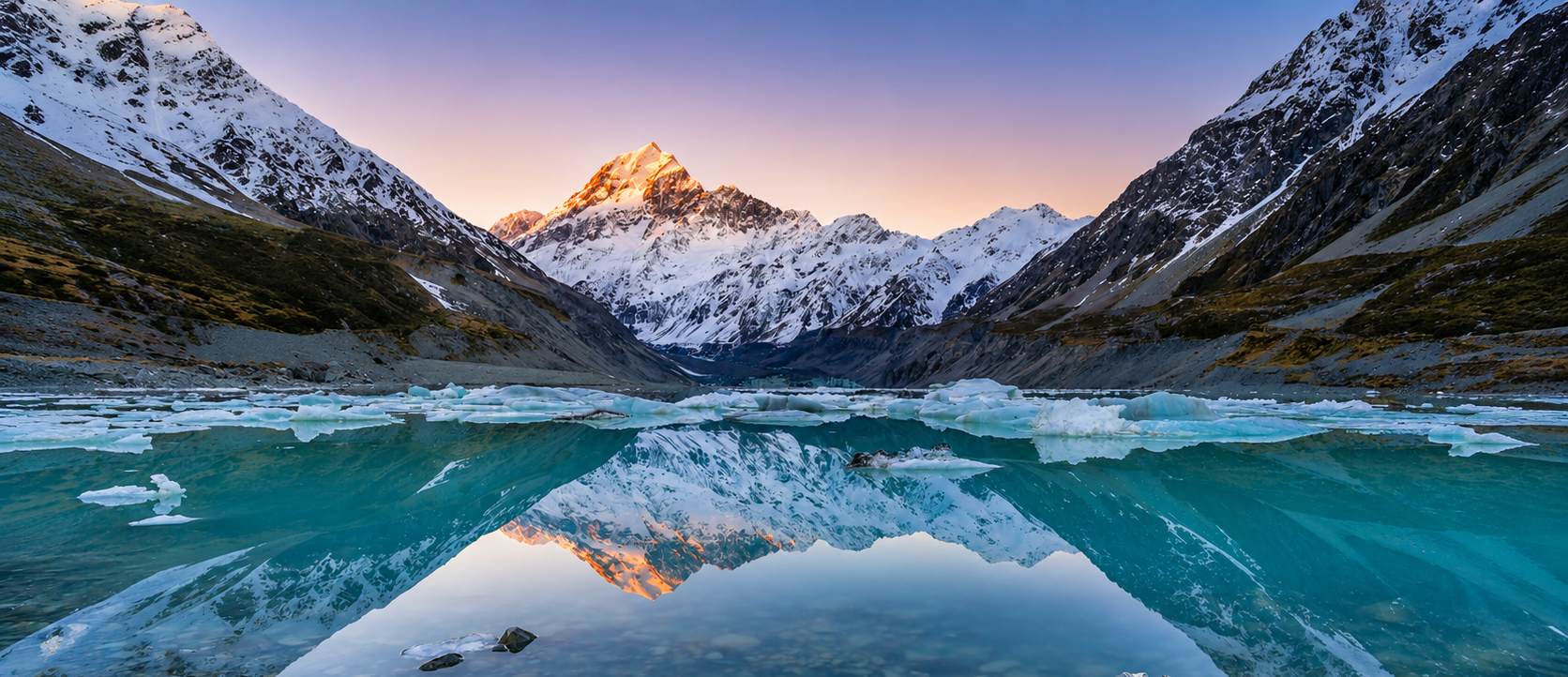
AORAKI/MOUNT COOK
5 Best Things to Do in Aoraki/Mount Cook, New Zealand
There are some places in New Zealand where the journey towards them is almost as memorable as arriving, and Aoraki/Mount Cook is one of the best examples.
The drive along State Highway 80 beside Lake Pūkaki gives you plenty of warning that you are heading somewhere special. The lake can take on an almost unreal turquoise colour, the Southern Alps gradually grow across the horizon and, when the weather is clear, Aoraki begins appearing ahead of you long before you reach the village. It is one of those roads where the driving time on your map quickly becomes irrelevant because you keep finding reasons to stop. Mackenzie tourism information rightly treats the Lake Pūkaki road itself as part of the experience, with some of the best views of the lake and Aoraki found along the approach to the national park.
Once you reach Aoraki/Mount Cook Village, the scale becomes even more obvious. The national park contains 19 peaks above 3,000 metres, including Aoraki/Mount Cook, New Zealand's highest mountain, and the landscape is dominated by rock, ice, glaciers and huge valleys carved by forces that make the village below look very small indeed.
What I particularly like about Aoraki/Mount Cook is that you do not need to be a mountaineer to experience that landscape properly. There are short tracks with enormous views, longer climbs that will test your legs, glacial lakes that can be explored on foot or by boat, scenic flights into the Southern Alps and some of the darkest night skies in the country.
At the same time, this is somewhere I would avoid trying to rush.
Aoraki/Mount Cook is often squeezed into South Island itineraries as a stop between Queenstown and Christchurch, and you certainly can visit that way. I just do not think it is the best way to experience it. The weather changes quickly here, cloud can hide Aoraki completely and then disappear later in the day, and the mountains look different in the morning, afternoon and evening.
Staying at least one night gives you a much better chance of seeing the area in different conditions. Two nights is even better, particularly if hiking, a scenic flight or one of the glacier experiences is important to you.
For a first visit, these are the five experiences I would build the trip around.
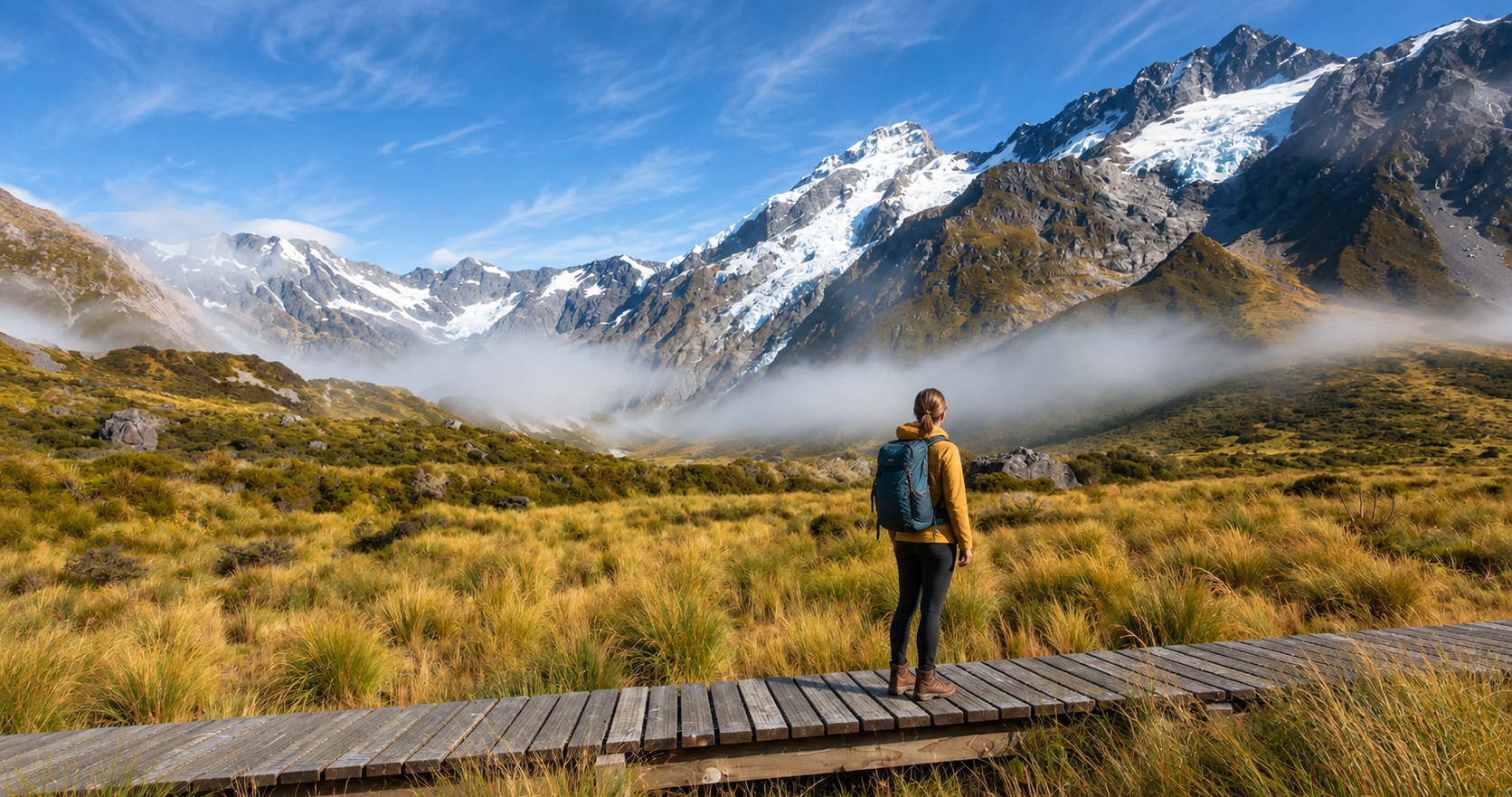
Walk the Hooker Valley Track
1. Walk the Hooker Valley Track
Best for: First-time visitors, photographers and anyone wanting the classic Aoraki/Mount Cook experience
Allow: Around 3–4 hours, although I would happily give it half a day
Difficulty: Relatively accessible in normal conditions
My verdict: If you only walk one track at Aoraki/Mount Cook, this is the one I would choose
The Hooker Valley Track is popular enough that it would be easy to assume it has become overhyped. In this case, I think the popularity is justified.
What makes the walk so good is how quickly the scenery begins. You do not spend two hours walking through fairly ordinary country waiting for a viewpoint at the end. From White Horse Hill you are already surrounded by serious mountains, with glacier-fed rivers, moraine ridges and the enormous face of Kakīroa/Mount Sefton dominating sections of the valley.
The track gradually takes you further into the Hooker Valley towards Hooker Lake, with Aoraki becoming more prominent as you go. The landscape changes along the way from rocky moraine to open tussock and broad glacial valley floor, so even though the route itself is not particularly technical, it still feels as though you are moving deeper into the mountains.
As of July 2026, the full Hooker Valley Track is open again following completion of the new second bridge across the Hooker River. At 189 metres, that new crossing is now New Zealand's longest suspension bridge.
That makes the complete walk to Hooker Lake available again, which is a major improvement for anyone planning a current Aoraki/Mount Cook itinerary.
The Walk Into the Valley
The track begins at White Horse Hill and passes several worthwhile points almost immediately. Freda's Rock commemorates pioneering mountaineer Freda Du Faur, while the Alpine Memorial is another short side trip before you reach the first major river crossing.
Even in this early section, it is worth taking your time. Mueller Lake sits beneath the surrounding mountains, Kakīroa/Mount Sefton rises sharply above it and, depending on conditions, you may hear movement from the ice and snow high above the valley.
This is one of those walks where constantly trying to reach the next named point slightly misses the experience. The landscape is changing around you all the time, and turning around occasionally gives you views that are just as good as the ones ahead.
The suspension bridges add another dimension. Crossing a glacial river with cold grey-blue water running underneath while mountains fill the horizon feels much more adventurous than the actual difficulty of the track might suggest. The bridges move, particularly when other people are crossing, but that is part of their character.
After the new second bridge, the valley opens and the walking becomes particularly beautiful. Tussock replaces much of the rough moraine landscape and Aoraki begins sitting more directly ahead.
Reaching Hooker Lake
Hooker Lake is the natural end point of the walk, sitting beneath Aoraki and surrounded by the Southern Alps.
In summer, pieces of ice can sometimes be seen floating on the lake, having broken away from the glacier further up the valley. DOC specifically warns visitors to stay out of the water and off floating or frozen ice: the glacial lakes are typically around 3°C, and icebergs can move or roll unexpectedly.
You should not need that warning once you see the water, but somebody inevitably does.
The lake is a place I would stay for a while rather than turning around the moment I reached it. Have something to eat, find somewhere sensible to sit and look towards the mountain. If Aoraki is hidden behind cloud, give it a little time. Alpine weather changes quickly, and a summit that was invisible when you arrived can sometimes appear surprisingly quickly.
If it does not, the walk is still worthwhile. The idea that Aoraki/Mount Cook only counts if you get a completely cloud-free photograph is one of those travel expectations I would happily leave behind.
Is the Hooker Valley Track Too Busy?
At certain times, it can be very busy.
DOC warns that White Horse Hill can have limited parking from November through March, particularly between around 10am and 4pm, and the Hooker Valley Track itself attracts very high visitor numbers.
I would not let that stop me doing the walk.
I would simply adjust the timing.
Starting earlier gives you a quieter track and cooler conditions in summer. Later in the afternoon can also be beautiful, although you need to leave enough daylight to return comfortably.
The scenery is too large for the walk to feel completely ruined by other people. You are not coming here for total isolation. You are coming because the valley is extraordinary.
A Current Parking Note
Parking at White Horse Hill is currently charged at $2.50 per half hour, up to $25 for the day, with a 20-minute free period for short drop-offs and pickups.
I would factor that into the day rather than arriving and being surprised by it.
It also gives you another reason not to drive out simply to take one photograph from the car park.
If you are paying to park, walk somewhere.
What About Winter?
Winter completely changes the character of the track.
The route itself is designed to avoid avalanche terrain as long as you remain on the marked track, but shaded sections can become extremely icy. DOC currently recommends microspikes and hiking poles for winter conditions, along with proper warm clothing and suitable footwear.
This is an alpine environment even though the track is accessible.
The fact that hundreds of people walk it in summer does not make winter conditions harmless.
Aotearoa Adventures Tip
If you wake up to a clear morning and the Hooker Valley is one of your priorities, I would go rather than automatically saving it for later. Aoraki/Mount Cook weather is too changeable to assume tomorrow will look the same.
I would also allow more time than the basic walking estimate. This is not a track where you want to spend the whole day checking whether you are “on pace”.
Explore Haupapa/Tasman Glacier and Tasman Lake
2. Explore Haupapa/Tasman Glacier and Tasman Lake
Best for: Glaciers, shorter walks, families and travellers who want something different from Hooker Valley
Allow: Around 1–2 hours for the viewpoints or half a day with Glacier Explorers
My pick: Do the viewpoint even if you do nothing else; add the boat trip if glaciers are a major reason for your visit
My verdict: This is the part of Aoraki/Mount Cook too many visitors rush past
If the Hooker Valley gives you the classic alpine postcard version of Aoraki/Mount Cook, the Tasman Valley gives you something rougher and more obviously shaped by ice.
I like the contrast.
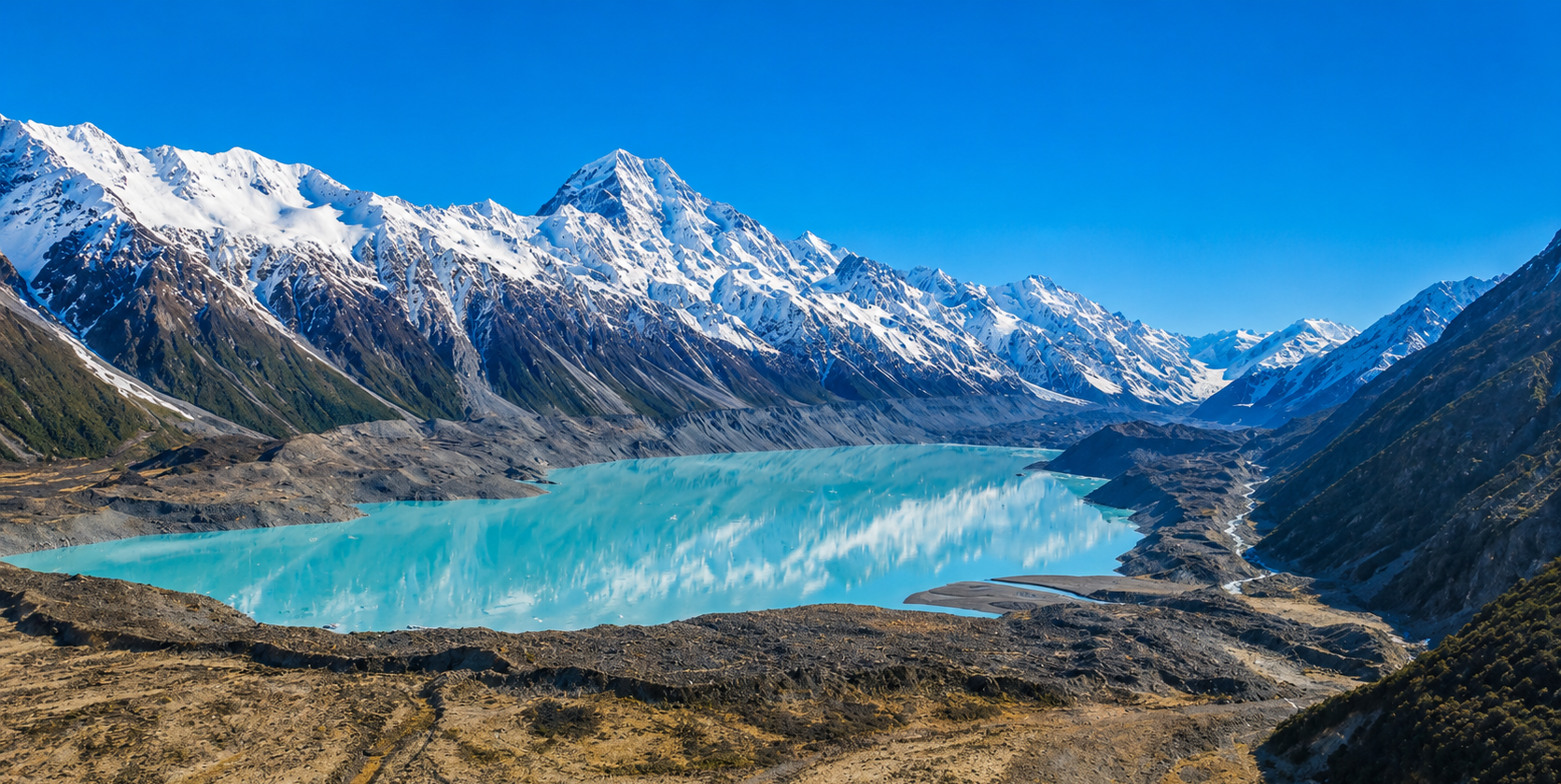
The landscape around Haupapa/Tasman Glacier is broad, rocky and exposed. Huge walls of moraine show where the glacier has been, while Tasman Lake occupies a space that did not even exist in its present form a few decades ago. DOC records the lake as beginning to form in 1974 and continuing to grow as the glacier has retreated.
That makes the valley interesting for more than just the view.
You are looking at a landscape that is visibly changing.
Getting Into the Tasman Valley
Just before reaching Aoraki/Mount Cook Village, Tasman Valley Road turns away from State Highway 80 and follows the valley for around seven kilometres towards the main car park.
The drive is short, but the scenery changes quickly.
By the time you reach the end of the road, the valley feels much more barren than the country around Lake Pūkaki. There is less of the green alpine postcard scenery and much more exposed rock, gravel and moraine.
It feels raw.
That is exactly what I like about it.
Tasman Glacier View
If you only have a little time, walk to the Tasman Glacier Viewpoint.
The track is short but involves a steady climb of more than 300 steps. It only takes around 15 minutes to reach the main viewpoint, where you look across Tasman Lake towards Haupapa/Tasman Glacier, New Zealand's longest glacier.
This is a great example of how Aoraki/Mount Cook can reward relatively little walking with an enormous view.
Tasman Lake stretches away below you, with moraine walls on either side and the glacier sitting beyond. During summer, icebergs can often be seen floating on the lake, while winter can bring lake ice.
Again, stay off it.
A frozen glacial lake is not an invitation.
Why the Glacier Can Surprise People
Visitors sometimes expect a giant wall of bright white ice to be sitting immediately in front of them.
The reality is more complicated.
The lower part of a glacier can carry huge amounts of rock and debris, and Haupapa/Tasman Glacier has retreated significantly. From some viewpoints the surrounding moraine can initially dominate what you see.
I actually think understanding that makes the experience more interesting.
The enormous terminal moraine and growing lake tell the story of the glacier just as clearly as the ice itself.
This is not a static landscape.
Glacier Explorers
If you want to get much closer to the glacial environment, Glacier Explorers is the paid experience I would look at.
The trip takes visitors onto Tasman Lake in small boats, moving among floating icebergs and towards the glacier while maintaining appropriate safety distances. It is currently New Zealand's only glacier boat tour.
What makes this one of the better paid experiences at Aoraki/Mount Cook is that it gives you access to somewhere you cannot simply reach on your own.
You can look at the lake for free.
You cannot independently take yourself out among the icebergs.
That distinction matters when deciding what is worth spending money on.
The complete experience takes around 2 hours 45 minutes and includes a 1.5-kilometre walk between the car park area and lake edge, so it is not simply a case of stepping straight from the coach into a boat.
A Seasonal Activity
Glacier Explorers is seasonal rather than year-round. For the current 2026 season, the operator is reopening on 24 August.
That is exactly the sort of activity I would check for your actual travel dates instead of assuming an old article still applies.
Bookings are also described by the operator as essential.
Is Glacier Explorers Worth Paying For?
If you are travelling on a tight budget, I would be perfectly happy with the Tasman Glacier View Track and other free walks.
The national park does not suddenly become disappointing because you did not buy a boat ticket.
If you are interested in glaciers, travelling with people who do not want a major hike or looking for one paid experience that adds something genuinely different, I think Glacier Explorers is a strong choice.
It complements the hiking rather than replacing it.
Aotearoa Adventures Tip
Do not leave the Tasman Valley simply because you have already walked Hooker Valley. They feel surprisingly different.
If the Hooker Valley is green, open and focused on Aoraki, the Tasman side feels much more like a working glacial landscape.
3. Take a Scenic Flight Over Aoraki/Mount Cook and the Southern Alps
Best for: A major holiday experience, photographers and anyone wanting to understand the scale of the Southern Alps
Allow: Around 20 minutes to an hour depending on the flight
My pick: Choose the route rather than simply choosing the cheapest flight
My verdict: Expensive, but one of the few activities that reveals a completely different Aoraki/Mount Cook
There is only so much of Aoraki/Mount Cook National Park you can understand from the valley floor.
The mountains themselves block your view.
You walk along one valley and see one side of a ridge. You drive into the Tasman Valley and see another. What you do not see is everything behind them: the snowfields, hidden glaciers, high passes and enormous amount of alpine country that has no road access at all.
That is what changes when you get into the air.
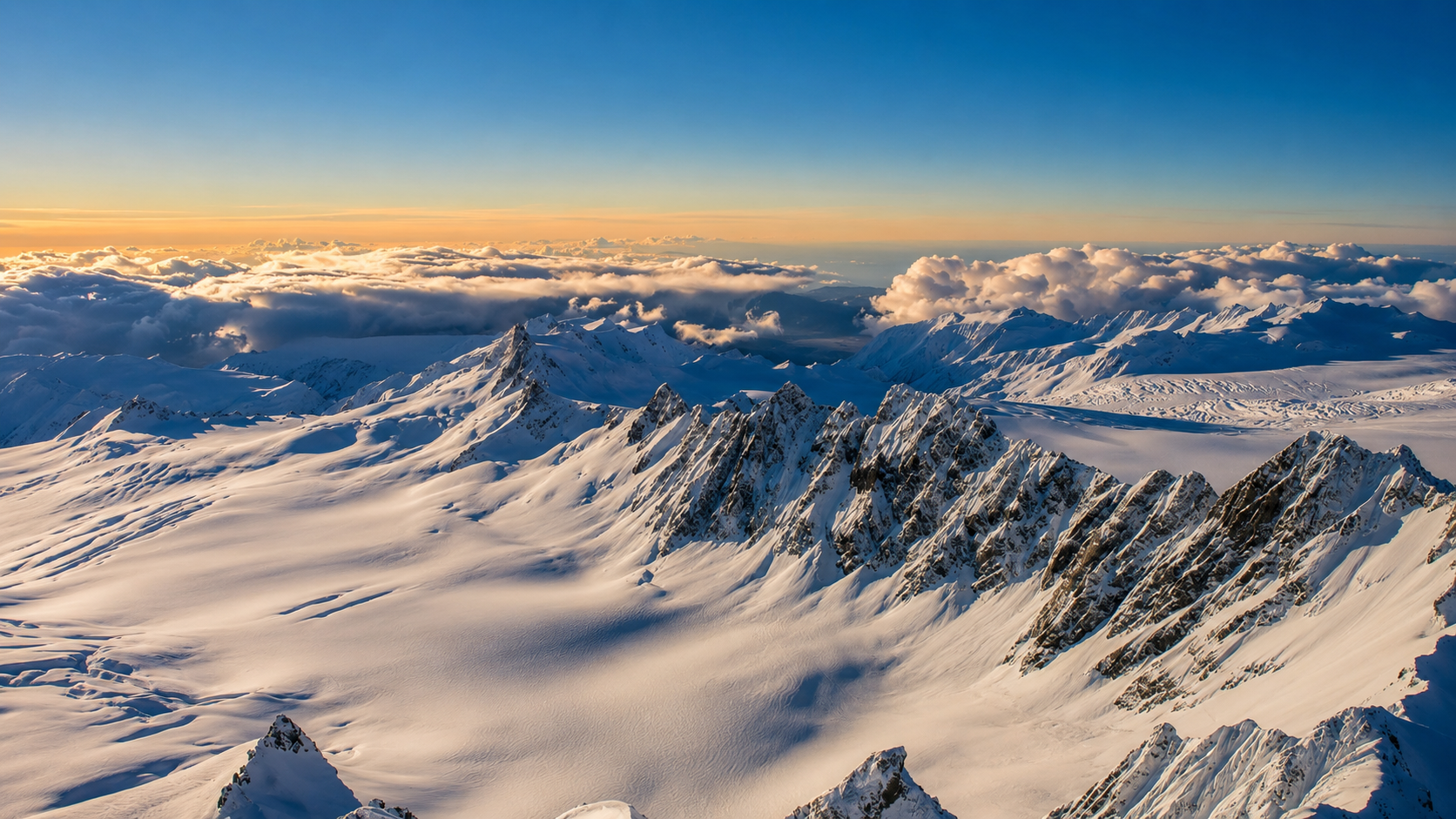
Within minutes, the valleys you have been walking through begin making sense. Haupapa/Tasman Glacier stretches away beneath you, Aoraki no longer looks like one isolated mountain and the Southern Alps begin revealing the scale that maps and photographs struggle to communicate.
Scenic flights operate throughout the Mackenzie region using helicopters, fixed-wing aircraft and ski planes, with routes offering views of Aoraki, glaciers and the wider alpine landscape. Some options include snow or glacier landings.
Helicopter or Ski Plane?
I would think less about which aircraft sounds more exciting and more about what you actually want to experience.
A helicopter is particularly good if an alpine landing matters to you. It can get close to the terrain and, depending on the flight and conditions, put you down somewhere in the mountains for a few minutes.
A ski plane has a completely different character and can cover large areas efficiently while still offering snow-landing experiences on some routes.
Neither is automatically the better option.
The important questions are where the flight goes, how long you are actually in the air and whether the route includes the glaciers or areas you most want to see.
What the Flight Changes
From the road, Aoraki dominates everything.
From the air, you start understanding that it is the highest point in an enormous alpine landscape rather than an isolated peak.
Glaciers appear behind mountains you thought were the end of the range. Snowfields spread across high country. The Tasman Valley, which already looked huge from the ground, becomes one feature among many.
That perspective is the reason I think scenic flights here can justify the cost.
You are not simply paying for a faster way of reaching another viewpoint.
You are seeing something that is effectively inaccessible to ordinary visitors on foot.
The Alpine Landing
If your flight includes a snow or glacier landing and conditions allow it, this is likely to be the part you remember most.
There is something very different about an aircraft touching down, the engine noise disappearing and suddenly finding yourself standing in the middle of the Southern Alps.
The village is gone.
The road is gone.
Most signs of normal life disappear with them.
Even if the landing only lasts a short time, it gives you a sense of the environment that looking through the window cannot quite reproduce.
Is It Worth the Money?
Not for everyone.
I would not recommend a scenic flight to somebody struggling to afford the rest of their trip when the Hooker Valley and Tasman Valley already give you extraordinary scenery for very little.
But if this is a major New Zealand holiday and you are choosing one substantial splurge, Aoraki/Mount Cook is one of the places where I think flying makes sense.
The setting is the experience.
Book Around the Weather
Flights depend on visibility, cloud and wind.
If scenic flying is important to you, book it near the beginning of your stay rather than during the final hour before you leave. That gives you a chance of moving it if the mountains decide not to cooperate.
And if the pilot cancels because the weather is unsuitable, take that decision seriously.
Nobody needs an adventurous pilot in the Southern Alps.
Aotearoa Adventures Tip
Compare what the routes include rather than looking only at price. A slightly longer flight that crosses the glaciers or includes a snow landing may give you much more of the experience you actually came for.
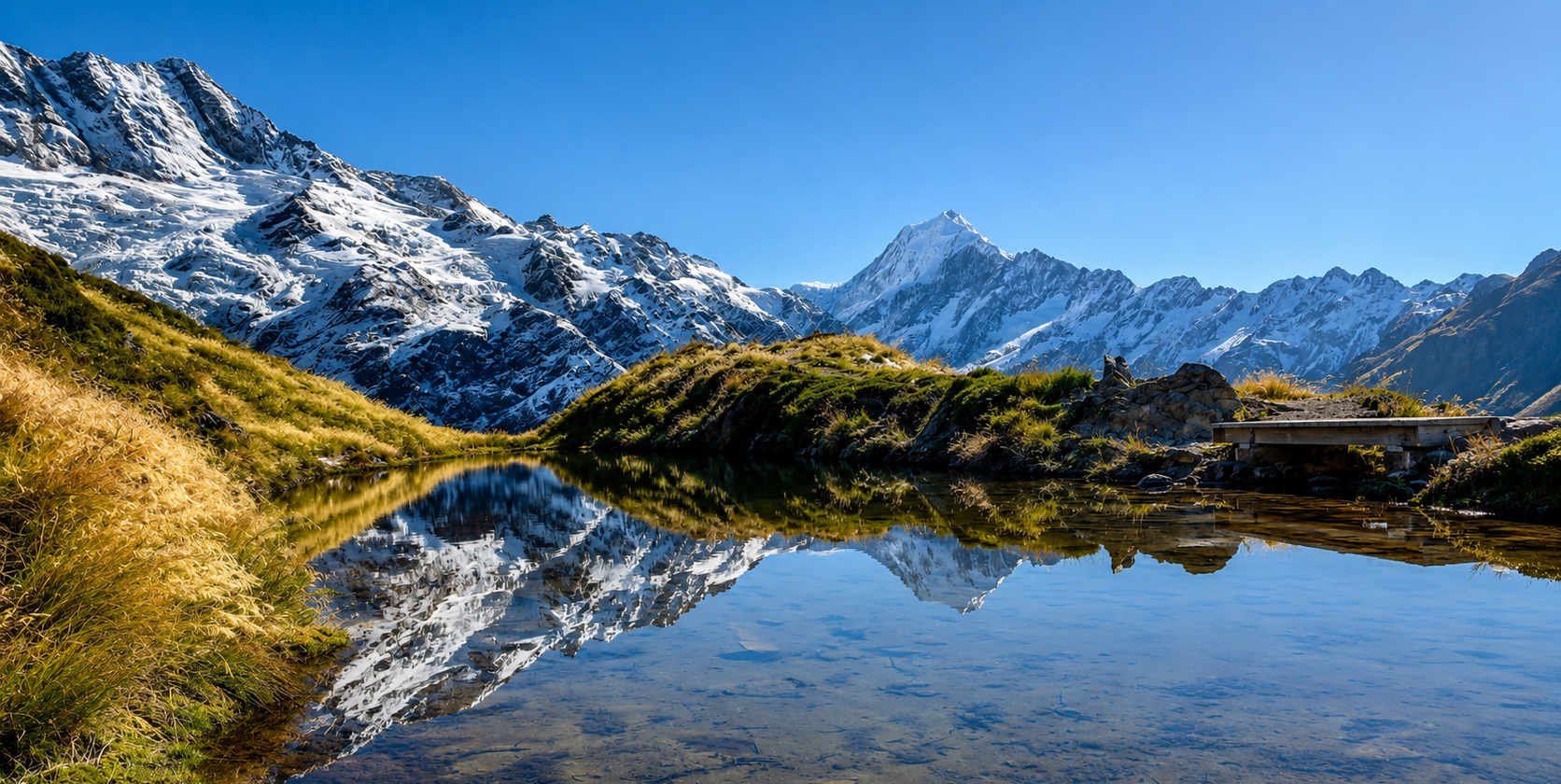
Climb to Sealy Tarns
4. Climb to Sealy Tarns
Best for: Fit walkers who want something tougher than Hooker Valley
Allow: Around 3–4 hours return
Difficulty: Hard, mainly because it keeps going uphill
My pick: The best half-day climb for an elevated view over the Hooker Valley
My verdict: Your legs may complain, but the view is worth earning
The Hooker Valley Track is accessible enough that almost anyone with reasonable mobility and fitness can enjoy the scenery.
Sealy Tarns is where things become more demanding.
The track is sometimes called the Stairway to Heaven, and the name makes slightly more sense once you discover that approximately 2,200 steps sit between the lower track and the tarns.
DOC lists around 600 metres of elevation gain.
There is no particularly clever trick to the walk.
You go uphill.
Then you continue going uphill.
The good news is that the view keeps improving with you.
What the Climb Feels Like
The track initially follows the route towards Kea Point before branching towards the Mueller Range.
Once the real climbing begins, the steps become fairly relentless.
Early on, this can feel encouraging. You gain height quickly, so the view begins opening almost immediately. The Hooker Valley spreads out below, Mueller Lake becomes more visible and the mountain faces opposite begin lining up in a way you simply cannot see from the valley floor.
After another few hundred steps, you may feel slightly less enthusiastic about how efficiently the track gains height.
That is normal.
The best approach is simply to find a pace that works and stop when you need to. Turning around for a few minutes is not wasted time because the view behind you is one of the main reasons for being there.
Reaching the Tarns
The tarns themselves are small alpine pools sitting on a natural bench above the valley.
On a calm day you may get reflections, particularly when there is little wind, but I would not make perfect mirror photographs the reason for climbing all that way.
The real reward is the position.
From Sealy Tarns you are looking down into the Hooker Valley rather than moving through it. Aoraki, Mueller Lake and the surrounding mountain faces sit across a huge landscape, and the amount of height you have gained suddenly becomes obvious.
It is the sort of place where sitting down for twenty minutes feels particularly satisfying.
Partly because of the view.
Partly because sitting down feels excellent after 2,200 steps.
Is Sealy Tarns Better Than Hooker Valley?
They are different enough that I would not really compare them.
Hooker Valley is the better overall walk for most first-time visitors. It has more variety, requires less effort and brings you directly into the valley beneath Aoraki.
Sealy Tarns gives you the better elevated perspective.
If you enjoy hiking and have two days, do both.
If you only have one walking day, choose based on how much climbing you actually want rather than which photograph looks more impressive online.
Should You Continue to Mueller Hut?
Sealy Tarns is also the halfway point towards the Mueller Hut route.
That does not mean everyone reaching the tarns should automatically continue.
Beyond this point, the terrain becomes more alpine and the commitment increases substantially. DOC describes Mueller Hut as an alpine route rather than an ordinary walking track, and snow and ice can be present for much of the year.
If you have the skills, time and suitable conditions, Mueller Hut can be extraordinary.
If you do not, Sealy Tarns is already a fantastic destination.
Knowing when you have reached the right turnaround point is part of good mountain judgement.
Winter Is Different
In winter, DOC warns that Sealy Tarns can become extremely icy and that crampons and an ice axe may be required. Avalanche risk can also be present.
This is not one of those times where a pair of normal sneakers and confidence will fill the gap.
Call into the visitor centre, ask about conditions and choose something else if the track is not suitable.
Aotearoa Adventures Tip
Do not attack the first section too quickly. The track rewards a steady pace far more than an enthusiastic first 500 steps followed by a long conversation with yourself about why you started.
Take water, sun protection and warm layers. There is little shelter once you gain height and the weather can change quickly.
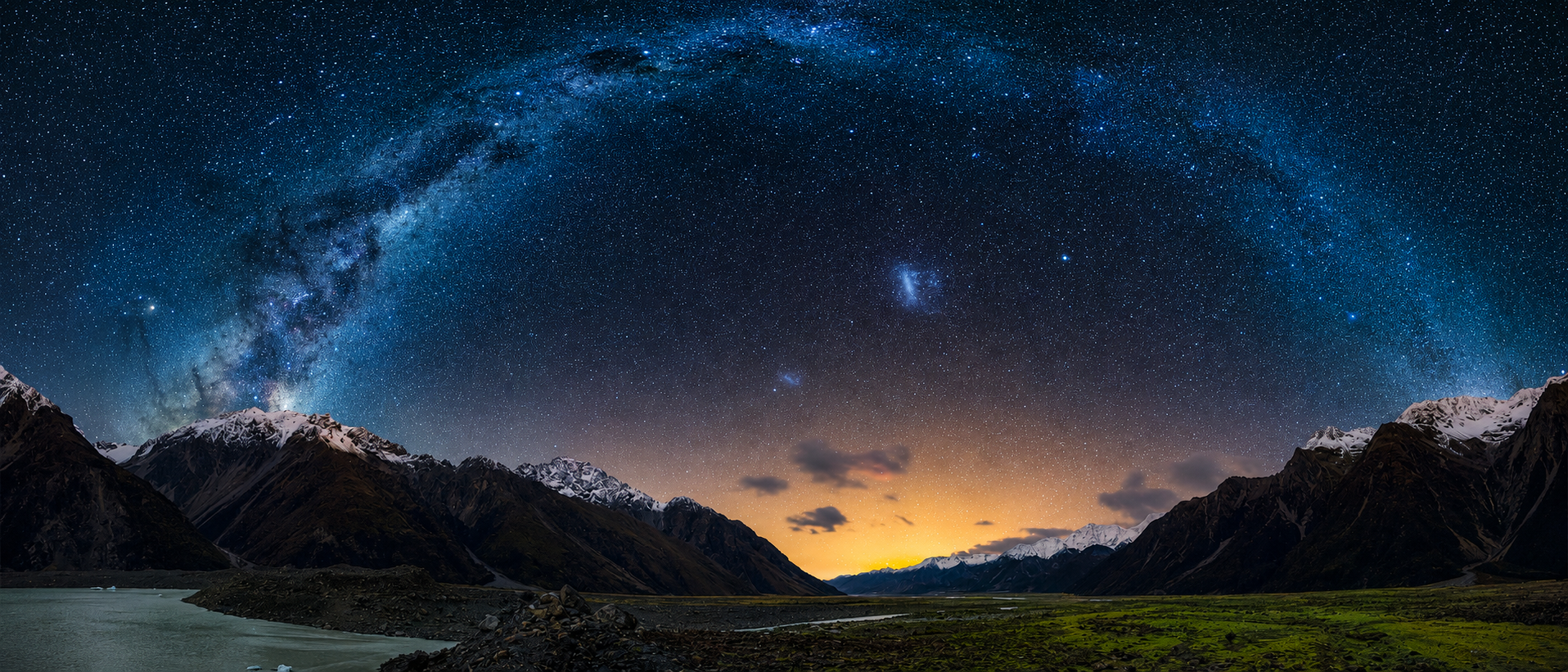
5. Stay After Dark and Experience the Aoraki Mackenzie Night Sky
Best for: Couples, photographers, families with older children and anyone staying overnight
Allow: As long as you like independently, or roughly 75–90 minutes for a guided experience
My pick: Look outside on your own first, then book a guided tour if astronomy genuinely interests you
My verdict: One of the strongest reasons to stay overnight rather than treating Mount Cook as a day trip
The most overlooked Aoraki/Mount Cook experience happens after many day visitors have already left.
The mountains disappear into darkness and the sky takes over.
Aoraki/Mount Cook National Park sits within the Aoraki Mackenzie International Dark Sky Reserve, and DOC specifically identifies the national park as one of New Zealand's best places for viewing the night sky because there are no nearby cities and lighting within the village is carefully controlled.
If you live in a city or reasonably large town, the difference can be immediate.
At first you notice the brightest stars.
Then your eyes adjust and many more begin appearing between them.
On a clear, dark night the Milky Way can stretch across the sky with a level of detail that is almost impossible to see under normal urban lighting.
And you do not actually need to book anything to enjoy it.
Stargazing for Free
This might be the cheapest activity in the entire guide.
Go outside.
Move away from the brightest lights.
Put your phone away for a while and give your eyes time to adjust.
That is basically it.
Take a warm jacket because standing still at night is considerably colder than walking around during the day, even in summer.
If you have a camera or phone with a good night mode, you can experiment with astrophotography, but I would make a deliberate effort not to spend the entire evening looking at the sky through a screen.
It slightly defeats the point.
Big Sky Stargazing
If you actually want to understand what you are looking at, a guided experience adds much more.
Big Sky Stargazing operates within Aoraki/Mount Cook National Park and currently runs guided sessions of around 75–90 minutes, using high-powered telescopes and astronomy guides.
Depending on the time of year and conditions, the tour may cover constellations, planets, star clusters, nebulae and features such as the Magellanic Clouds.
The advantage is not simply getting access to a telescope.
It is having somebody point at a part of the sky you have looked at hundreds of times and explain what is actually there.
That can completely change the experience.
The Weather Problem
Like scenic flights, stargazing depends on the sky cooperating.
Cloud can arrive.
The moon can be bright.
Conditions vary from night to night.
The current Big Sky experience has a weather fallback arrangement involving an indoor planetarium presentation and partial refund when outdoor viewing cannot go ahead.
That is useful, but I would still treat a perfectly clear night as something nature provides rather than something your booking has purchased.
Why Staying Overnight Makes Such a Difference
During the middle of a busy day, Aoraki/Mount Cook can feel surprisingly active.
Car parks fill.
Buses arrive.
Tracks get busy.
Then the afternoon begins fading.
People drive away.
The village becomes quieter and the whole national park starts feeling different.
That change is one of the main reasons I would choose an overnight stay if the itinerary allows.
You experience Aoraki/Mount Cook rather than simply visiting it.
Aotearoa Adventures Tip
Do not check the sky once at 8pm and give up because it is cloudy. Alpine weather can change quickly.
Look again later.
You may be surprised by how different things look an hour or two afterwards.
Which Aoraki/Mount Cook Activities Are Actually Worth Paying For?
This is an important question because Aoraki/Mount Cook is somewhere you can have an extraordinary trip without booking expensive activities every day.
The mountains, tracks and viewpoints already provide most of the experience.
If I were travelling on a tighter budget, I would concentrate on the Hooker Valley, Tasman Glacier viewpoints, Sealy Tarns if conditions and fitness allowed, and independent stargazing. Apart from parking and normal travel costs, that gives you several days of excellent experiences without constantly reaching for your wallet.
If I had enough money for one paid activity, I would probably choose Glacier Explorers if the tour was operating and glaciers were a major interest. It gets you somewhere you cannot independently go and complements the free viewpoints well.
If I wanted one major holiday splurge, I would choose a scenic flight.
That is the activity that changes your perspective on the entire national park rather than simply adding another attraction to the day.
For Aotearoa Adventures, I think this is also where the affiliate strategy should stay restrained. The most natural booking points are Glacier Explorers, scenic flights, stargazing and organised Mount Cook tours. The walks do not need artificial booking links added simply because there is space for one.
Don't Miss the Drive Along Lake Pūkaki
The drive towards Aoraki/Mount Cook is good enough that I think it deserves to be treated as part of the itinerary rather than transport.
Lake Pūkaki begins appearing beside State Highway 80, and when the weather is clear you can often see Aoraki sitting at the far end of the lake. Mackenzie tourism specifically highlights the road into Aoraki/Mount Cook as one of the best places to enjoy the lake and mountain together.
The colour of the water is one of the first things people notice. The lake is fed by glacial water containing extremely fine rock particles, giving it the turquoise appearance that seems almost too bright under the right light.
There are places to stop safely along the drive, and I would use them.
What I would not do is stop half on the road because Aoraki suddenly looks good.
It will probably still look good at the next proper pull-off.
A photograph is not worth creating a traffic problem on one of the South Island's most popular scenic roads.
Don't Ignore the Aoraki/Mount Cook Visitor Centre
Visitor centres sometimes get treated as places you only go when you need a map.
The Aoraki/Mount Cook National Park Visitor Centre is worth more than that.
Entry is free, and the centre contains exhibits about the national park, mountaineering history, conservation and the landscape. It also has current track and weather information, which becomes particularly valuable if you are considering Sealy Tarns, Mueller Hut or visiting during winter.
I would call in near the beginning of the stay.
You might spend twenty minutes there.
You might spend considerably longer.
Either way, asking somebody who actually knows the current mountain conditions is a better strategy than assuming a blog post written in summer applies to your winter trip.
What About Kea Point and Red Tarns?
Not every Mount Cook walk needs to take half a day.
If you arrive later in the afternoon, the weather looks uncertain or you simply want something shorter, Kea Point and Red Tarns are worth knowing about.
Kea Point gives you an excellent shorter walk towards views of Mueller Lake, Mount Sefton and Aoraki without the commitment of Hooker Valley.
Red Tarns is steeper, gaining around 300 metres from the village and providing a high viewpoint over the valley. DOC specifically notes it as a beautiful summer sunset location.
I would use these as flexible options rather than treating every Aoraki/Mount Cook day as a major expedition.
Sometimes a two-hour walk is exactly what the itinerary needs.
How Many Days Do You Need at Aoraki/Mount Cook?
You can visit Aoraki/Mount Cook in a day.
I would prefer two nights.
That gives you one arrival afternoon, a full day and another morning before you leave. More importantly, it gives you multiple chances at good weather.
If you arrive in cloud, there is no need to panic because you are not leaving in two hours.
If the morning is clear, you can change the plan and walk Hooker Valley immediately.
If your scenic flight is cancelled, you may still have another opportunity.
The extra night is less about filling the trip with activities and more about giving the mountains time to cooperate.
A Simple 2-Night Aoraki/Mount Cook Itinerary
On the first day, I would take my time driving beside Lake Pūkaki rather than trying to arrive as quickly as possible. Once in the village, I would visit the DOC visitor centre and then choose either the Tasman Glacier viewpoints, Kea Point or Red Tarns depending on the weather and how much daylight remained.
After dinner, I would go outside and look at the sky. If stargazing was a major interest, this would be a good night for the guided experience.
The second day would be the main walking day. If the weather was clear, I would walk the Hooker Valley in the morning and keep the afternoon for Glacier Explorers, a scenic flight or simply a slower visit to the Tasman Valley.
The final morning could be used for Sealy Tarns if I was fit, well prepared and had enough time. Otherwise, I would choose a shorter track, enjoy breakfast and take another slow drive beside Lake Pūkaki on the way out.
That feels much more like experiencing Aoraki/Mount Cook than arriving at lunchtime, running down a track and driving away before dinner.
What If You Only Have One Day?
Keep it simple.
I would walk the Hooker Valley Track first.
Then, if time and energy allowed, I would drive into the Tasman Valley and do the glacier viewpoint before leaving.
That gives you two very different landscapes without turning the day into a race.
If a scenic flight is one of the main reasons you are visiting, book that and build everything else around it.
What I would not do is attempt Hooker Valley, Sealy Tarns, Glacier Explorers, a scenic flight and stargazing simply because all five appear in this article.
A good trip is not measured by how many headings you completed.
Best Time to Visit Aoraki/Mount Cook
Aoraki/Mount Cook is worth visiting throughout the year, but each season changes what you can realistically do.
Summer
Summer is the easiest period for most visitors. The days are long, the lower walking tracks are generally more straightforward and seasonal activities such as Glacier Explorers operate.
It is also busy.
DOC specifically warns about heavy visitor numbers at White Horse Hill from November through March, so starting walks earlier or later can make a noticeable difference.
Autumn
Autumn can be a very good compromise.
Temperatures become cooler for walking, visitor numbers begin easing and the lower tracks can still be excellent.
As you move later into the season, however, higher routes can begin developing snow and ice.
Do not assume that because the valley floor looks autumnal the Mueller Range is doing the same thing.
Winter
Aoraki/Mount Cook in winter can look extraordinary.
Snow reaches lower, the mountains become even more dramatic and visitor numbers can be lower.
The important point is that the walking becomes different.
Hooker Valley can be icy. Sealy Tarns may require proper winter equipment, and alpine routes can involve serious avalanche hazards.
Choose the walk based on the actual conditions rather than the photograph you hoped to recreate.
Spring
Spring can give you snowy mountains with increasingly long days, but the higher country may remain wintry for quite some time.
Again, check.
Aoraki/Mount Cook does not change season neatly because the calendar says September has arrived.
Where Should You Stay?
For a first visit, I would stay as close to Aoraki/Mount Cook Village as the budget allows.
There is something genuinely valuable about waking up already beneath the mountains rather than beginning the day with another hour of driving.
Aoraki/Mount Cook Village
Staying in the village puts you close to the visitor centre, walking tracks and main activities.
It also means you are still there after many day visitors have left, which makes the evening and early morning much more enjoyable.
Accommodation can be expensive and fills quickly during popular periods, so this is one part of a South Island itinerary I would organise reasonably early.
White Horse Hill
If you are camping, White Horse Hill gives you an extraordinary setting right near the start of several walking tracks.
DOC currently requires bookings, and the campground can fill throughout the year, particularly between Christmas and mid-February.
This is not a campsite where I would arrive late during peak season and assume something will work itself out.
Glentanner
Glentanner is a useful alternative if the village is full or too expensive.
You remain close enough to the national park for easy day trips while getting a little more accommodation choice.
Twizel
Twizel offers considerably more options and can be cheaper, but you lose the experience of staying directly beneath the mountains.
If your budget requires it, Twizel is completely sensible.
If the price difference is manageable, I would stay closer.
Do You Need a Car?
For the type of Aoraki/Mount Cook trip described in this guide, I think a car is extremely useful.
The village itself is small, but the main places you will want to visit are spread between White Horse Hill, the Tasman Valley and Lake Pūkaki.
Having your own vehicle also allows you to respond to the weather. If Hooker Valley is clear at 8am, you can go. If the cloud sits lower later, you can switch to the visitor centre or another shorter activity.
There are organised day tours from larger South Island destinations, and they make sense for travellers who do not want to drive.
The trade-off is freedom.
A bus will not normally stop simply because Lake Pūkaki suddenly looks particularly good.
Is Aoraki/Mount Cook Expensive?
It can be remarkably affordable or remarkably expensive, depending on how you build the trip.
You can walk some of New Zealand's best-known alpine tracks for very little beyond transport and parking.
At the other end of the scale, glacier boat trips, scenic flights and premium accommodation can quickly increase the cost.
I would use the same approach here that I recommend throughout Aotearoa Adventures: pay for access, not simply because something is available.
Pay for Glacier Explorers because it gets you onto the lake.
Pay for a scenic flight because it shows you parts of the Southern Alps you cannot reach.
Pay for guided stargazing if you want somebody to help you understand what you are seeing.
Then let the walking tracks do the rest.
Aoraki/Mount Cook for Families
Families do not need to miss out simply because the area looks highly alpine.
The Hooker Valley works well for active families with children comfortable walking several hours, while the Tasman Glacier viewpoints provide huge scenery for much less walking.
Glacier Explorers can also be a good paid choice, particularly for families where not everyone wants to tackle a major hike.
The visitor centre is worth including too, especially if the weather turns.
I would simply resist the temptation to make children complete the adult version of the itinerary.
A three-hour mountain walk feels considerably longer when somebody asks how much further it is every seven minutes.
Aoraki/Mount Cook for Serious Hikers
If hiking is the main reason you are visiting, the five activities in this guide only begin to cover the possibilities.
Mueller Hut is the obvious next step, offering an alpine route above Sealy Tarns with huge views across the national park.
But this is where the distinction between a walking track and an alpine route matters.
Current DOC guidance emphasises mountain hazards, snow, ice and the need to assess whether you have the skills and equipment for the route.
I would much rather turn around at Sealy Tarns and have an excellent day than continue because “Mueller Hut was on the plan”.
Mountains are not impressed by plans.
What Should You Pack?
Even in summer, I would carry a waterproof jacket and a warm layer.
Mountain weather can change rapidly, and DOC specifically warns about strong winds, heavy rain, snowfall and sudden temperature changes at any time of year.
I would also bring good walking shoes, sun protection, water, snacks and a small daypack.
For winter trips, normal summer walking gear may not be enough. Check current conditions before deciding what footwear or traction equipment you need.
Do not let a bright blue sky outside the hotel convince you the entire day will stay that way.
Aoraki/Mount Cook does not make promises.
A Few Things I Would Know Before Visiting
The first is that cloud around Aoraki is normal. Do not let one cloudy afternoon convince you that the trip has been ruined.
The second is that staying overnight makes a real difference. You gain both weather flexibility and the chance to see the national park after dark.
The third is that not every activity needs to be completed. If your legs are tired after Hooker Valley, you do not need to climb 2,200 steps simply because Sealy Tarns appears next on this page.
I would also check the current DOC information before each major hike, particularly outside summer.
And one final practical point: drones are not generally permitted in Aoraki/Mount Cook National Park without authorisation, and DOC says it does not generally approve permits for recreational drone use there.
Enjoy the view without putting a drone above everyone else's head.
Final Thoughts: Is Aoraki/Mount Cook Worth Visiting?
Absolutely.
For me, Aoraki/Mount Cook belongs on a first South Island road trip because there are very few other places where such a huge alpine landscape is this accessible.
You can drive into the national park beneath New Zealand's highest mountain, walk through a glacial valley, stand above a lake filled with floating ice, climb high enough to look down over the Hooker Valley and then finish the day beneath one of the darkest skies in the country.
You can spend almost nothing beyond the basics and still have an extraordinary couple of days.
Or you can take a helicopter into the mountains, land on snow and see the Southern Alps from a completely different perspective.
Both are legitimate ways to experience the place.
What I would not do is rush through simply because Queenstown or Christchurch is waiting.
Take your time on the Lake Pūkaki road.
Stay a night or two if the itinerary allows.
Walk somewhere properly rather than only taking photographs beside the car.
Go into the Tasman Valley even if you have already seen Hooker Valley.
Aoraki/Mount Cook does not really need a long list of attractions to make it interesting.
The landscape is the attraction. Everything else is simply another way of getting closer to it.