

SCENIC CRUISES
5 Best Scenic Cruises in New Zealand: The Complete Guide
New Zealand is a country that makes much more sense once you get onto the water.
From the road, you can see the mountains around Queenstown, the cliffs of Fiordland and the islands scattered across the Bay of Islands, but a boat changes the perspective completely. Mountains that looked impressive from a viewpoint suddenly rise almost vertically above you. Waterfalls disappear into mist before reaching the surface. Small coves appear between headlands that you would never have known were there, and places that felt busy from the shore become surprisingly quiet once the boat pulls away.
Scenic cruising also fills a useful gap in a New Zealand adventure itinerary. Not every memorable day needs to involve jumping from something, paddling through rapids or walking uphill for six hours. A cruise can still take you into some of the most spectacular landscapes in the country, but you get to sit down occasionally while doing it.
Some cruises are almost entirely about scenery. Others add wildlife, historic ships, island stops or Māori art. The best ones are not simply boat rides; the boat gives you access to a landscape that is difficult to appreciate properly from anywhere else.
These are the five New Zealand scenic cruises I would put at the top of the list.
1. Cruise Piopiotahi/Milford Sound
Best for: First-time New Zealand visitors, Fiordland scenery and anyone planning a South Island road trip
Allow: Roughly 1½–2 hours on the water, plus the Milford Road journey
My pick: A smaller or medium-sized cruise with plenty of outside deck space
My verdict: If you only take one scenic cruise in New Zealand, make it this one
Milford Sound is one of those New Zealand places that has appeared in so many photographs that you could be forgiven for wondering whether the real thing can possibly feel as impressive.
It does.
The important thing is getting onto the water.
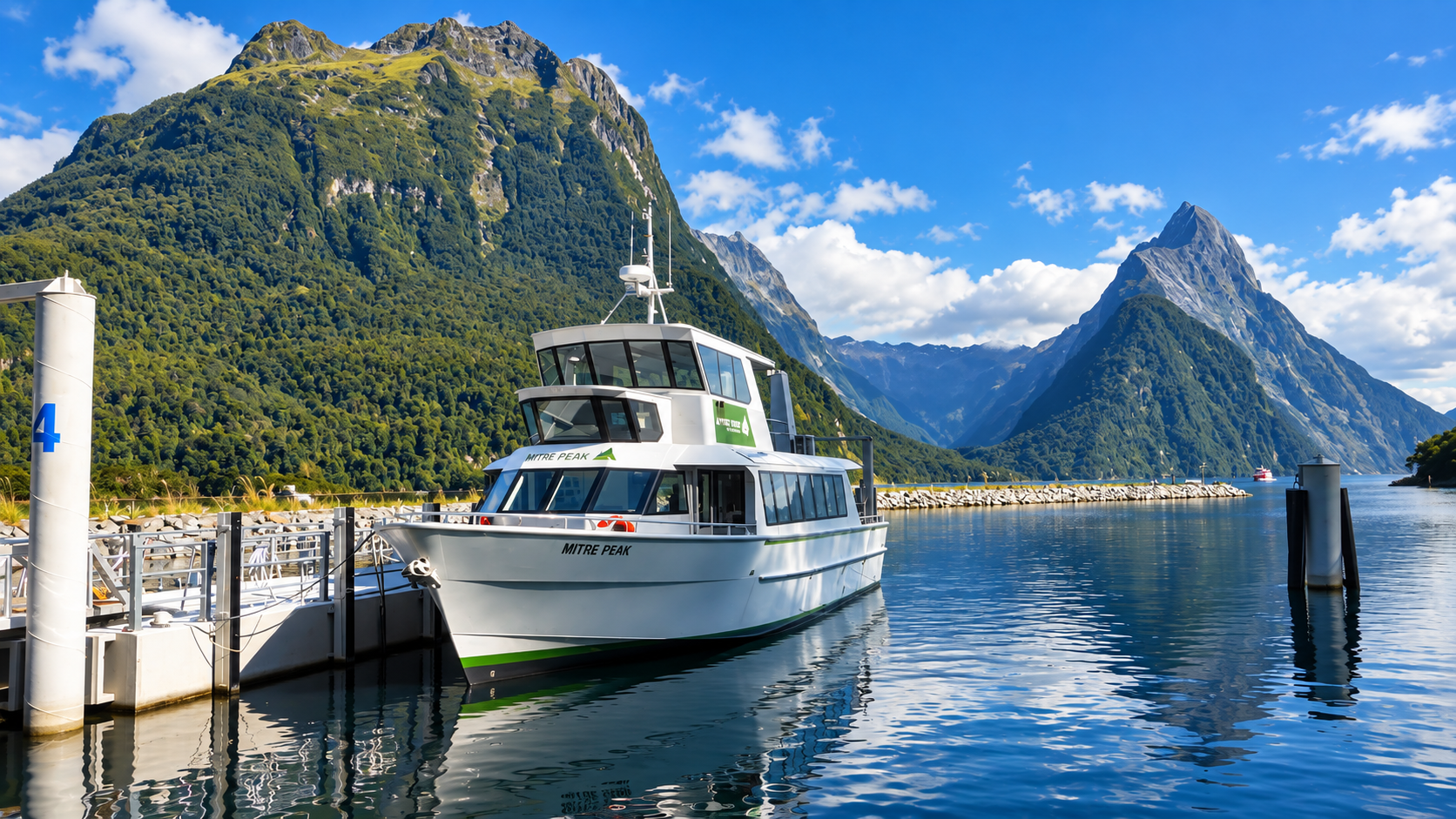
From the shore, Mitre Peak and the surrounding cliffs look enormous. Once the boat leaves the terminal and moves deeper into the fiord, the scale becomes much harder to judge. Forest-covered mountains rise almost directly from the water, waterfalls drop from hanging valleys and the boat begins looking very small against everything around it.
Current Milford day cruises generally spend around 1½ to 2 hours on the water, travelling the length of the fiord towards the Tasman Sea and back. Typical highlights include Mitre Peak, Lady Bowen Falls, Stirling Falls and Seal Rock, with many cruises reaching the outer fiord when sea and weather conditions allow.
The Milford Road Is Part of the Experience
One mistake I would avoid is thinking of the boat as the entire Milford day.
The drive from Te Anau to Milford Sound is one of the best road journeys in New Zealand, passing through the Eglinton Valley, native beech forest and increasingly dramatic alpine country before the Homer Tunnel takes you directly through the mountains.
That means I would not rush from Te Anau simply to meet the cruise.
Leave enough time to stop.
Take the short walks.
Stand in the Eglinton Valley for a few minutes.
Look around near the upper Milford Road rather than treating every stop as another delay between you and the boat.
By the time you arrive at Milford, you have already had half the adventure.
What the Cruise Feels Like
Once you leave the terminal, Mitre Peak becomes the obvious landmark, rising 1,692 metres from the water. The boat then works its way past huge cliff faces and permanent waterfalls, with temporary falls appearing everywhere after heavy rain.
Stirling Falls is one of the most entertaining moments on many cruises because captains often bring the boat surprisingly close.
If somebody tells you to stand outside near the front, understand that this may not be advice designed to keep you dry.
The spray is part of it.
Put the waterproof jacket on and enjoy the experience properly.
You can sit inside afterwards.
Milford Sound in the Rain
This is probably the most useful piece of Milford advice I can give:
Do not assume rain has ruined your cruise.
Fiordland is supposed to be wet.
Rain creates temporary waterfalls across cliffs that can appear almost dry in settled conditions. Cloud may hide some of the highest peaks, but the entire fiord becomes moodier and more dramatic.
I would take a clear day.
I would happily take a rainy day.
What I would not do is arrive with one exact photograph in mind and decide anything else is a disappointment.
Milford is better when you let the weather choose the version you get.
Where Should You Stand?
Outside.
At least for some of it.
The indoor cabins are useful when it is cold or wet, but you lose some of the scale behind glass.
Walk around the vessel.
Look backwards as well as forwards.
Some of the best views appear once you have already passed a waterfall or mountain and can suddenly see it framed by the surrounding cliffs.
I also would not spend the whole cruise holding a phone in front of your face.
Take the photograph.
Then put it down.
Milford is one of those places where twenty almost-identical images rarely improve the memory.
Wildlife
Kekeno/New Zealand fur seals are commonly seen around Seal Rock, and dolphins or penguins may also appear, although wildlife should always be treated as a bonus rather than a promised attraction. Current Milford operators specifically include seal viewing among the regular highlights.
If dolphins happen to appear beside the boat, brilliant.
If they do not, you still have an entire fiord surrounding you.
That seems like a reasonable consolation prize.
Day Cruise or Overnight Milford Sound?
For most travellers, the normal day cruise is enough.
If Milford is one of the biggest priorities of your South Island trip and the budget allows it, however, the overnight cruise offers a genuinely different experience.
The current Milford Mariner overnight trip leaves around 4pm and returns the following morning, with cabin accommodation, meals and activities such as kayaking or tender-boat exploration included. Once the day boats leave, you get to experience the fiord at a much quieter time.
That is not simply a longer version of the standard cruise.
It changes the atmosphere.
Should You Visit From Queenstown or Te Anau?
If possible, stay in Te Anau.
You can absolutely book coach-and-cruise tours from Queenstown, and they are useful if your itinerary does not allow anything else. But it turns Milford into a very long day.
From Te Anau, you can give the Milford Road much more attention and return without adding several more hours of travel.
For me, Fiordland deserves to be part of the trip rather than a brief excursion from Queenstown.
Aotearoa Adventures Tip
If you are self-driving, do not choose the earliest cruise simply because it appears first on the booking page unless you are genuinely willing to leave Te Anau very early.
I would rather take a slightly later departure and enjoy Milford Road properly than spend one of New Zealand's best drives watching the clock.
2. Experience Patea/Doubtful Sound
Best for: Wilderness, couples, photographers and travellers who prefer quieter experiences
Allow: Most of the day
My pick: The standard wilderness cruise for most travellers; overnight if this is a special trip
My verdict: Milford is more immediately dramatic, but Doubtful Sound feels much more remote
Doubtful Sound is not simply another Milford Sound.
If you have time for both, do both.
The difference starts before you even reach the fiord because there is no normal public road into Doubtful Sound. The standard journey begins at Manapouri with a boat trip across Lake Manapouri, followed by a coach journey over Wilmot Pass before you finally reach Deep Cove and board the main cruise.
By the time you arrive, it already feels as though you have travelled somewhere properly remote.
That is exactly the point.
Doubtful Sound Is Huge
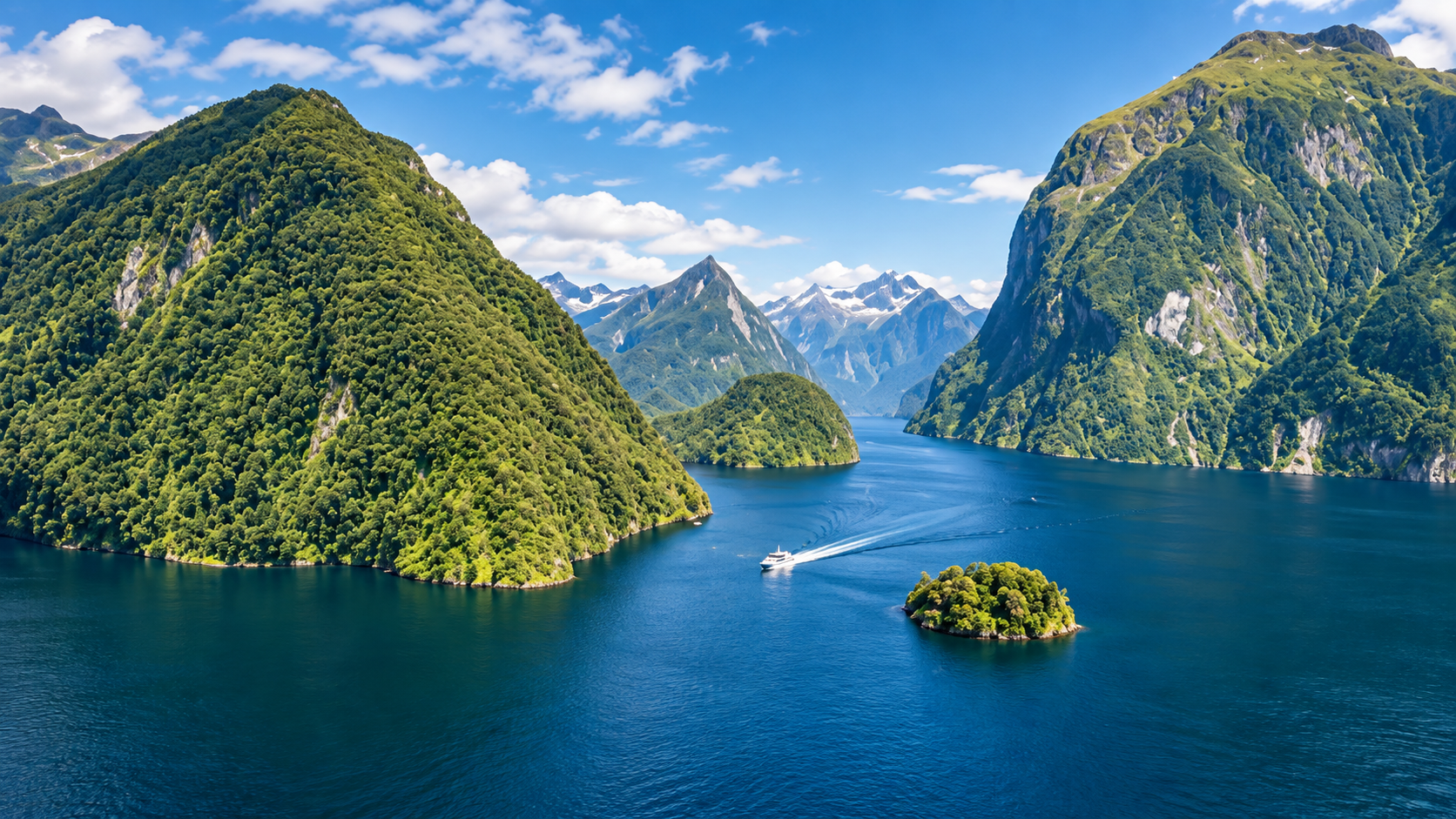
Patea/Doubtful Sound stretches for around 40 kilometres from its head to the Tasman Sea and is the deepest of New Zealand's fiords. It also divides into several long arms, creating a much broader and more complicated waterway than Milford.
Milford can feel almost theatrical because the mountains rise directly around a relatively compact fiord.
Doubtful has more room.
Long channels disappear between forested mountains, side arms turn away from the main waterway and there are sections where you can look around without seeing any obvious human development at all.
That is the version of Fiordland I think people imagine when they talk about wilderness.
The Journey Across Lake Manapouri
Do not treat the first boat as a transfer that needs to be endured before the real cruise.
Lake Manapouri is beautiful in its own right.
Current Doubtful Sound day trips begin with roughly a 45-minute cruise across Lake Manapouri before crossing Wilmot Pass by coach. The actual wilderness cruise through Doubtful Sound then lasts about 2½ hours.
That means you are getting several different landscapes within one day.
First an enormous lake.
Then rainforest and mountains.
Then the fiord itself.
The Silence
One of the most memorable parts of some Doubtful Sound cruises comes when the vessel stops and the engines are turned off.
Everybody is asked to stay quiet.
At first it feels almost unnatural because we are so used to constant mechanical noise.
Then you begin noticing everything else.
Water.
Birds.
Wind moving through the forest.
A waterfall somewhere across the fiord.
Doubtful is sometimes associated with the idea of a “place of silence”, and standing on a stationary boat in the middle of it makes that description easy to understand.
You suddenly realise how noisy normal travel usually is.
Wildlife
Doubtful Sound is home to New Zealand's southernmost population of bottlenose dolphins, as well as fur seals and tawaki/Fiordland crested penguins.
Again, I would not book the trip solely because you expect wildlife.
This is not a zoo.
The dolphins may be somewhere else.
The penguins may have other plans.
If they appear, it adds something extraordinary to an already spectacular day.
If they do not, the wilderness is still the reason you came.
Milford Sound or Doubtful Sound?
This is probably the hardest cruise decision in New Zealand.
If you only have one Fiordland day, I would choose Milford Sound.
You get the famous scenery plus the Milford Road, and the entire experience is easier to fit into a normal itinerary.
If you have more time and want something quieter and more immersive, choose Doubtful Sound.
Milford hits you immediately.
Doubtful gradually draws you in.
I would describe Milford as spectacular and Doubtful as atmospheric.
That is obviously subjective, but I think it captures the difference reasonably well.
Day Cruise or Overnight?
If you have the money and Doubtful Sound is one of the major reasons for the trip, an overnight experience is where I would consider spending extra.
The appeal is not simply getting a longer cruise.
It is being in Doubtful Sound once the normal day schedule is over.
There is a major difference between seeing wilderness for a few hours and actually spending the night surrounded by it.
For most travellers, however, the day trip is already a significant and complete experience.
Aotearoa Adventures Tip
Do not put anything important immediately after a Doubtful Sound day.
This is not a quick sightseeing cruise.
The Lake Manapouri crossing, Wilmot Pass and main fiord cruise make it a substantial day, and I think it works much better when you let the experience stand on its own.
VIEW DOUBTFUL SOUND WILDERNESS CRUISES
3. Cruise Lake Whakatipu on the TSS Earnslaw
Best for: Queenstown visitors, couples, families and anyone who likes history as much as scenery
Allow: Around 90 minutes for the cruise alone or roughly half a day with Walter Peak
My pick: TSS Earnslaw plus the Walter Peak Gourmet BBQ if you have time
My verdict: The easiest scenic cruise to recommend in Queenstown
The TSS Earnslaw is completely different from the first two cruises in this guide.
You are not heading into a remote fiord.
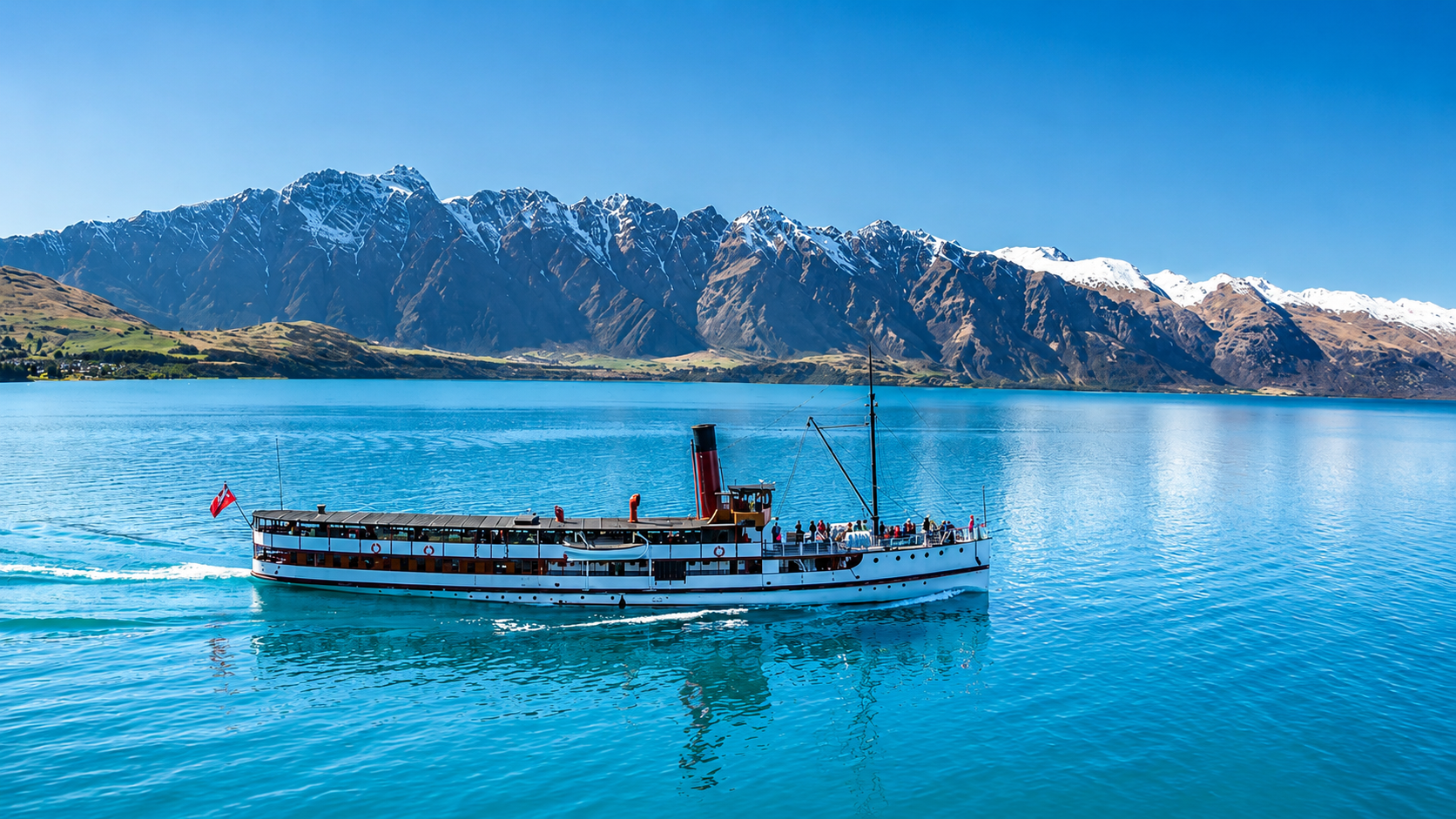
You are leaving Queenstown's waterfront aboard a coal-fired steamship built in 1912 and travelling across Lake Whakatipu beneath the Remarkables and surrounding mountains. The ship is still powered by its working steam engines, which passengers can watch in action from onboard.
That makes the boat itself part of the attraction.
A modern catamaran could travel across the lake more quickly.
That is not really the point.
The Cruise Across Lake Whakatipu
The standard TSS Earnslaw lake cruise lasts about 90 minutes return, while the crossing from Queenstown towards Walter Peak takes around 45 minutes.
Once you leave the wharf, Queenstown begins shrinking behind you.
The Remarkables sit across the lake, Cecil Peak and Walter Peak dominate the opposite side and the shape of Lake Whakatipu becomes much easier to understand once you are actually on it.
Queenstown is so closely connected to the lake that I think it is slightly strange to spend several days there without getting onto the water at least once.
The Earnslaw is the most interesting way to do it.
Go and Look at the Engines
Do not spend the entire cruise sitting in the café.
Walk around the ship.
The engine room is open to view and you can watch the enormous machinery working below deck. The vessel also has historical displays explaining its long connection with Lake Whakatipu.
This is one of the reasons the cruise works particularly well for families.
Children who are bored by scenic commentary may suddenly become very interested when they discover there is a working steam engine underneath them.
Adults often react fairly similarly.
Cruise Only or Walter Peak?
You can simply do the lake cruise and return to Queenstown.
There is nothing wrong with that.
If you have enough time, I think adding Walter Peak High Country Farm makes the experience much more complete.
Current options combine the return cruise with farm tours, garden experiences or a gourmet BBQ meal. The longer combinations generally take around 3½ to 4 hours.
My pick would probably be the Gourmet BBQ.
Not because every scenic cruise needs food attached to it, but because Walter Peak gives the boat journey a destination.
You cross the lake, spend time somewhere you cannot simply walk to from central Queenstown, eat beside the water and then return across the lake.
That feels like a proper half-day experience.
TSS Earnslaw or Spirit of Queenstown?
RealNZ also operates the modern Spirit of Queenstown catamaran.
If budget, modern comfort and straightforward sightseeing matter most, the Spirit makes sense.
If character matters, I would take the Earnslaw.
The historic steamship is slower and more old-fashioned.
That is exactly why I like it.
Recent operator comparisons describe the Earnslaw as the heritage choice, with the Spirit providing a faster modern cruise with panoramic windows.
When Would I Do the Cruise?
Late afternoon is particularly good when the weather is clear because the changing light can look beautiful across Lake Whakatipu.
But I would not become too obsessed with finding the perfect sailing.
One of the strengths of this activity is convenience.
It departs from central Queenstown and fits around almost any itinerary.
That means it is ideal for the day when you have spent the morning doing something slightly more energetic and suddenly discover that sitting on a steamship sounds extremely appealing.
Aotearoa Adventures Tip
If you are staying centrally, walk to the wharf rather than driving. Parking in Queenstown can become more stressful than the actual holiday.
If Walter Peak interests you, book the cruise and farm or dining combination together rather than treating the boat as a separate activity.
4. Cruise the Bay of Islands to Motukōkako/Hole in the Rock
Best for: North Island road trips, coastal scenery, wildlife and families
Allow: Around half a day
My pick: A cruise that includes an island stop rather than simply turning around at the Hole in the Rock
My verdict: The best full scenic coastal cruise in the North Island
The Bay of Islands gives you a completely different version of New Zealand cruising.
Instead of mountains closing around a fiord, the landscape opens.
Islands, beaches and rocky headlands appear in almost every direction as you travel away from Paihia or Russell towards Cape Brett.
The Bay of Islands contains 144 islands, so the appeal is not one single view. It is the constant change as the boat moves between islands and out towards the more exposed coastline. Current full scenic tours combine the islands with Cape Brett, Motukōkako/Hole in the Rock, wildlife viewing and time ashore.
This is the cruise I would choose if I wanted the day to feel like a small coastal journey rather than simply a loop on the water.
Motukōkako/Hole in the Rock
The most famous part is Motukōkako/Hole in the Rock.
As you approach Cape Brett, the sheltered Bay of Islands begins giving way to the open Pacific Ocean and the coastline becomes rougher and more dramatic.
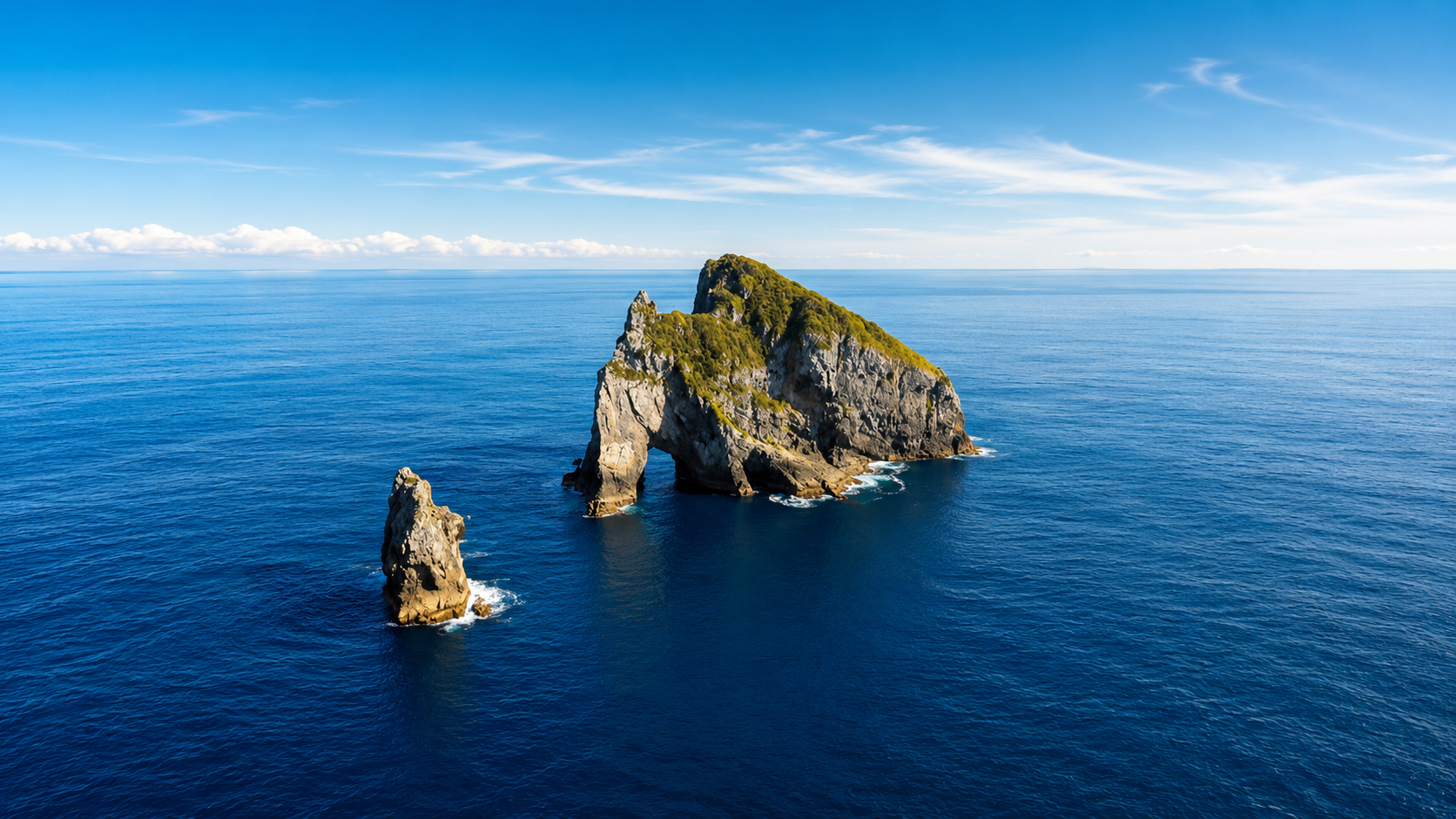
Motukōkako rises out of the water with a large natural arch running through the island.
When sea conditions are suitable, some cruise boats travel directly through it. Current operators are careful to describe that as weather- and sea-dependent rather than guaranteed.
I think that is important.
Do not book the cruise solely because you want photographic evidence of being inside the hole.
If the skipper says the sea is too rough, I would strongly favour their judgement over the day's social-media plans.
The island is impressive whether you pass through it or not.
The Bay Is More Than the Hole in the Rock
This is where I think some itineraries undersell the experience.
Motukōkako is one stop.
The Bay of Islands itself is the cruise.
You pass beaches, coves and islands throughout the day, with the sheltered inner bay gradually changing as you travel towards Cape Brett.
Current Discover the Bay trips last around 4½ hours, including roughly a 1½-hour island stop at Otehei Bay on Urupukapuka Island.
That island stop is a major reason I would choose this style of cruise.
You actually get off the boat.
Go for a walk.
Swim if the weather is good.
Sit on the beach.
Then continue the journey.
It breaks the day up beautifully.
Wildlife
Dolphins are the obvious wildlife people hope to see, but whales, seals and seabirds may also be encountered. The current Explore Group cruise is operated under Department of Conservation marine-mammal viewing licensing.
As always, wildlife is wildlife.
I would never treat dolphin sightings as the sole measure of whether the trip was successful.
If they appear alongside the boat, it can be one of the highlights of the entire Northland visit.
If they do not, you still have the islands.
Paihia or Russell?
Most visitors base themselves around Paihia, and it is the straightforward departure point.
I would also consider staying in Russell, especially if you prefer somewhere with more historic character and a slower atmosphere.
Current Hole in the Rock cruises depart from both Paihia and Russell, so either can work without complicated logistics.
What About Seasickness?
This is the cruise on my five where I would think about seasickness most seriously.
Much of the Bay of Islands can be sheltered.
The outer section around Cape Brett and Motukōkako is exposed to the Pacific and can feel completely different.
If you know you are prone to motion sickness, take whatever precautions normally work for you before the boat reaches the open water.
That is much more useful than discovering halfway through the day that staring at the horizon while regretting breakfast is now your main activity.
Aotearoa Adventures Tip
Choose a cruise that gives you enough time to experience the islands as well as the famous rock.
For me, an island landing transforms this from a sightseeing boat ride into a proper Bay of Islands day.
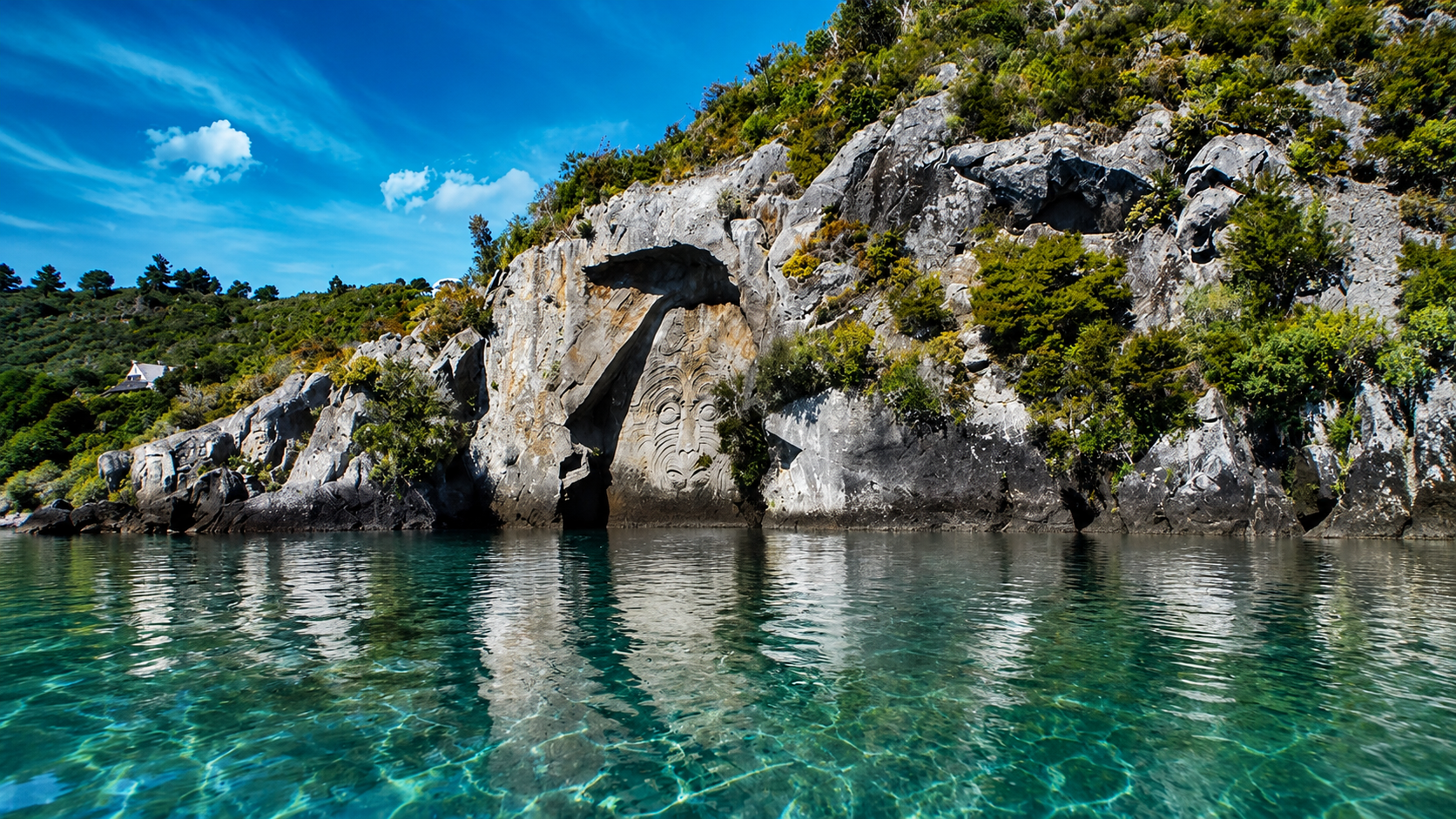
5. Cruise Lake Taupō to the Ngātoroirangi Mine Bay Māori Rock Carvings
Best for: Couples, families, culture and anyone wanting an easy activity around Taupō
Allow: Around 90 minutes to 2 hours
My pick: Sail if you have time; take one of the larger cruise boats if convenience or family comfort matters
My verdict: One of the easiest scenic cruises to fit into a North Island itinerary
Lake Taupō is so large that standing on the lakefront does not really tell you what it is like.
It feels more like looking at an inland sea than an ordinary lake.
Once you leave Taupō Harbour and move along the shoreline, the township begins disappearing behind you and the scale becomes much easier to appreciate.
Then you reach Mine Bay.
The Ngātoroirangi Mine Bay Māori Rock Carvings rise around 14 metres above the water and are only accessible from the lake.
That makes a boat or sailing trip one of the few scenic cruises in this guide where the main attraction genuinely cannot be reached by road.
The Carvings
The main carving depicts Ngātoroirangi and was created by master carver Matahi Whakataka-Brightwell and a team of artists, with work completed in 1980 after four years. Smaller carvings around it depict tūpuna and kaitiaki connected with local Māori history.
This is an important detail because people occasionally assume the carvings are ancient.
They are a significant contemporary Māori artwork, created using traditional carving knowledge and connected with whakapapa and the history of the Taupō region.
Knowing that story makes the cruise much more interesting than simply arriving, taking the photograph and leaving.
Which Lake Taupō Cruise Should You Choose?
Taupō has more variety than people expect.
You can take a larger sightseeing vessel, travel on the replica-steamboat-style Ernest Kemp, or choose one of several sailing experiences.
Current Ernest Kemp cruises run for around two hours, while the Chris Jolly scenic cruise is approximately 90 minutes. Both travel to Mine Bay and include commentary about the lake and carvings.
For families, I would probably choose one of the larger vessels.
There is more indoor space, shelter if the weather turns and less concern about everybody becoming bored or uncomfortable halfway across the lake.
For a couple or anyone who enjoys sailing, I would choose a yacht.
Taupō's sailing operators offer trips to the carvings with a much quieter feel than a traditional sightseeing boat, and some have sunset departures.
The Lake Is Part of the Experience
The carvings may be the destination, but do not ignore everything around them.
On a clear day, the southern end of the lake can provide views towards the volcanic mountains of Tongariro National Park.
Closer to Taupō, forested bays and pumice cliffs line the shore.
The water itself changes constantly with the weather, from bright blue on a sunny day to much darker colours under cloud.
The official Taupō visitor guide makes a similar point: cruising lets you experience native bush-lined coves, the carvings and the wider scale of the lake rather than focusing only on one attraction.
Morning or Sunset?
If the lake is calm and the mountains are visible, morning can be beautiful.
If you are travelling as a couple and the weather is settled, I particularly like the idea of a late-afternoon or sunset sailing cruise.
You have already spent the day exploring.
There is nowhere important you need to rush afterwards.
You simply head onto the lake, see the carvings and watch the light change across the water.
That feels much more memorable than squeezing the cruise between two other bookings.
Combine It With a Taupō Adventure Day
Taupō is another place where a scenic cruise works well as the calmer half of a bigger day.
You could cruise to Mine Bay in the morning and jet boat near Huka Falls later.
Or use the cruise as recovery after rafting the Tongariro River or doing a bigger hike.
I actually like that contrast.
Not every activity needs to raise your heart rate.
Aotearoa Adventures Tip
Do not treat the rock carvings as simply something to photograph.
Choose a cruise with good commentary so you understand who created them and what they represent.
It turns a pretty lake trip into something much more connected with Taupō itself.
Which Scenic Cruise Is the Best in New Zealand?
If I were helping somebody choose just one, my answer would depend on their itinerary.
For a first South Island trip, choose Milford Sound.
It is famous because very few places combine mountains, rainforest, waterfalls and water on that scale.
If you have already seen Milford and want something quieter and wilder, choose Doubtful Sound.
If you are staying in Queenstown and do not want to dedicate an entire day to Fiordland, take the TSS Earnslaw.
For a North Island coastal cruise, the Bay of Islands is the clear choice.
And if you are already travelling through the central North Island, the Lake Taupō Mine Bay cruise is easy, relatively affordable and gives you something you cannot simply drive to.
None of them really replaces another.
They show completely different versions of New Zealand.
Milford Sound vs Doubtful Sound: Which Cruise Should You Book?
For most first-time visitors, I still think Milford Sound wins.
The Milford Road adds another spectacular part to the day, the fiord itself is immediately dramatic and there are more departure choices.
Doubtful Sound requires more effort.
You need to cross Lake Manapouri and travel over Wilmot Pass before the main cruise even begins.
But that effort is also the reason it feels more remote.
If your priority is the famous photograph, choose Milford.
If your priority is wilderness, choose Doubtful.
If you have three or four nights around Te Anau?
Do both.
I do not think you would come away feeling you repeated the same experience.
What About Abel Tasman?
Abel Tasman is one of the most beautiful coastlines in New Zealand, but I have kept it outside the top five because I think it is better experienced through a combination of boat, walking and kayaking than on a conventional sit-down scenic cruise.
Water taxis travel between Mārahau or Kaiteriteri and the main beaches including Anchorage, Bark Bay, Onetahuti, Awaroa and Tōtaranui. Some full-day combinations cruise virtually the length of the coastline before dropping passengers onto the Coast Track.
If you want a scenic cruise with a little more activity, this could easily replace Lake Taupō in your personal top five.
My ideal Abel Tasman day would be:
boat in, walk a good section of the Coast Track, spend some time at the beach and boat back.
You get more of the national park than simply staying onboard.
→ Read: [5 BEST THINGS TO DO IN ABEL TASMAN]
What About the Marlborough Sounds?
The Marlborough Sounds are another destination that deserves more attention.
Picton has a range of cruises through Queen Charlotte Sound/Tōtaranui, including lodge-and-lunch trips, wildlife cruises and the wonderfully practical Sounds Delivery Cruise, which carries passengers and supplies to remote homes, lodges and jetties around the Sounds.
That last one particularly appeals to me because the boat is not operating purely for tourists.
You get to see how people actually live in places without easy road access.
There is also the Pelorus Mail Boat, which has been delivering mail around Pelorus Sound/Te Hoiere since 1918 and now takes passengers along on selected runs. Current trips last around five to six hours.
If you like quieter, less obviously touristy experiences, I would absolutely put Marlborough on the shortlist.
Are Scenic Cruises Worth Paying For?
Sometimes.
I would not tell somebody to book a boat simply because there happens to be water near their destination.
The cruise should give you something the shore cannot.
That is why the five in this guide make sense to me.
At Milford and Doubtful, the boat puts you inside the fiord.
At Queenstown, the Earnslaw gives you both Lake Whakatipu and a historic steamship.
In the Bay of Islands, a cruise takes you between islands and out to Cape Brett.
At Taupō, you need to be on the water to see the Mine Bay carvings properly.
That is real added value.
This is also how I would approach affiliate links on Aotearoa Adventures.
A reader is far more likely to click “Compare Milford Sound Cruises” when you have just explained why the cruise matters than they are to respond to a random “Book Now” button at the top of the page.
Help first.
Booking second.
What Is the Best Scenic Cruise for Families?
I would put TSS Earnslaw at the top.
The cruise is manageable in length, the steam engine gives children something interesting beyond scenery and Walter Peak adds animals and farm experiences if you want to extend the day.
Lake Taupō is another very good option because larger vessels offer sheltered indoor areas and the total experience is relatively short.
The Bay of Islands works particularly well for older children who enjoy boats, wildlife and an island stop.
Milford is excellent for families too, but remember that the cruise is only one part of a much longer day if you are travelling from Te Anau or Queenstown.
Sometimes the children's opinion of the experience depends less on the waterfall and more on how many hours they spent on a bus before seeing it.
What Is the Best Scenic Cruise for Couples?
I would choose Doubtful Sound if budget and time allow.
There is something about the quietness that suits a slower trip.
The TSS Earnslaw plus Walter Peak dinner would be my Queenstown choice.
For the North Island, I would look at a sunset sailing trip on Lake Taupō rather than the larger daytime sightseeing vessels.
And for a summer Northland trip, the Bay of Islands is difficult to beat when the weather is settled.
What Is the Best Scenic Cruise If You Don't Have Much Time?
Choose the TSS Earnslaw in Queenstown or Lake Taupō.
Both leave directly from towns where visitors are likely to be staying and can fit comfortably into part of a day.
Milford is a relatively short cruise but requires considerable travel to reach.
Doubtful Sound is effectively a full-day journey.
The Bay of Islands sits somewhere in the middle, with around half a day needed for the full Hole in the Rock and island experience.
What If the Weather Is Bad?
This depends enormously on the destination.
Milford and Doubtful Sound
Rain can actually improve the landscape by creating waterfalls.
Unless conditions are severe enough to affect transport or operations, I would not cancel simply because the forecast shows rain.
Queenstown
Lake Whakatipu can look beautiful under moody cloud, although clear weather obviously gives you better mountain views.
Bay of Islands
The outer cruise is more exposed to ocean conditions.
Poor seas can prevent boats from travelling through the Hole in the Rock or affect the planned route.
Lake Taupō
Wind matters.
A calm lake feels completely different from a rough one, particularly on smaller sailing vessels.
The important thing is not expecting every New Zealand cruise to behave exactly like a sheltered harbour trip.
You are on natural water.
The weather is part of it.
What Should You Wear on a New Zealand Scenic Cruise?
Even in summer, bring a layer.
Water is very good at making an already cool day feel cooler.
For Fiordland I would also bring a waterproof jacket regardless of what the morning forecast claims.
If you are cruising the Bay of Islands, add sunscreen and a hat but make sure the hat is something you are comfortable either securing or donating to the Pacific Ocean.
For Milford, I would wear footwear that you do not mind getting slightly wet if you intend to stand near the waterfalls.
And for any cruise, sunglasses make a big difference when the sun is reflecting from the water.
What About Seasickness?
Milford and Doubtful are generally protected fiord environments, although the outer sections can still experience movement.
Lake Whakatipu and Lake Taupō can become choppy in wind.
The Bay of Islands is the one I would think most seriously about if you know you are prone to seasickness because the route towards Cape Brett enters more exposed ocean.
If you normally use motion-sickness medication, follow the instructions and take it early enough to work.
Do not wait until you feel terrible.
At that point the scenery may become considerably less important to you.
When Is the Best Time for Scenic Cruises in New Zealand?
One of the advantages of cruising is that many of these experiences operate throughout the year.
Summer
December through February gives you long days and warmer weather.
It is also the busiest period, so I would pre-book popular Milford, Doubtful, Bay of Islands and Queenstown sailings.
Autumn
Autumn can be excellent in Queenstown, particularly when cooler temperatures and changing colours arrive around the wider region.
Fiordland remains dramatic, and the main summer crowds begin easing.
Winter
Winter completely transforms the South Island mountain cruises.
Snow around Queenstown and Fiordland can make the scenery spectacular.
The TSS Earnslaw normally operates through the year aside from its scheduled annual maintenance period.
Spring
Spring gives you longer days, snow remaining on higher mountains and often plenty of water moving through Fiordland.
It can also be very changeable.
That is not necessarily a disadvantage.
Some of my favourite New Zealand landscapes are the ones where the weather cannot quite decide what it is doing.
Should You Book Scenic Cruises in Advance?
For the major experiences, I would.
I would particularly pre-book:
Milford Sound if you need a specific sailing time.
Doubtful Sound because departures involve multiple transport stages.
TSS Earnslaw with Walter Peak dining, where the dining component can sell separately from basic cruise availability.
Bay of Islands during summer.
At Taupō, advance booking is useful for smaller sailing boats because capacity is naturally much more limited than on a larger sightseeing vessel.
The general rule I would use across Aotearoa Adventures is simple:
Book what you would genuinely be disappointed to miss.
You do not need to reserve every hour of the holiday months ahead.
My Ideal New Zealand Scenic Cruise Road Trip
If cruising was going to become one of the themes of a New Zealand trip, you could actually experience five completely different landscapes without the activities becoming repetitive.
Start in the Bay of Islands, travelling between subtropical-looking islands towards Cape Brett.
Continue south to Lake Taupō, where the experience becomes quieter and more cultural as you cruise to Mine Bay.
In the South Island, spend a few days in Queenstown and cross Lake Whakatipu aboard the TSS Earnslaw.
Then move to Te Anau.
Give Milford Sound one full day.
Give Doubtful Sound another.
In the space of one holiday, you would have cruised ocean coast, volcanic lake, alpine lake and two enormous glacial fiords.
That is a surprisingly good summary of just how varied New Zealand actually is.
Final Thoughts: Are New Zealand's Scenic Cruises Worth It?
Absolutely, if you choose the right ones.
New Zealand has plenty of spectacular roads and walks, but there are landscapes that simply make more sense from the water.
You can stand at Milford Sound and admire Mitre Peak from shore, but cruising beneath the cliffs shows you how enormous the place really is.
You can drive through Fiordland for days without reaching Doubtful Sound at all.
You can look across Lake Whakatipu from Queenstown without realising how dramatically the mountains surround it until you move out towards the middle.
You cannot drive to the Mine Bay carvings.
And there is no roadside viewpoint that gives you the experience of travelling between the islands of Northland towards Cape Brett.
That is why these cruises earn their place in an adventure-focused website.
Adventure does not always need to involve adrenaline.
Sometimes it means going somewhere the road cannot take you.
For the biggest landscape, choose Milford Sound.
For wilderness, choose Doubtful Sound.
For history and an easy Queenstown afternoon, take the TSS Earnslaw.
For islands, wildlife and a proper coastal journey, explore the Bay of Islands.
And if you are visiting the central North Island, spend a couple of hours on Lake Taupō and see the Ngātoroirangi carvings the way they are meant to be seen — from the water.
Then get off the boat and continue the trip.
There will probably be another mountain waiting.
Ready to Explore New Zealand From the Water?
CHECK TSS EARNSLAW & WALTER PEAK EXPERIENCES