

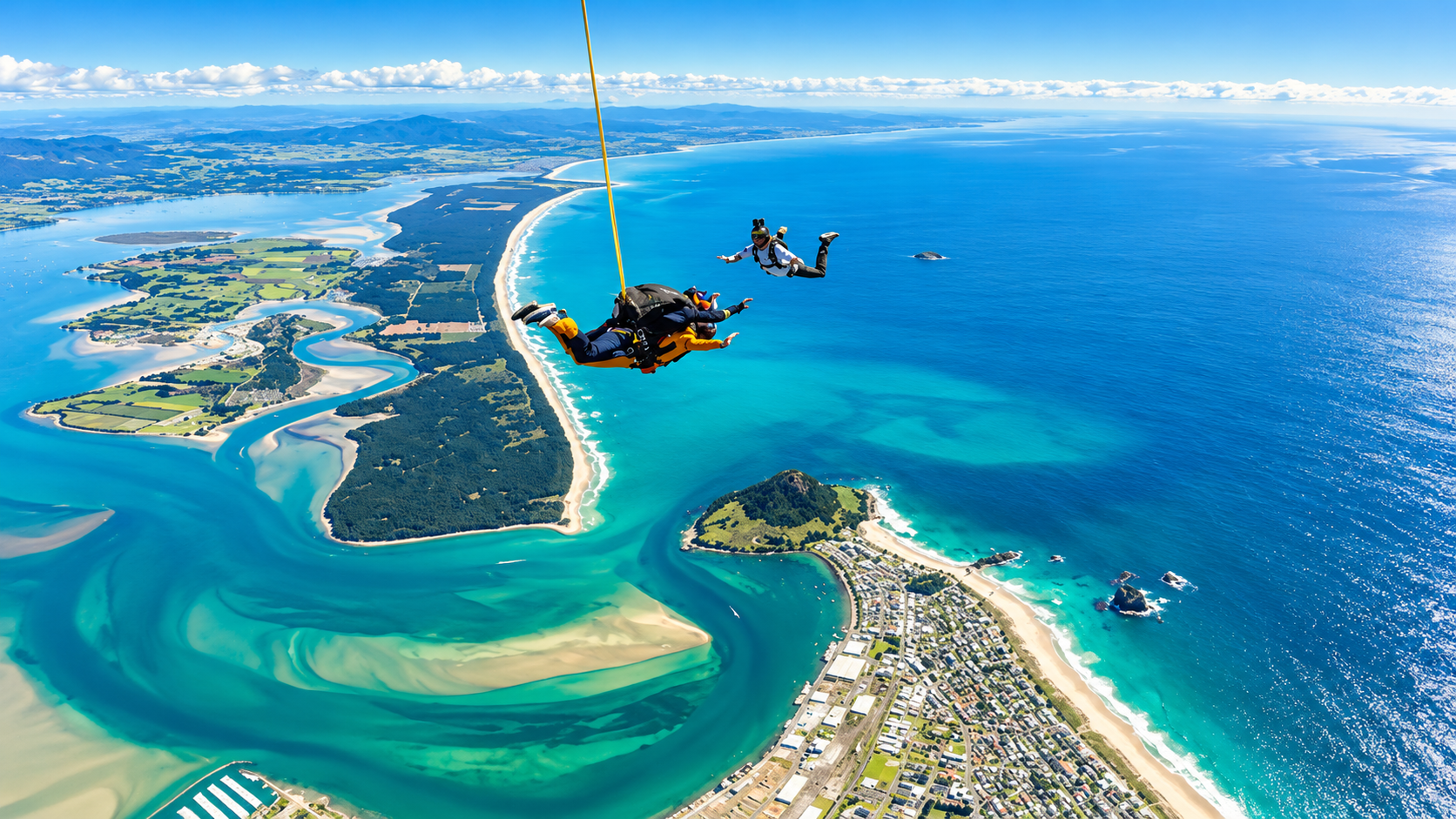
SKYDIVING
6 Best Places to Skydive in New Zealand: Where I’d Choose for the Ultimate Jump
There are plenty of adventure activities in New Zealand that look intimidating from a distance. Skydiving is slightly different because the intimidating part follows you all the way into the aircraft.
You can be excited when you book it, confident while signing in and surprisingly relaxed while putting on the harness. Then the plane starts climbing, the landscape gets smaller beneath you and eventually somebody opens the door.
That tends to change things.
For a lot of first-time skydivers, the strange thing is that the fear is often worst before the jump. Once you are actually out of the aircraft, there is very little time left for worrying. You are suddenly freefalling above one of New Zealand's lakes, mountain ranges, glaciers or coastlines at around 200 kilometres per hour, and the whole experience becomes much more difficult to describe than you expected.
New Zealand is particularly good for skydiving because the activity and the scenery work so well together. You are not simply jumping from a plane for the adrenaline. Depending on where you choose, the flight to altitude can take you above the Southern Alps, Lake Wakatipu, Lake Wānaka, Lake Taupō, West Coast glaciers, Aoraki/Mount Cook or the golden coastline around Abel Tasman.
That creates another problem.
Where should you actually skydive?
If you are only going to do it once, the location matters. Altitude matters as well, but I would not automatically choose a jump simply because it is the highest available. The scenery, your wider itinerary, the weather and how much you want to spend should all be part of the decision.
For Aotearoa Adventures, these are the six places I would put at the top of the list.
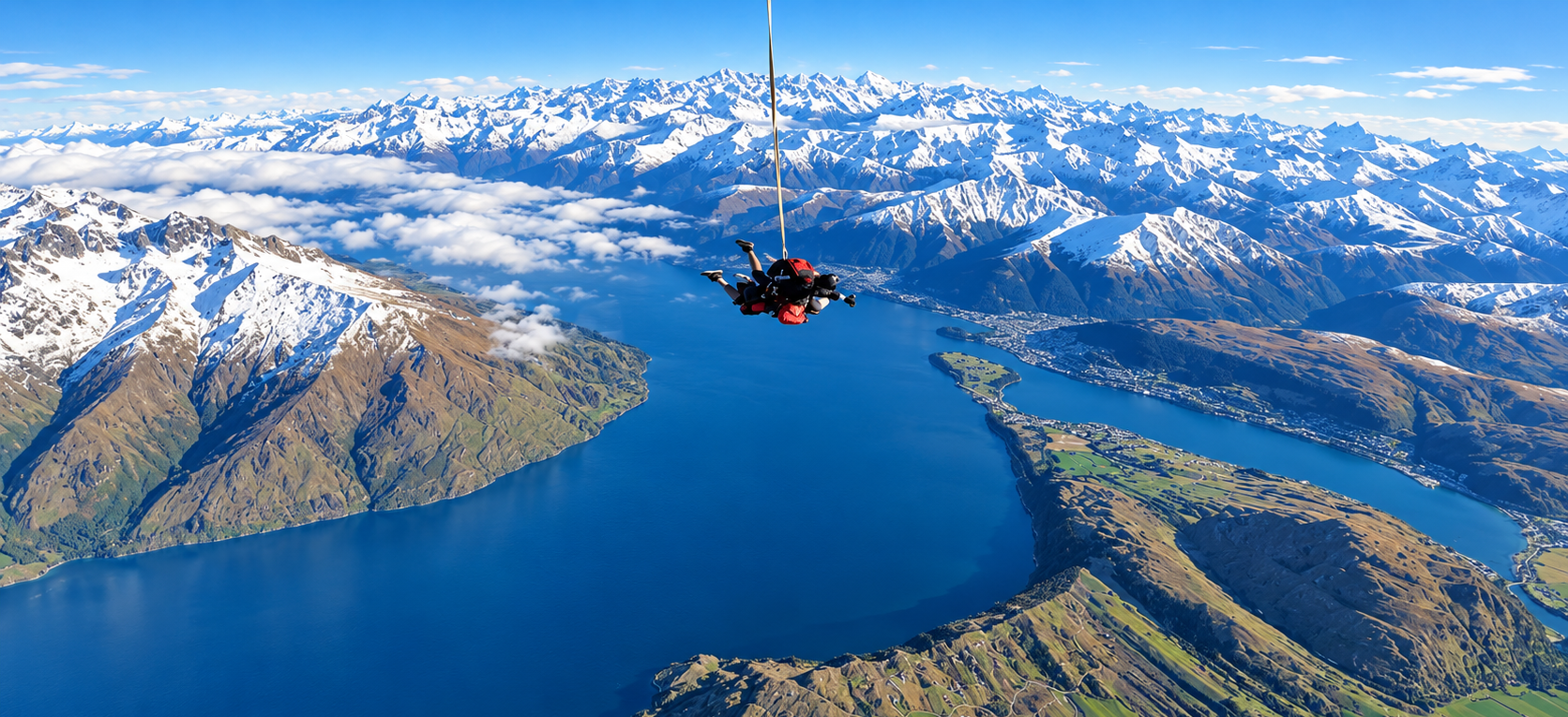
1. Queenstown – The Classic New Zealand Skydive
Best for: First-time visitors to New Zealand, adventure travellers and anyone already staying in Queenstown
Maximum current altitude: 15,000 ft
Freefall: Up to around 60 seconds
My pick: The 15,000 ft jump if the budget allows
Why choose it: Queenstown scenery and the full adventure-capital atmosphere
If somebody told me they were travelling around New Zealand, had never skydived before and wanted the classic experience, Queenstown would probably be the easiest place to recommend.
It just fits.
Queenstown already feels like somewhere people come to do slightly unreasonable things. Bungy jumping, jet boating, canyon swings, skiing, mountain biking and rafting are all part of the town's identity, so stepping out of a plane thousands of feet above the Wakatipu Basin somehow does not feel completely out of place.
NZONE Skydive currently offers jumps from 9,000, 12,000 and 15,000 feet, with the highest option providing up to around 60 seconds of freefall. The company began tandem operations in Queenstown in 1990 and now reports more than 350,000 jumps.
The big reason to choose Queenstown, though, is the view.
As the aircraft climbs, Lake Wakatipu opens beneath you and the mountains begin stacking up in almost every direction. The Remarkables are particularly obvious, while the wider Southern Alps create the sort of landscape that reminds you exactly why you chose to skydive in New Zealand rather than somewhere flatter.
I actually think the flight to altitude deserves more attention than it gets.
Most people book skydiving because they want the freefall, but the climb is essentially a scenic flight with the slightly inconvenient knowledge that you will not be landing in the aircraft.
At 15,000 feet, the landscape becomes enormous.
Then the door opens.
What the Queenstown Jump Feels Like
The build-up is usually more nerve-racking than the freefall itself.
You are attached to your tandem instructor, shuffled towards the aircraft door and suddenly the mountains you were peacefully admiring ten minutes earlier are underneath you.
There is a very brief moment where your brain has enough time to question every decision that brought you here.
Then you are gone.
The initial acceleration is the part people tend to imagine as a stomach-dropping roller-coaster sensation. Skydiving feels different. Once you reach freefall speed, there is an almost strange sense of being supported by the air rather than simply falling through it.
You also discover that 60 seconds can feel both incredibly long and nowhere near long enough.
Once the parachute opens, everything changes again. The noise disappears, the pace slows and you finally have time to look around properly.
That contrast between freefall and the quiet descent is one of the best parts of the whole experience.
Why Queenstown Works So Well for a First Skydive
The logistics are easy.
NZONE checks guests in from central Queenstown and provides transport to the drop zone, so you do not necessarily need a car. Current jump options run from 9,000 to 15,000 feet, which also means you can choose how much you want to spend rather than having only one package available.
It is also easy to build the jump into a larger adventure trip.
You could skydive one morning, jet boat the Shotover later in the day and spend tomorrow wondering why your Queenstown itinerary has apparently declared war on your nervous system.
My advice would actually be the opposite.
Do the skydive and leave some room afterwards.
The adrenaline takes a while to settle.
You may find that sitting beside Lake Wakatipu with food and repeatedly telling people, “I still can't believe I actually did that,” is enough activity for the next hour.
Aotearoa Adventures Tip
Book your skydive early in your Queenstown stay rather than on your final morning.
Skydiving is weather dependent and NZONE specifically warns that unsuitable weather can cause cancellations. Giving yourself another day provides a much better chance of rescheduling.
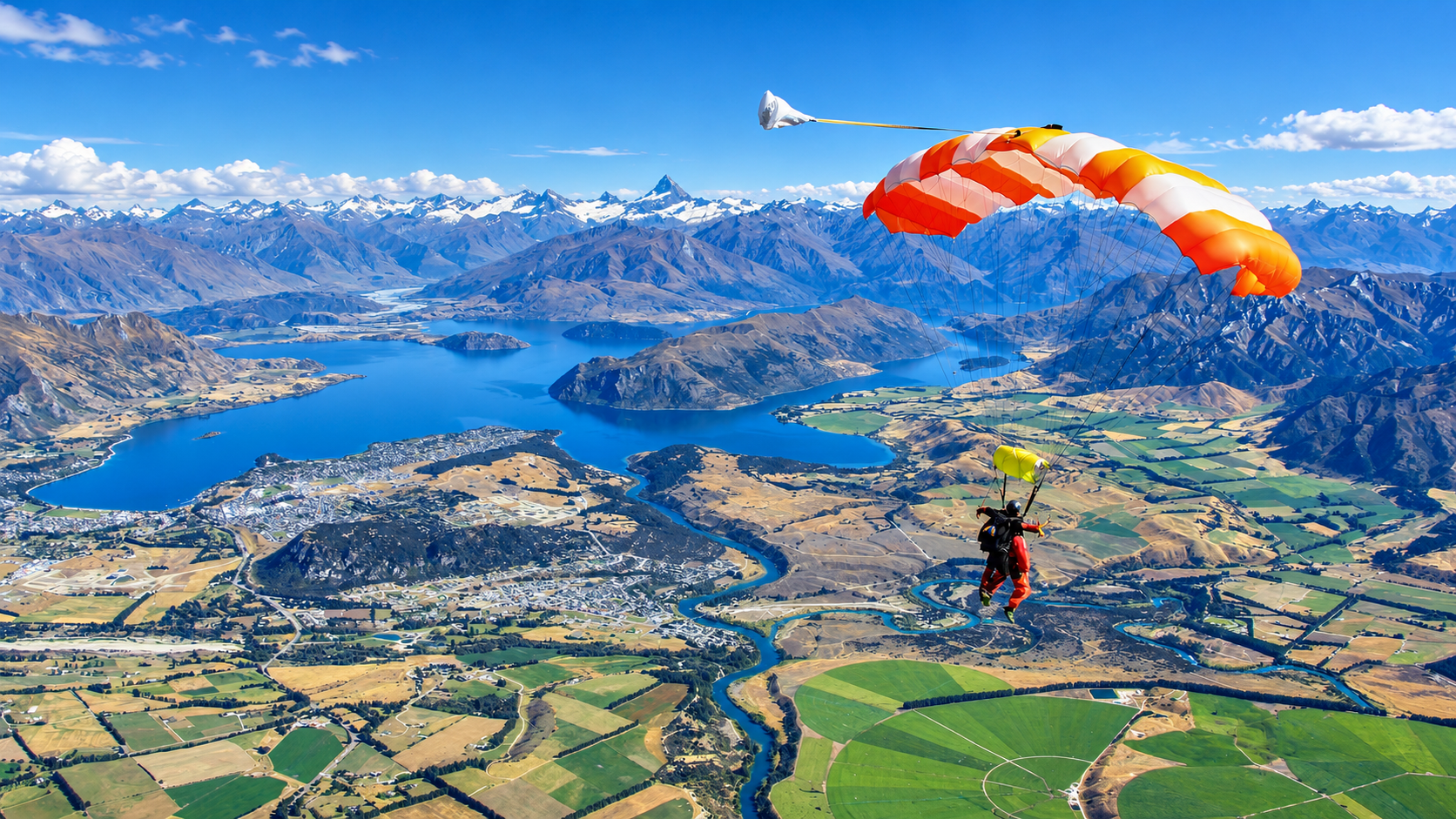
2. Wānaka – My Pick for Lakes and Mountain Scenery
Best for: Scenery, couples, road trippers and anyone staying around Wānaka
Maximum current altitude: 15,000 ft
Freefall: Up to around 60 seconds
My pick: 15,000 ft
Why choose it: A spectacular combination of lakes and the Southern Alps
Wānaka offers a different kind of skydive from Queenstown.
It is still unmistakably Southern Alps country, but the landscape feels more open. Instead of one dramatic lake basin surrounded by adventure infrastructure, you are looking across a network of lakes, valleys and mountains extending towards Aoraki/Mount Cook.
Skydive Wānaka currently operates from Wānaka Airport with jumps from 9,000, 12,000 and 15,000 feet. The operator says that on clear days the flight to altitude can reveal as many as six lakes, the Upper Clutha area and the Southern Alps stretching towards Aoraki/Mount Cook.
That is what makes Wānaka particularly appealing to me.
You are already visiting one of New Zealand's most scenic towns, and then you move high enough above it to see how all of those mountains and lakes actually connect.
The Flight Up Is Half the Experience
The aircraft takes roughly 10–15 minutes to climb to altitude, which gives you plenty of time to watch Wānaka shrink below you.
Lake Wānaka is the obvious feature, but the view becomes broader as you climb.
The Upper Clutha begins threading through the landscape and other lakes appear beyond the surrounding ridges. On a clear day, the high Southern Alps sit on the horizon.
This is where I think choosing the highest jump starts making sense for reasons beyond freefall time.
Yes, the extra altitude gives you more time falling.
But it also gives you a longer scenic flight and a much wider view.
If you are already spending several hundred dollars on something you may only do once in your life, I would at least look carefully at the difference between the altitude options before automatically selecting the cheapest.
Wānaka or Queenstown?
This is a difficult one because both are excellent.
I would choose Queenstown if skydiving was part of a bigger adrenaline-focused trip.
There is something fitting about doing your first skydive in the adventure capital.
I would choose Wānaka if scenery was the priority.
The Wānaka landscape feels less developed and gives you huge views across lakes and mountains without Queenstown sitting as prominently in the middle of everything.
There is also a practical advantage for travellers staying in Queenstown: Skydive Wānaka currently offers paid return transfers from Queenstown as well as complimentary transfers from central Wānaka.
So you do not necessarily need to choose based purely on where your accommodation is.
The 15,000 ft Option
The current 15,000 ft experience offers up to roughly 60 seconds of freefall, compared with up to 45 seconds from 12,000 feet and around 25 seconds from 9,000 feet.
That difference looks fairly small when you read it on a booking page.
It does not feel small when you are falling through the sky at roughly 200 km/h.
If skydiving is one of the big experiences of your New Zealand trip and the extra cost fits the budget, I would choose the 15,000-foot jump.
Aotearoa Adventures Tip
Wānaka is somewhere I would keep the skydive and a major hike such as Roys Peak on different days.
Both depend on decent weather, but trying to climb a mountain immediately after spending the morning dealing with the emotional consequences of jumping out of an aircraft feels unnecessarily ambitious.
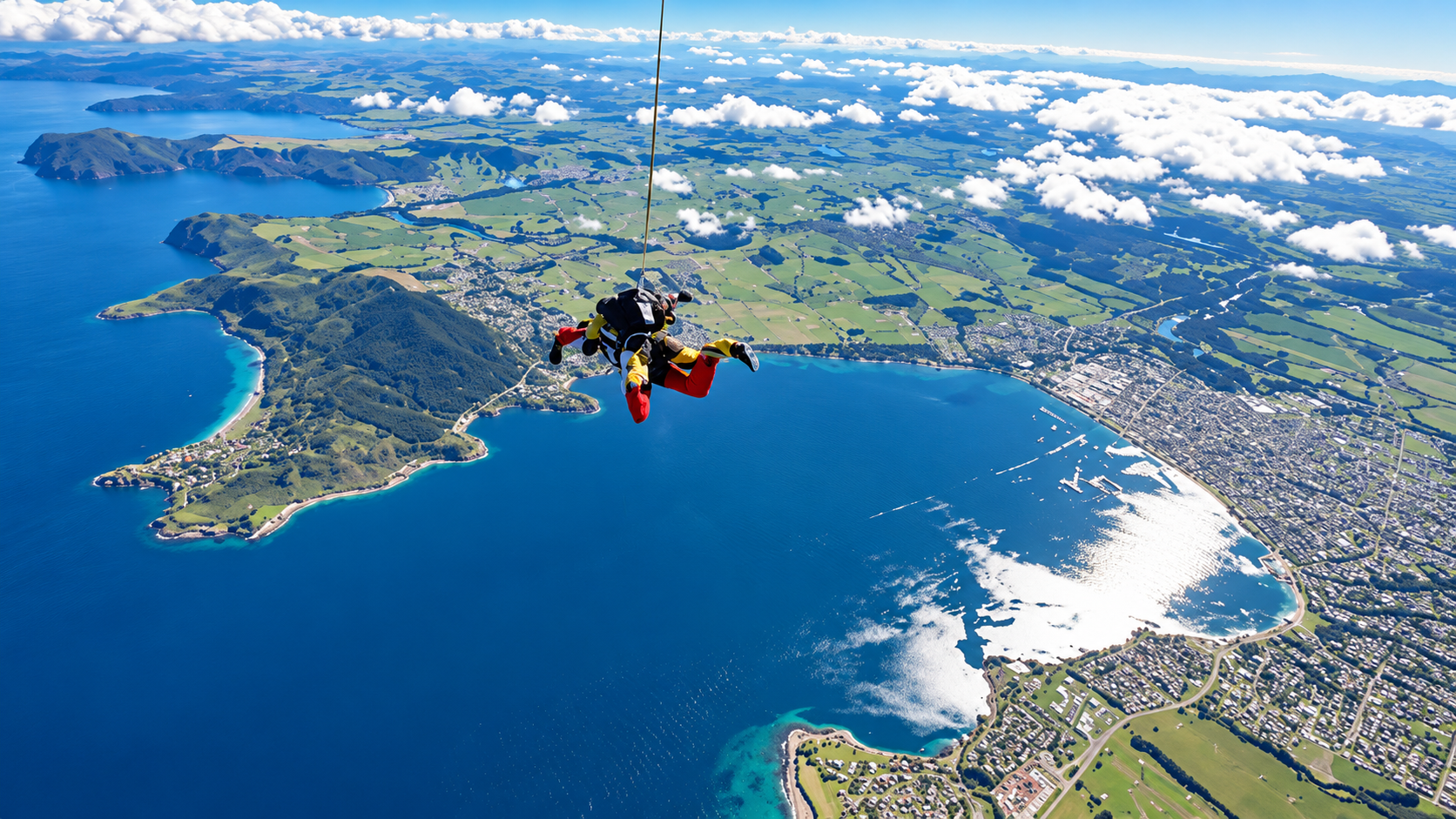
3. Taupō – One of the Best Places for Your First Skydive
Best for: First-timers, North Island travellers and anyone comparing prices and altitude choices
Maximum current altitude: 16,500 ft
Freefall: Up to around 70 seconds
My pick: 15,000 ft for the balance of price and freefall
Why choose it: Lake Taupō, Central Plateau views and plenty of jump options
Taupō has been one of New Zealand's major skydiving destinations for decades, and I think it remains one of the best choices for somebody doing their first tandem jump.
The scenery is completely different from Queenstown and Wānaka.
Instead of being surrounded by the Southern Alps, you are above Lake Taupō, with the volcanic Central Plateau sitting beyond it. On the right day, that means views towards Tongariro National Park and its distinctive volcanic peaks.
Taupo Tandem Skydiving has operated since 1992 and currently offers jumps from 9,000, 12,000, 15,000 and 16,500 feet, giving it one of the broadest choices of altitude among the main New Zealand drop zones.
That flexibility is useful.
Not everyone needs the biggest jump simply because it exists.
Why Taupō Is Good for Nervous First-Timers
There is something reassuring about doing a first skydive somewhere that does a huge number of tandem jumps.
Taupo Tandem Skydiving says it has taken more than 200,000 people skydiving since opening.
That does not make stepping out of the plane feel normal.
Nothing makes that feel normal.
But it does mean the entire process is built around people who have never done this before.
You do not need prior experience. Your instructor takes care of the technical side while you receive a briefing and concentrate on doing what you are told at the appropriate moments.
Essentially, your main job is not to suddenly develop your own skydiving technique halfway through the flight.
Which Taupō Height Should You Choose?
This is where Taupō gets interesting.
The current options range from 9,000 feet to 16,500 feet. The operator advertises roughly 40 seconds of freefall at 12,000 feet, around 60 seconds at 15,000 and up to roughly 70 seconds at 16,500.
For most people, I think 15,000 feet is probably the sweet spot.
You get a meaningful amount of freefall without paying for the absolute top package.
If money is tight but you have always wanted to skydive, the lower altitude options make Taupō particularly attractive.
I would rather see somebody do a 9,000- or 12,000-foot jump they can afford than miss the experience entirely because the internet convinced them that anything below the maximum height somehow does not count.
Trust me.
You are still jumping out of a plane.
It counts.
Taupō Is Easy to Build Into an Adventure Trip
This is another reason it works so well for Aotearoa Adventures.
You can combine a skydive with rafting on the Tongariro River, jet boating around Huka Falls, mountain biking, hiking around Tongariro National Park or simply spending time around the lake.
The operator currently even sells combination products pairing skydiving with activities such as jet boating.
I would still spread the bigger activities over more than one day if your itinerary allows it.
There is no obligation to discover the maximum amount of adrenaline your body can process between breakfast and dinner.
Aotearoa Adventures Tip
If your South Island itinerary is already packed and you are wondering whether you need to save skydiving for Queenstown, don't.
Taupō is a genuinely excellent place to do it and gives you a completely different landscape.
For travellers focusing mainly on the North Island, I would happily make this the skydiving stop.
4. Franz Josef Glacier – The Most Dramatic Scenery on This List
Best for: Glaciers, photographers, bucket-list travellers and anyone wanting a truly memorable location
Maximum current altitude: 18,000 ft
Freefall: Up to around 85 seconds
My pick: Go high if this is your once-in-a-lifetime jump
Why choose it: Mountains, glaciers, rainforest and the Tasman Sea in the same view
If I was choosing purely on scenery, Franz Josef would be extremely difficult to ignore.
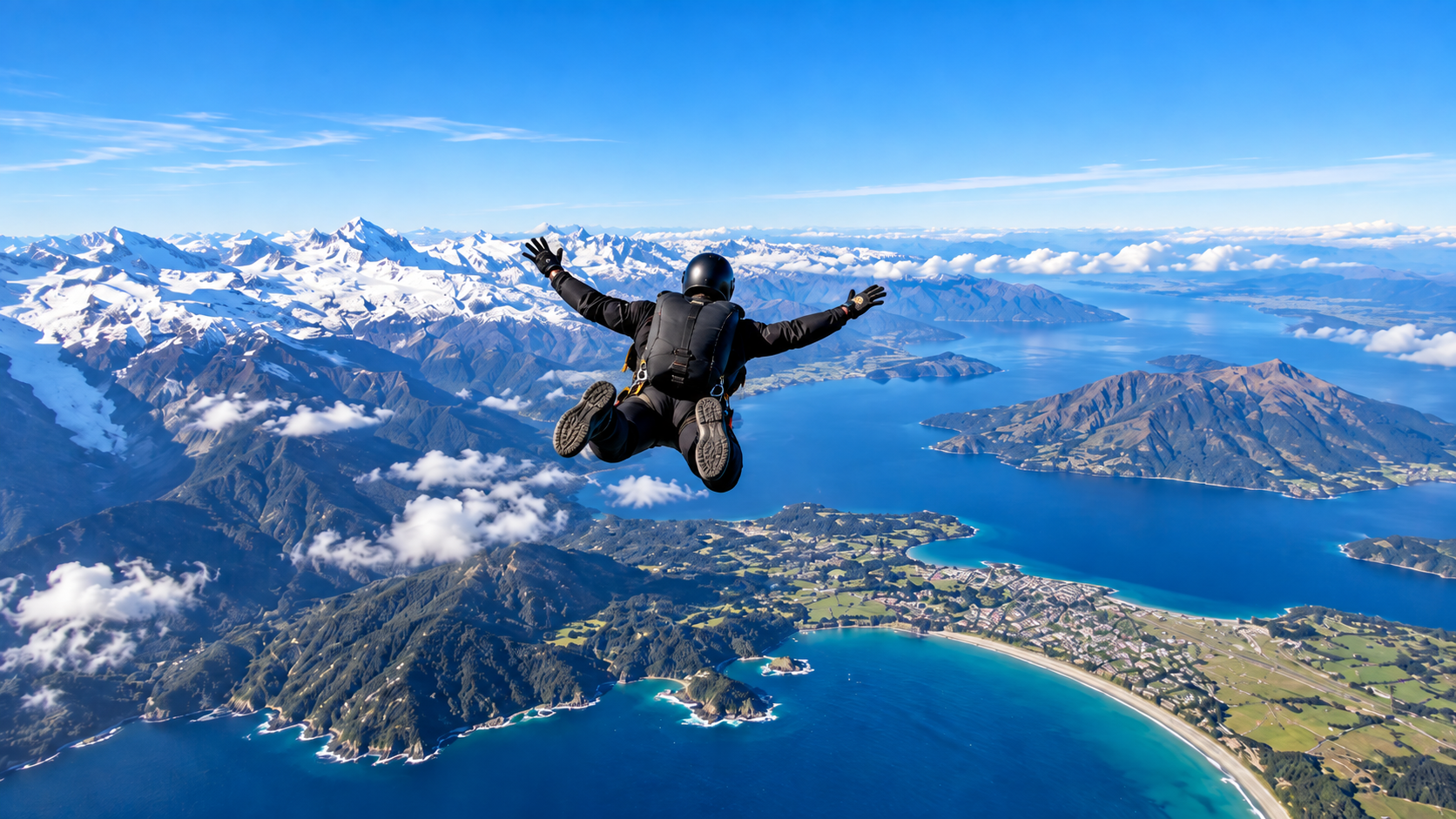
The West Coast already creates one of New Zealand's strangest and most beautiful landscape combinations. Temperate rainforest sits beneath enormous Southern Alps peaks, glaciers descend towards the valleys and the Tasman Sea is only a relatively short distance away.
Now imagine seeing all of that from thousands of metres above it.
Skydive Franz currently offers fixed-wing tandem jumps from 10,000, 13,000, 16,500 and 18,000 feet, with the 18,000-foot option offering up to around 85 seconds of freefall.
The operator also currently offers a helicopter skydive option at Franz Josef, making this one of the more unusual skydiving locations in the country.
Why Franz Josef Looks So Different From the Air
Most scenic skydives give you one dominant landscape.
Taupō gives you a huge lake and volcanoes.
Abel Tasman gives you coastline.
Wānaka gives you mountains and lakes.
Franz Josef gives you almost everything at once.
On one side are the Southern Alps, including views towards Aoraki/Mount Cook and the West Coast glaciers. On the other side is the Tasman Sea. Below are braided rivers, rainforest and the glacier valleys.
That is an extraordinary amount of New Zealand in one view.
It is also why I think the longer scenic flight to the highest altitude can become part of the value rather than simply something you sit through while waiting for the jump.
The current 18,000 ft package includes around a 30-minute flight to altitude before up to 85 seconds of freefall.
In other words, you are effectively getting one of the best scenic flights on the West Coast immediately before somebody opens the door.
Would I Pay for the 18,000 ft Jump?
This is one of the locations where I would seriously consider it.
It is expensive.
There is no point pretending otherwise.
But if this is one of the biggest experiences of your New Zealand trip, Franz Josef is exactly the sort of landscape where being higher gives you something meaningful.
You are looking across national parks, glaciers and the Southern Alps rather than simply trying to add another 20 seconds to the bragging rights.
If that price is uncomfortable, choose one of the lower options.
The glacier does not suddenly become ugly at 13,000 feet.
Allow for West Coast Weather
This is the biggest planning issue.
The same mountains that make Franz Josef so spectacular also make the weather unpredictable.
Low cloud can sit against the Southern Alps and stop flying even while conditions elsewhere on the Coast appear reasonably pleasant.
That is why I would never put a Franz Josef skydive on the final morning of a one-night stop.
Stay at least two nights if the jump matters to you.
Book the skydive for the first suitable opportunity.
Then use the rest of your time for glacier walks, Lake Matheson and exploring the wider area.
Aotearoa Adventures Tip
If you are deciding between a glacier heli-hike and skydiving, think about what you actually want.
The heli-hike puts you physically onto the glacier.
The skydive gives you the enormous overview.
Both are exceptional, but they are completely different experiences.
If your budget only allows one, choose the perspective that excites you more.
5. Aoraki/Mount Cook – The Best Pure Alpine Skydive
Best for: Mountains, glacial lakes and South Island road trips
Maximum current altitude: 16,500 ft
Freefall: Up to around 70 seconds
My pick: 16,500 ft
Why choose it: Aoraki, the Southern Alps and the Mackenzie Basin
If Franz Josef is the most varied scenery on this list, Aoraki/Mount Cook is probably the purest alpine experience.
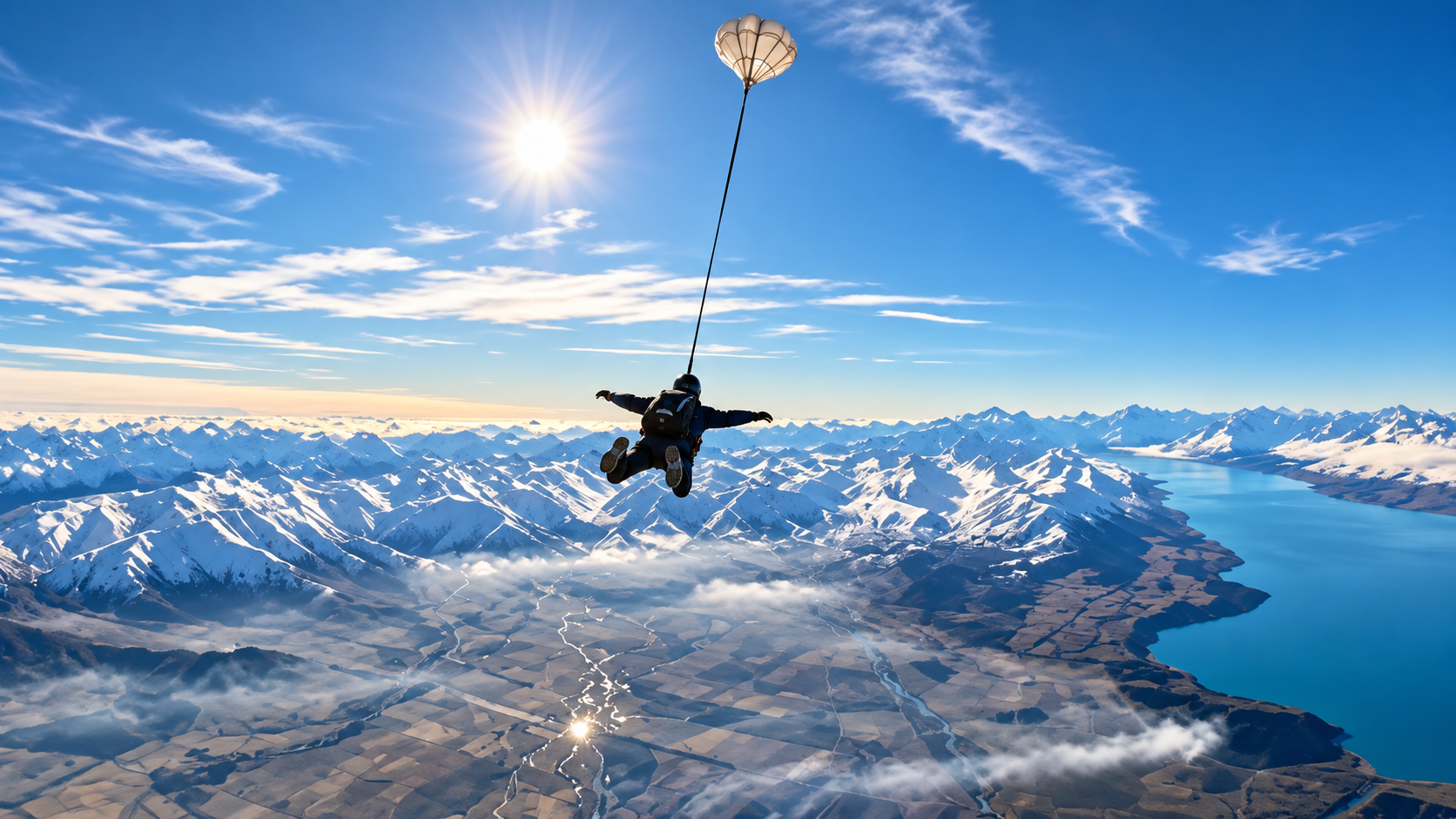
The drop zone is at Pukaki, so you are not jumping directly out of Aoraki/Mount Cook Village. What you get instead is a huge panorama across the Mackenzie Basin towards the national park, with views over Lake Pūkaki and the wider Southern Alps.
Current jumps are offered from 10,000, 13,000 and 16,500 feet, with the highest providing up to approximately 70 seconds of freefall. The operator lists views across Aoraki/Mount Cook National Park and Lakes Pūkaki, Tekapo and Ōhau.
For somebody already driving between Queenstown, Wānaka, Aoraki/Mount Cook and Christchurch, it fits beautifully into a South Island itinerary.
Lake Pūkaki From Above
Lake Pūkaki already looks strange from ground level.
The glacial sediment suspended in the water gives it that distinctive turquoise-blue colour that appears almost artificial under bright sunlight.
From the air, the contrast becomes even more obvious.
You have this enormous blue lake surrounded by dry Mackenzie country, then snow-covered peaks rising behind it.
This is one of the locations where the scenery does not need much help.
You could probably remove the skydiving part and sell the flight itself.
Fortunately, they do not remove the skydiving part.
Why I Would Choose the Highest Option Here
The 16,500-foot jump currently includes roughly a 20-minute scenic flight, up to around 70 seconds of freefall and several minutes under the parachute.
If I had deliberately chosen Aoraki/Mount Cook because of the landscape, I would want enough time at altitude to appreciate it.
The higher jump also makes the transition particularly dramatic.
You spend twenty minutes gradually understanding the landscape from above, then go from calmly looking at Aoraki through an aircraft window to travelling at terminal velocity rather quickly.
There are few experiences with a more decisive change of pace.
Combine It With Your Mount Cook Stay
One thing I would not do is drive all the way through the Mackenzie Basin purely for the skydive and immediately leave.
Spend time at Aoraki/Mount Cook as well.
Walk the Hooker Valley.
Visit the Tasman Valley.
Stay overnight if you can.
Watch the stars.
Skydiving works best here as one part of an alpine trip rather than an isolated attraction.
Aotearoa Adventures Tip
If you are planning both a scenic flight and a skydive around Aoraki/Mount Cook, think carefully about whether you need both.
The flight to altitude already gives you a substantial aerial view.
You may decide that the money is better spent on a glacier experience or another activity elsewhere on the trip.
6. Abel Tasman – The Best Coastal Skydive
Best for: Beaches, ocean scenery, couples and travellers wanting something different from alpine skydiving
Maximum current altitude: 18,000 ft
Freefall: Up to around 85 seconds
My pick: 16,500 ft for most travellers
Why choose it: Golden coastline, turquoise water and huge open views
Abel Tasman is the odd one out on this list.
That is why I would include it.
After Queenstown, Wānaka, Franz Josef and Mount Cook, it would be easy to think that the best New Zealand skydive must involve as many snow-covered mountains as possible.
Abel Tasman proves otherwise.
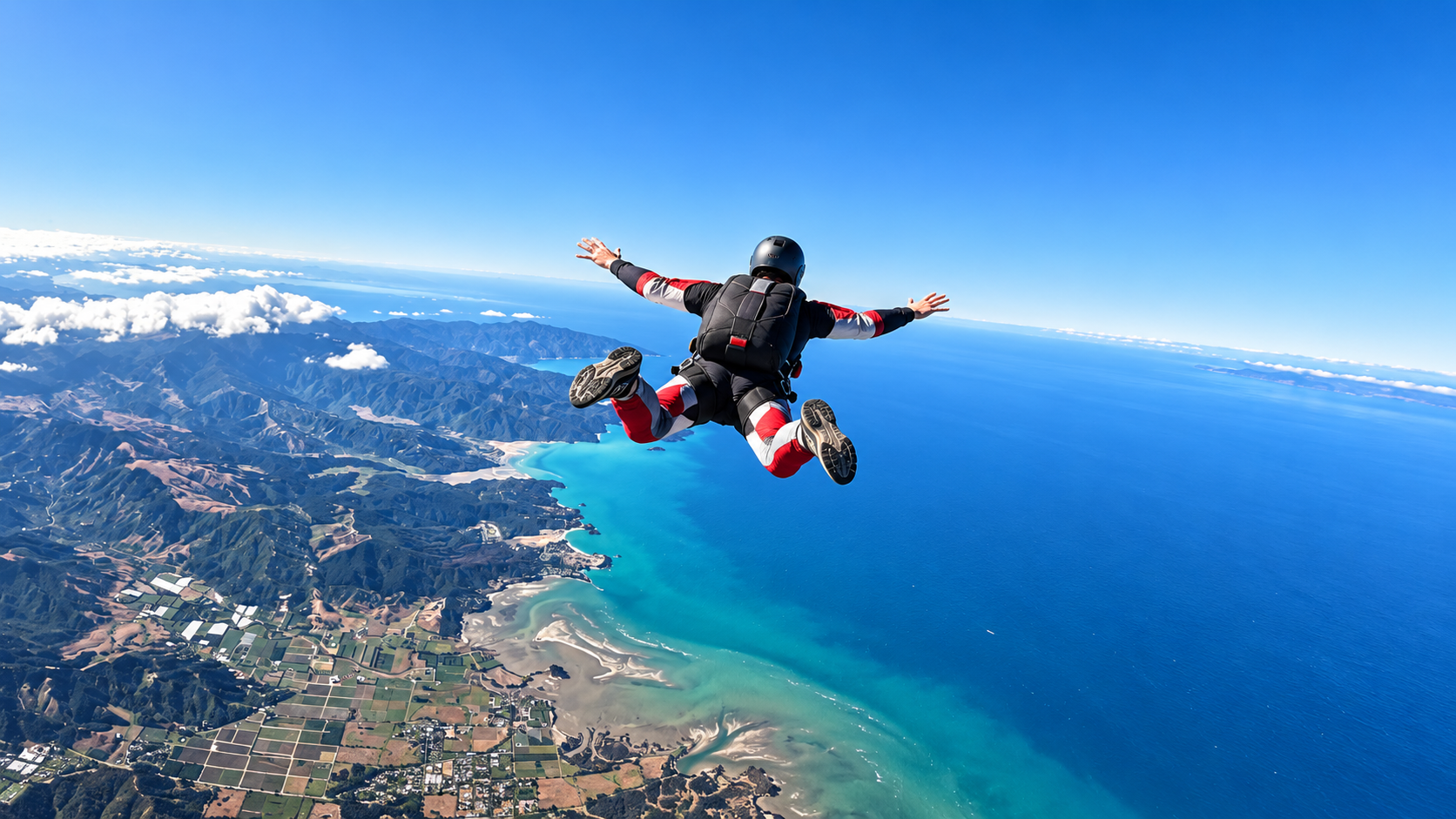
The drop zone is in Motueka, close to Abel Tasman National Park. Instead of jumping above a deep mountain basin, you look across Tasman Bay, the national park's forested coastline, golden beaches and the surrounding ranges.
On clear days, the operator says the higher jumps can provide views of both the North and South Islands. Current options include 13,000, 16,500 and 18,000 feet, with the 18,000-foot jump offering up to around 85 seconds of freefall.
It feels much more coastal and open than the other South Island locations.
Why the Coast Looks So Good From the Air
Abel Tasman is beautiful from the ground, but much of what makes it special is difficult to appreciate from one beach.
From above, the shape of the coastline becomes much clearer.
Headlands, bays, beaches and forest sit alongside bright blue water, while the wider Nelson Tasman region spreads out behind them.
That creates a completely different type of skydive photograph too.
Instead of dark mountains and snow, you get ocean, coastline and lighter colours.
If you are travelling around New Zealand for several weeks and have already spent half the holiday looking at mountains, that difference can be refreshing.
The 18,000 ft Option
The current top jump includes a much longer climb to altitude and up to roughly 85 seconds in freefall.
That is a lot of freefall.
But once again, I would not automatically tell everyone to buy it.
The 16,500-foot option already gives you up to around 70 seconds and the big coastal view. For many people, that will be more than enough.
The 18,000-foot jump makes sense if this is genuinely a bucket-list experience and you want the longest version available.
Easy to Combine With Abel Tasman National Park
This is another reason I like the location.
You can spend one day kayaking along the Abel Tasman coast and another seeing the exact same landscape from thousands of feet above it.
Those two experiences complement each other brilliantly.
One puts you at water level beneath the cliffs.
The other lets you see the entire coastline at once.
The Motueka drop zone is also around 35 minutes by road from Nelson Airport, according to the operator, making it reasonably easy to include in a wider Nelson/Tasman trip.
Aotearoa Adventures Tip
If you are already planning a few days around Mārahau, Kaiteriteri or Motueka, I would put the skydive near the beginning of the stay.
Then, if coastal weather changes the flight schedule, you still have time to move it.
So, Where Is the Best Place to Skydive in New Zealand?
There isn't one answer that works for everyone.
If somebody forced me to break it down, I would choose like this:
Best overall first skydive: Queenstown
Best for mountain-and-lake scenery: Wānaka
Best North Island choice: Taupō
Best for dramatic scenery: Franz Josef
Best pure alpine view: Aoraki/Mount Cook
Best coastal scenery: Abel Tasman
I would also add Auckland as a strong alternative for travellers who do not have time to reach the destinations above. Skydive Auckland currently operates from Parakai, around 45 minutes from central Auckland, and offers jumps up to 18,000 feet with views that can include both coastlines, Waiheke Island, Great Barrier Island and, in clear conditions, Mt Ruapehu.
The important thing is not to become so obsessed with finding the objectively “best” location that you never book one.
Every place on this list gives you a spectacular view.
And once the aircraft door opens, there is a strong chance you will temporarily stop caring about whether somebody on the internet ranked your location fourth instead of third.
What Does a Tandem Skydive Actually Feel Like?
This is difficult to explain properly because the sensation is not quite what most people imagine.
The plane ride is often the stressful part.
You have time to think.
Time to look out the window.
Time to notice how high you are.
Time to remember that normal passengers remain inside aircraft until they reach an airport.
As you get closer to jump height, the instructor checks your harness and equipment and prepares you for the exit.
Then the door opens.
That is normally the moment where the whole idea suddenly feels extremely real.
The Exit
The first few seconds are chaotic.
You are accelerating, the aircraft disappears and your brain is processing far more information than usual.
Then the freefall settles.
At terminal speed, the air feels incredibly powerful. You are not floating gently, but it does not feel the same as dropping on a roller coaster either.
The wind is loud.
Your face does things you did not authorise.
If you bought the photographs, this is where you discover exactly how photogenic you are at 200 km/h.
Under the Parachute
Then the parachute opens and everything becomes quiet.
This part surprised me the most conceptually when first learning how tandem jumps work: a significant part of the experience is not adrenaline at all.
You float.
The instructor may turn the parachute.
You finally have time to look at the scenery.
After the intensity of the freefall, the calm descent can be every bit as memorable.
Is Skydiving Scary?
Yes.
That is partly the point.
You are doing something your brain has spent your entire life telling you not to do.
Being nervous does not mean you are somehow unsuited to skydiving.
Most first-time tandem passengers are nervous.
Some talk constantly.
Some go very quiet.
Some are perfectly relaxed until the aircraft door opens and then suddenly develop several new concerns.
The important distinction is between fear and feeling unsafe.
A professional operator should explain the process clearly, answer questions and make you comfortable with what is happening.
If you have concerns about a health condition, weight restriction, mobility or anything else that could affect the jump, contact the operator beforehand rather than guessing.
Should You Buy the Photos and Video?
This is one of the few upsells where I think the answer is often yes.
You may only skydive once.
You are also unlikely to remember the first few seconds clearly because your brain is extremely busy trying to understand why you are outside an aircraft.
The video captures that.
There are generally two common approaches.
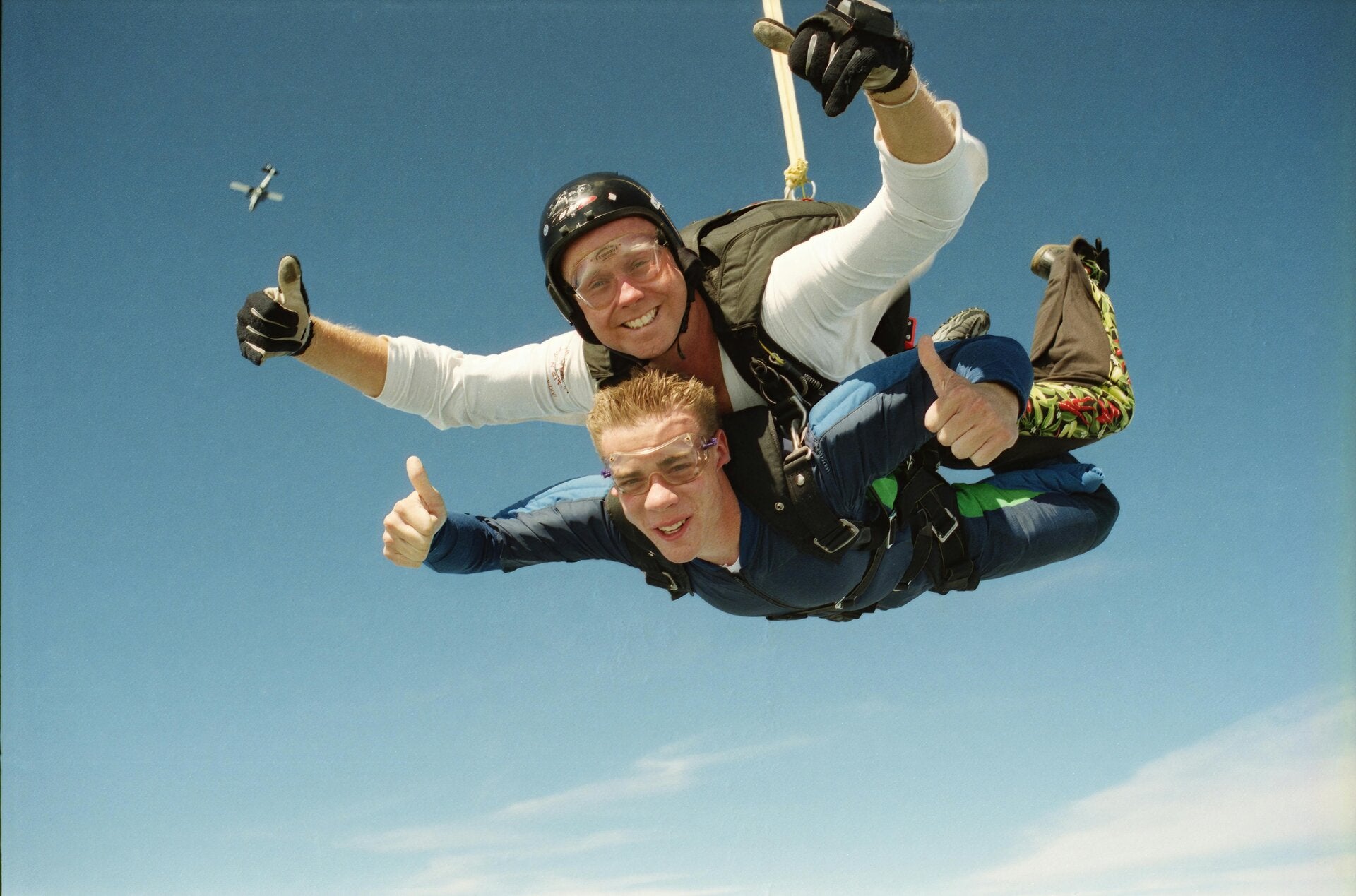
An instructor-mounted camera gives you close-up footage of your face and the jump.
An outside camera flyer means another skydiver jumps alongside you to capture a wider perspective.
Some operators offer both together.
If the budget allows it, the outside camera footage can be fantastic because you actually see yourself freefalling through the landscape rather than filling most of the frame with your own cheeks.
But it is a luxury.
The experience is still the experience without a camera package.
What Should You Wear Skydiving?
Keep it simple.
Wear comfortable clothes that allow you to move easily.
Use secure closed shoes such as trainers.
Avoid loose jewellery and anything that could fly away.
Depending on the operator and conditions, you may be given a jumpsuit or additional gear.
It can be significantly colder at altitude than it is on the ground, so follow the operator's advice about layers.
And if you have long hair, tie it back.
Your tandem instructor will probably appreciate not spending the entire freefall eating it.
Skydiving Weight Limits
This is one thing you should check before booking.
There is no single weight rule for every New Zealand operator. Limits vary by company, equipment and conditions, and some operators assess passengers individually near the upper limit.
For example, Franz Josef currently lists a standard maximum of 100 kg, with some heavier passengers potentially accepted at the tandem master's discretion, while Mount Cook also lists 100 kg as the normal maximum with limited discretionary exceptions. Queenstown asks guests over 95 kg to check its specific requirements.
If you are anywhere near an operator's stated limit, contact them before paying.
Weather conditions can affect what is possible on the day as well.
Can Children Skydive in New Zealand?
Policies vary by operator rather than there being one simple rule across every drop zone.
Age, weight, height and harness fit can all be relevant, and people under 18 generally need parental or guardian consent.
For example, Mount Cook currently says under-18s require consent and younger children are assessed individually, while Queenstown lists a minimum weight of 40 kg and requires passengers to fit securely into the harness.
If you are planning skydiving for a teenager or younger child, check directly with the operator before building the itinerary around it.
When Is the Best Time to Skydive in New Zealand?
You can skydive throughout much of the year at the major drop zones, but conditions matter more than the month printed on the calendar.
Summer
Summer gives you long daylight hours and normally plenty of available departure times.
It is also busy.
Popular locations such as Queenstown, Wānaka and Abel Tasman can fill during peak travel periods, so I would book ahead.
Autumn
Autumn can be excellent.
Temperatures begin cooling and South Island mountain scenery can look particularly good later in the season.
It is also often less hectic than the height of summer.
Winter
Winter skydiving over the Southern Alps can look incredible.
Snow coverage adds even more contrast around Queenstown, Wānaka and Aoraki/Mount Cook.
Just remember that cold conditions and weather can affect operations.
Dress appropriately.
Spring
Spring can provide beautiful snowy mountain views but changeable weather.
Once again, leave enough days in the destination that a weather cancellation does not destroy the whole plan.
Morning or Afternoon: When Should You Skydive?
If I had a completely free itinerary, I would generally book earlier in the day.
That does not mean mornings are always better.
Weather can be unsuitable at 8am and perfect at 2pm.
The reason I prefer an earlier booking is logistical.
If the first attempt cannot operate, there may still be time to move later that day.
If you booked the final departure and it gets cancelled, your options become much more limited.
Whatever time you choose, keep the surrounding part of the day flexible.
Do not book something non-refundable 20 minutes after your expected landing time.
Aviation and weather occasionally have their own plans.
How Long Should You Allow?
Do not look at “60 seconds freefall” and assume this is a 15-minute activity.
There is check-in, paperwork, briefing, preparation, aircraft loading, the flight to altitude, the skydive itself and the return to the base.
Some operators advise allowing around three hours for the complete experience; Queenstown suggests roughly 3.5 hours, while Franz Josef and Mount Cook also advise around three hours.
Weather delays can make it longer.
My approach would be to give skydiving half a day.
Anything else you manage to fit around it is a bonus.
Which Skydive Would I Choose?
If I were planning this for six different travellers, this is how I would match them.
The first-time visitor who wants the iconic experience
Queenstown.
It fits perfectly into an adventure trip and gives you huge alpine scenery without complicating the itinerary.
The photographer who cares most about the landscape
Franz Josef.
Glacier, mountains, rainforest and ocean are an extraordinary combination.
The North Island traveller
Taupō.
Excellent scenery, several altitude options and easy to combine with the Central Plateau.
The traveller who loves mountains
Aoraki/Mount Cook.
It is difficult to find a more unapologetically alpine skydive.
The couple spending several days around Wānaka
Wānaka.
Beautiful, slightly quieter surroundings and an enormous lake-and-mountain panorama.
The traveller who wants something different
Abel Tasman.
Golden beaches and turquoise coastline provide a completely different backdrop from New Zealand's famous alpine jumps.
My Advice If You're Still Nervous
Do not spend three months trying to make yourself completely unafraid.
You probably won't.
Book it.
Choose a reputable operator.
Read the instructions.
Turn up.
Tell the instructor you are nervous if you are.
Then take the whole experience one stage at a time.
You do not have to mentally jump out of the plane while sitting at home planning your holiday.
All you have to do right now is make the booking.
On the day, all you have to do is check in.
Then put the gear on.
Then board the aircraft.
Then enjoy the view.
Eventually the door opens.
By that point, somebody considerably more experienced than you is attached to your back.
That seems like a perfectly reasonable time to stop overthinking it.
Final Thoughts: Is Skydiving in New Zealand Worth It?
I think skydiving sits in a slightly different category from most travel activities.
It is expensive.
It is over quickly.
And you can absolutely visit New Zealand without doing it.
But if you have always wanted to skydive, this is one country where the location genuinely adds something to the experience.
You could jump above Lake Wakatipu with the Remarkables beside you, look across the lakes around Wānaka, fall towards Lake Taupō with the Central Plateau beyond, see glaciers and the Tasman Sea from Franz Josef, look across Lake Pūkaki towards Aoraki/Mount Cook or watch the golden Abel Tasman coastline spread out beneath you.
You are going to remember the jump regardless.
You might as well give yourself something extraordinary to look at while you are up there.
For most travellers, I would not worry endlessly about finding the single best skydive in New Zealand.
Choose the location that fits your trip.
Choose an altitude that fits your budget.
Book early enough to allow for the weather.
And if you are sitting in the aircraft wondering why you ever thought this was a good idea, remember that thousands of people before you have had exactly the same thought.
A few seconds later, most of them were too busy enjoying themselves to care.
Ready to Skydive in New Zealand?
Compare the experiences that fit your itinerary rather than simply choosing whichever one has the largest number next to the altitude.
COMPARE ALL NEW ZEALAND SKYDIVING EXPERIENCES