

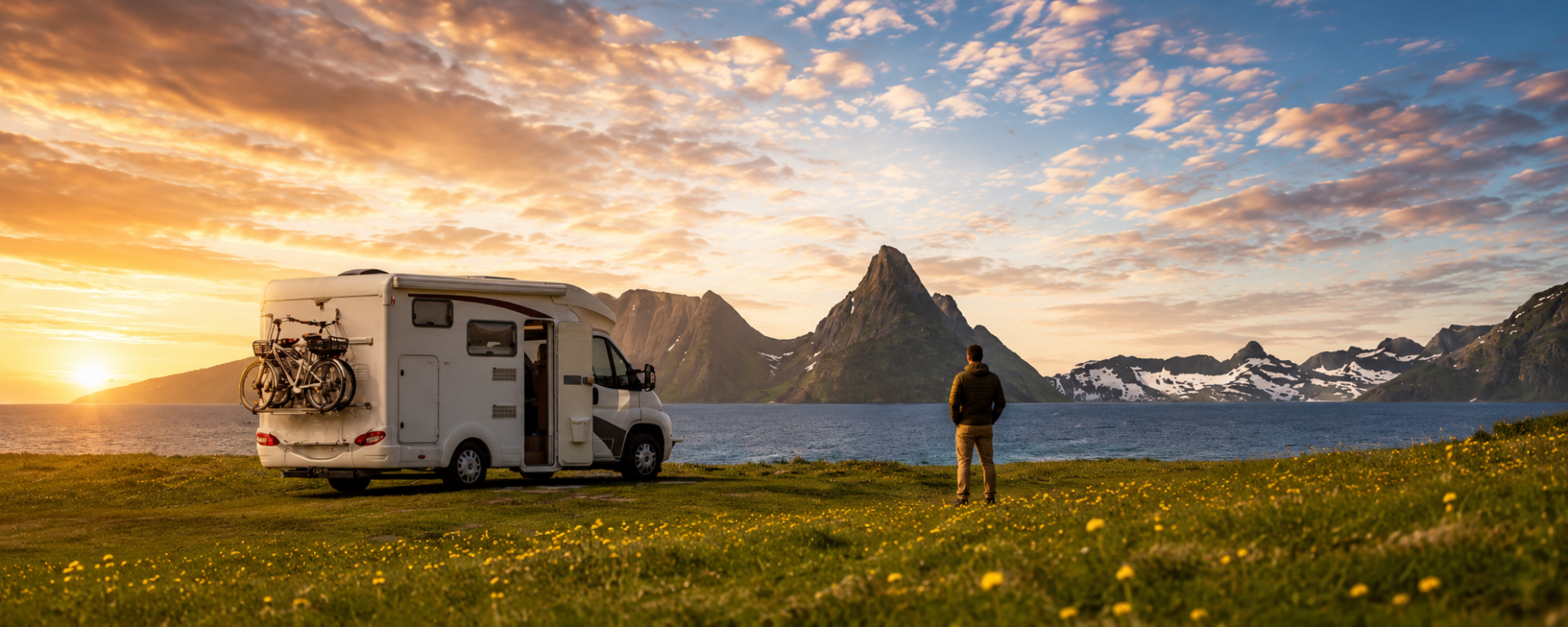
Campervanning New Zealand: Complete Beginner’s Guide
Campervanning New Zealand: Complete Beginner’s Guide
There are few ways of travelling around New Zealand that look quite as appealing as a campervan road trip. The idea is easy to understand: your transport and accommodation travel with you, the route can change whenever you want, and some of the country's best landscapes become part of everyday life rather than somewhere you simply visit for an afternoon.
It is easy to picture the good parts. Waking beside mountains, making coffee before setting off down an empty road, stopping beside an alpine lake for lunch and arriving somewhere completely different by evening. In the right circumstances, campervanning really can feel like that.
What gets mentioned less often is the practical side. Campervans are larger and slower than normal cars, campsites need planning, freedom camping has rules, fuel costs can add up and several consecutive wet evenings inside a small van can test how romantic you really find compact living.
None of that means you should avoid it. New Zealand is genuinely one of the best countries in the world for a campervan holiday. It simply works much better when you understand what you are signing up for before collecting the keys.
For a first trip, I would think of campervanning as a style of travel rather than a guaranteed money-saving option. If the idea of having your own little home on the road genuinely excites you, it can become one of the highlights of the holiday. If you mainly want the cheapest possible transport and accommodation, a small rental car combined with motels or holiday parks may sometimes make more sense.
This guide covers what first-time campervan travellers need to know, including choosing a van, campsites, freedom camping, self-containment rules, costs, driving, cooking, showers, toilets, route planning and whether campervanning is actually the right choice for your New Zealand adventure.
Is New Zealand Good for a Campervan Holiday?
Very.
The combination of relatively compact distances, spectacular landscapes and a large network of campsites makes New Zealand particularly well suited to travelling by campervan.
The real advantage is flexibility. With conventional accommodation, your day is often shaped around getting from one hotel to the next. In a campervan, you have more freedom to change the route, spend longer somewhere you like or move on when the weather is better somewhere else.
That flexibility works particularly well in a country where weather can play such a big part in what you are able to do. If cloud cancels a scenic flight in Franz Josef, you may be able to stay another night. If tomorrow looks much better in Wānaka than where you currently are, you have more options than somebody with every hotel booked months in advance.
Campervanning also suits the New Zealand road-trip experience because so much of the appeal lies between the major destinations. The road beside Lake Pūkaki, the drive through Haast Pass, the coastline around Kaikōura and the journey through Fiordland can be as memorable as the towns at either end.
The Department of Conservation alone manages more than 250 vehicle-accessible campsites on public conservation land, although not every campsite is suitable for every campervan because some are reached by narrow, steep, winding or gravel roads.
Add holiday parks, privately operated campgrounds and permitted freedom-camping areas, and there is a very good camping network to build a journey around.
Is Campervanning Right for You?
Before comparing rental companies, I would ask one question:
Do you actually like the idea of travelling in a campervan?
That may sound obvious, but campervan travel is sometimes marketed as though everyone automatically enjoys it.
Some people absolutely do. They love waking somewhere new, cooking outside, carrying everything with them and never having to unpack a suitcase properly. They enjoy the independence enough that dealing with water tanks, rubbish, campground facilities and a smaller living space barely feels inconvenient.
Other people discover fairly quickly that they prefer a proper shower, a large bed and a room where nobody has to rearrange the dining table before going to sleep.
Neither approach is better.
For me, campervanning makes the most sense when the campervan itself is part of the experience you want.
If you would rather spend the day exploring and then arrive at a warm motel with a bathroom and a bed already waiting, do that. A rental-car road trip through New Zealand is still an excellent road trip.
But if you like the idea of carrying home with you and having a little more independence over where each day ends, campervanning can be brilliant.
What Type of Campervan Should You Hire?
New Zealand campervans range from tiny converted cars to large motorhomes with proper kitchens, showers and toilets.
Choosing the right one is probably more important than choosing the company name printed on the side.
Small Campervans
A small camper is usually based around a van or people mover and is often designed for one or two travellers.
The biggest advantage is driving.
They feel much closer to a normal car, are easier to park, use less fuel and are less intimidating on narrow roads. If you are travelling as a couple and do not need a bathroom inside the vehicle, a smaller camper can be an excellent compromise.
The disadvantage is space.
Your bed, kitchen, clothes and living area may essentially occupy the same few square metres. When the weather is beautiful this can feel wonderfully simple because much of your life happens outside.
When it rains for two days, those few square metres begin to feel considerably more noticeable.
Larger Campervans and Motorhomes
Larger motorhomes give you far more comfort.
You may have a permanent bed, dining area, kitchen, fridge, toilet and sometimes a shower. For longer trips, families or travellers who value comfort, this can transform the experience.
The downside appears as soon as you start driving.
A large motorhome is wider, longer and heavier than a normal vehicle. New Zealand roads can be narrow and winding, particularly through mountain areas, and NZTA warns overseas visitors that travel often takes longer than expected because many roads are two-way, narrow, steep or winding.
A large motorhome also uses more fuel and can be harder to park in places such as central Queenstown.
For a couple on their first campervan trip, I would generally avoid hiring a huge six-berth vehicle simply because it looks comfortable inside.
Get enough space.
You probably do not need a travelling apartment.
How Big a Campervan Do You Really Need?
This is one area where I would not choose purely on price.
The cheapest two-person campervan might be perfectly adequate for a five-day summer trip.
For three weeks, the extra space of a slightly larger vehicle can become very valuable.
Think about what happens at night.
Where do your bags go?
Can one person go to bed while the other remains seated?
Does the bed need to be assembled every evening?
Can you comfortably cook inside when it rains?
If there are four people travelling, is there somewhere for four people's actual luggage as well as four people?
Campervan companies are understandably good at photographing vehicles when every surface is perfectly organised and nobody has brought shoes, coats, backpacks, groceries or wet towels.
Real travel contains all of those things.
Allow a little more space than the brochure suggests you need.
Do You Need a Self-Contained Campervan?
If you intend to freedom camp, this is extremely important.
New Zealand has changed its self-contained vehicle system considerably in recent years, and some older information online is now outdated.
The transition to the current regulated self-containment system is complete. The final transitional period for privately owned vehicles ended on 7 June 2026. Rental vehicles had already been required to meet the newer certification system earlier in the transition.
The newer certification requirements also include a fixed toilet, rather than simply carrying a portable toilet in the vehicle, and compliant vehicles use the newer green self-containment warrant system.
If you are renting a campervan and intend to freedom camp, I would therefore specifically confirm that the exact vehicle you are booking is currently certified for the type of camping you intend to do.
Do not simply assume that every campervan is self-contained because it has a bed and a sink.
And do not rely on a photograph of an old certification sticker from somebody's travel blog.
This is an area where the rules matter.
What Does Self-Contained Actually Mean?
The basic idea is that the vehicle must be capable of supporting its occupants without leaving human waste or wastewater behind.
That means proper systems for freshwater, wastewater, rubbish and toilet use.
It is designed to address the obvious problem that arises when large numbers of people camp away from formal facilities without being able to properly contain their waste.
For travellers, however, the most useful thing to remember is much simpler:
Self-contained does not mean you are allowed to camp anywhere.
It means your vehicle meets a particular standard.
Where you can actually stay is a completely separate question.
What Is Freedom Camping?
Freedom camping generally means camping on public land outside a formal campground.
This is probably the part of New Zealand campervan travel that creates the most confusion.
There is a persistent image online of somebody parking beside a deserted lake, opening the rear doors and waking up alone in paradise.
Sometimes you can stay in beautiful permitted locations.
But freedom camping is not a nationwide rule giving campervans permission to sleep wherever they find a flat piece of ground.
Local councils can restrict or prohibit freedom camping in particular areas. Rules can differ from one district to another, and signs at the actual location matter.
DOC also has its own rules for public conservation land. Freedom camping may be allowed on some conservation land but is prohibited in certain places, including DOC reserves unless you are in a managed campsite or signage specifically allows it. Some locations also impose conditions such as requiring a certified self-contained vehicle.
The practical rule I would follow is:
Never assume. Check.
If there is a sign, read it.
If you are uncertain whether overnight camping is permitted, find somewhere else.
There are too many legitimate places to stay in New Zealand to spend the night worrying about whether you are going to be moved on.
The Three Types of Places I Would Use
For a first campervan trip, I would rotate between holiday parks, DOC campsites and legal freedom-camping areas.
Each serves a different purpose.
Holiday parks are your comfort nights.
DOC campsites give you the landscape.
Freedom camping gives you flexibility.
Using all three creates a much better trip than trying to prove you can survive for three weeks without paying for a campsite.
Holiday Parks
Holiday parks are the easiest place to stay when you want proper facilities.
Depending on the park, you may find powered sites, bathrooms, hot showers, shared kitchens, laundry facilities, dump stations, Wi-Fi and communal areas.
These are particularly useful every few days.
You can recharge devices, deal with wastewater, wash clothes and have a long shower without wondering how much water remains in the campervan tank.
For larger motorhomes, a powered site also means you can comfortably use systems that rely on mains electricity.
Holiday parks are normally found in or near most major visitor destinations, making them particularly useful around places such as Rotorua, Taupō, Queenstown, Wānaka and Te Anau.
Personally, I would happily pay for one after several nights in more basic campsites.
A proper hot shower starts looking like an extremely sophisticated form of tourism around day five.
DOC Campsites
DOC campsites are one of the things that makes campervanning in New Zealand particularly attractive.
They are often located in beautiful places, and the experience can feel far closer to traditional camping than staying in a large holiday park.
Facilities vary considerably.
Some are basic.
Others are serviced campsites with flush toilets, water, cooking facilities, hot showers and rubbish collection. DOC categorises its campsites according to the facilities available, so it is worth reading the individual campsite page rather than assuming every site works the same way.
Many DOC campsites require bookings. DOC says all serviced campsites require bookings, along with some scenic and standard campsites during peak season, which is usually 1 October to 30 April. Other sites operate on a first-come, first-served basis.
That distinction matters in summer.
Do not drive to a very popular campground at 8pm in January assuming there will definitely be space.
Have a plan.
And preferably a backup plan.
Is the DOC Campsite Pass Worth It?
It can be, particularly on a longer campervan journey where you expect to stay at lots of DOC campsites.
DOC's Campsite Pass currently provides access to many of its conservation campsites for a year, although there are exclusions and conditions. Bookable sites still need to be reserved in advance, and the pass does not guarantee a place at non-bookable sites. There are also limits on how long you can use the pass at one campground, and powered sites carry an additional per-person nightly charge.
I would therefore not automatically buy one before working out your route.
First look at the campsites you realistically expect to use.
If a lot of them accept the pass, it may make excellent sense.
If your trip is mainly going to involve holiday parks and private campgrounds, perhaps not.
How Far Ahead Should You Book Campsites?
This depends heavily on the season.
If you are travelling in January, I would book important places in advance.
The same applies around Christmas, New Year and other popular holiday periods.
You do not necessarily need every single night planned six months ahead, because that removes one of the main benefits of having a campervan.
Instead, I would book the places where not getting a campsite would genuinely cause problems.
That might include a specific area in Fiordland, a popular lakeside campground, a holiday park near Queenstown or anywhere with limited alternatives.
Then leave some flexibility around the less important nights.
In the shoulder seasons, you can normally afford to be more spontaneous.
But even then, I would check whether the particular DOC campground you want requires a reservation before arriving.
What Does a Campervan Trip Actually Cost?
This is where the idea that campervanning is always cheap starts falling apart.
You need to consider the complete trip, not simply the rental price displayed on the booking page.
Your major costs can include the campervan rental itself, insurance, fuel, campsites, powered-site fees, ferry crossings, food, gas and any extras that are not included in the rental.
If you hire a large motorhome, fuel can become a significant part of the budget.
And if you stay in a commercial campground every night, accommodation is not exactly free either.
On the other hand, campervanning can save money in other areas.
You have a kitchen, meaning you do not need to eat at restaurants for every meal.
You also combine transport and accommodation into one major expense.
The value is therefore different for every trip.
I would compare:
campervan + fuel + campsites
against:
rental car + fuel + accommodation
Then decide which experience you actually prefer.
Do not simply assume the van wins.
When Is the Best Time to Campervan New Zealand?
For a first campervan trip, I particularly like February, March and November.
You get good daylight and generally favourable conditions for road trips without necessarily travelling at the absolute height of summer demand.
February gives you proper summer.
March is slightly quieter while still offering excellent outdoor conditions.
November gives you long spring days, greener landscapes and snow still visible on many of the higher South Island mountains.
January is fantastic but busy.
You will have long days and great summer conditions, but campsites and popular destinations can be in heavy demand.
Autumn can be beautiful, particularly around Queenstown, Arrowtown, Wānaka and Central Otago.
Winter campervanning is possible too, but I would only choose it if you genuinely want a winter trip.
Cold mornings are one thing in a hotel.
They become considerably more noticeable when you are living inside a vehicle.
Winter also means shorter daylight hours and potentially more difficult road conditions through alpine areas.
North Island or South Island for a Campervan Trip?
Both are excellent.
But they produce different road trips.
Campervanning the North Island
The North Island gives you geothermal landscapes, beaches, lakes, volcanic country and comparatively shorter distances between several major visitor destinations.
A route through Auckland, Coromandel, Rotorua, Taupō and Tongariro works particularly well.
Go farther north and the Bay of Islands gives you warmer coastal travel.
The North Island can also be a little easier for a shorter campervan holiday because several major destinations sit relatively close together.
You can spend less time on enormous driving days and more time actually camping somewhere.
Campervanning the South Island
If dramatic landscapes are the priority, I would choose the South Island.
The combination of Aoraki/Mount Cook, Queenstown, Wānaka, Fiordland, the West Coast, Abel Tasman and Kaikōura makes it extraordinarily good for road travel.
It is also where a campervan makes you particularly aware that the drive itself matters.
You will cross mountain passes, follow lakes and move between completely different environments within a few hours.
The trade-off is that distances can become larger and the roads more demanding.
Do not build a South Island campervan trip around changing campgrounds every night.
Pick areas.
Stay.
Explore them properly.
Should You Campervan Both Islands?
Yes, if you have enough time.
I would want at least three weeks, and ideally longer, for a satisfying two-island campervan journey.
With only ten or fourteen days, I think you will get much more from choosing one island or flying between separate road-trip sections.
When you have three or four weeks, connecting the islands by the Cook Strait ferry starts making much more sense.
You can road-trip down the North Island to Wellington, cross to Picton and continue through the South Island.
Just check how your campervan company handles ferry travel before booking.
Different rental companies may have different policies and procedures for taking vehicles between the islands.
How Long Should Your Campervan Trip Be?
A week can work very well if you choose one region.
For example, Queenstown, Wānaka and Fiordland can make an excellent shorter South Island trip.
On the North Island, you could build a week around Rotorua, Taupō and Tongariro, perhaps with Auckland at either end.
Two weeks gives you enough time for a substantial road trip through one island.
Three or four weeks makes a two-island trip realistic.
The biggest thing I would avoid is assuming that having your accommodation with you means you should constantly move.
It often has the opposite advantage.
Because everything is already with you, you can stay two or three nights somewhere without feeling as though you need to unpack and repack.
Use that freedom.
How Much Driving Should You Do Each Day?
Less than you think.
Campervans are not sports cars, and New Zealand roads are rarely the place to pretend otherwise.
NZTA warns visitors that roads can be narrow, winding and steep and that driving times can be longer than distances on a map suggest.
In a campervan, I would add even more time.
You may travel more slowly through bends.
You will stop.
You may need groceries.
You may need to empty wastewater.
You may suddenly discover an excellent beach where you would like to stay for two hours.
That is the whole point.
I would rather have three comfortable hours of actual driving with interesting stops around it than an itinerary requiring six or seven hours behind the wheel every day.
Driving a Campervan in New Zealand
New Zealand drives on the left-hand side of the road.
For overseas visitors coming from countries that drive on the right, this is the first adjustment.
The second is the vehicle itself.
A large campervan feels different from a car. It is wider, takes longer to stop and may have a larger turning circle. You also need more awareness of the rear of the vehicle when manoeuvring.
Give yourself time when you first collect it.
Do not make the opening section of the holiday a three-hour drive through a mountain range.
Start with something easy.
Learn where the corners of the vehicle are.
Work out the mirrors.
Get used to braking.
Then move into the bigger road-trip sections once it feels normal.
Let Faster Vehicles Pass
This is particularly important in a campervan.
You may be driving more slowly than local traffic, especially on winding roads.
That is fine.
Do not drive faster than you are comfortable with simply because another vehicle has appeared behind you.
When a safe slow-vehicle bay, pull-over area or other appropriate opportunity appears, let faster traffic pass.
It takes a few seconds.
You feel less pressured.
They disappear down the road.
Everyone wins.
Do not spend twenty kilometres staring anxiously into the mirror because you are determined not to lose your place in some imaginary race.
Be Careful With Gravel Roads
Some campsites and remote attractions are reached along gravel roads.
Before taking your campervan down one, check two things.
First, is the road suitable for a vehicle of your size?
Second, does your rental agreement allow you to use it?
DOC specifically notes that while most of its vehicle-accessible campsites can take campervans, some are reached by roads that are narrow, steep, winding or gravelly and may not suit all vehicles.
Take that seriously.
A remote campsite may look incredible.
It becomes slightly less appealing if you discover halfway down the access road that reversing your six-metre motorhome for two kilometres is the only way out.
Campervanning in Winter
Winter deserves more preparation.
A good motorhome can be comfortable in cold weather, particularly if it has proper heating.
A basic campervan can feel very different.
Condensation, cold floors and freezing mornings become part of daily life.
The roads also require more attention.
Snow and ice can affect mountain routes, particularly through the South Island and Central Plateau.
If winter travel is the plan, I would ask the rental company specifically about heating, insulation, snow chains and how the water system performs in low temperatures.
I would also stay in powered holiday parks more frequently.
Being able to plug in and keep the van warm can transform a winter night.
What Is It Like Sleeping in a Campervan?
This depends almost entirely on the vehicle.
Some larger motorhomes have proper permanent beds and can be extremely comfortable.
Smaller campervans may require you to convert the dining or seating area every night.
That is not necessarily a problem.
But imagine doing the setup at 10pm after driving for several hours in the rain.
Now imagine doing it every night for three weeks.
If you are considering a long trip, look carefully at the sleeping arrangement before booking.
I particularly like layouts where you do not need to completely dismantle the living area simply to go to bed.
A small amount of convenience becomes surprisingly valuable when repeated twenty times.
Cooking in a Campervan
Having a kitchen is one of the biggest advantages of campervan travel.
You can make breakfast before leaving the campsite, prepare lunch somewhere scenic and cook dinner without finding a restaurant every evening.
This can save a considerable amount of money.
It also becomes one of the enjoyable parts of the trip.
There is something difficult to beat about making a simple meal beside a lake after a full day outside.
I would keep campervan cooking simple.
Pasta, rice dishes, wraps, eggs, salads, grilled food and easy breakfasts work much better than deciding your two-burner camper kitchen is finally the place to attempt a six-course tasting menu.
Storage and refrigeration may also be limited.
Shop for a few days at a time rather than trying to stock three weeks of food on day one.
Where Should You Buy Groceries?
The easiest approach is using larger supermarkets whenever you pass through a major town.
Stock up before heading into national parks or remote areas, where selection can be limited and prices may be higher.
Places such as Auckland, Rotorua, Taupō, Christchurch, Queenstown, Nelson and other major centres are obvious opportunities to restock.
I would always keep some emergency food as well.
If weather delays the journey or you arrive somewhere after local shops have closed, it is useful to know dinner still exists inside the van.
The same applies to drinking water.
Do not wait until the tank is empty before beginning to think about where to refill it.
Water and Wastewater
Managing water is simply part of campervan life.
You need freshwater for drinking, washing and cooking.
Then all of that water eventually becomes wastewater that needs to be disposed of properly.
If you have a toilet, that creates another waste system that needs responsible disposal.
Use official dump stations.
Do not empty wastewater onto the ground.
And do not put campervan toilet waste into an ordinary campsite toilet unless the facility specifically says that it can be used that way. DOC notes that only some conservation campsites have dump stations and specifically tells campervan users not to put dump-station waste into campsite toilets.
This is not the glamorous part of campervanning.
But it is one of the things that allows everybody else to continue enjoying the places where you are staying.
How Often Will You Need a Dump Station?
That depends on the size of the tanks, how many people are travelling and how much water you use.
The answer becomes obvious surprisingly quickly once you are on the road.
For a first trip, I would not plan to stretch the vehicle to its absolute limits.
Use opportunities when they appear.
If you are at a holiday park with a dump station and the tanks are getting reasonably full, deal with them.
Do not leave thinking you have another two days and then spend tomorrow evening searching for a facility because somebody had a particularly enthusiastic shower.
Campervan life is easier when you stay slightly ahead of the practical jobs.
What About Showers?
If your motorhome contains a shower, great.
Just understand that it is not necessarily going to feel like the shower at home.
Water capacity is limited and the bathroom can be compact.
For that reason, even travellers with onboard showers often use campground facilities regularly.
Small campervans may not have a shower at all.
That is completely manageable if you plan your campsites sensibly.
I would use holiday parks and serviced campgrounds every few nights and treat the onboard systems as extra flexibility rather than trying to prove I can avoid civilisation for the entire holiday.
Toilets in Campervans
The toilet is one of the great dividing lines in campervan selection.
Some people consider an onboard toilet essential.
Others would rather have the extra space and use campground facilities.
If you plan to freedom camp where certified self-containment is required, the vehicle's toilet and certification become much more important because of the current self-containment rules.
If you are staying almost entirely in campgrounds with facilities, you may care considerably less.
The important thing is choosing based on how you will actually travel.
Do not pay for a large bathroom you will never use.
But do not hire the tiniest camper available and then discover that every place you wanted to stay legally requires something your vehicle does not have.
Keeping the Campervan Charged
There are usually two types of electrical needs in a campervan.
The vehicle itself needs power, obviously.
Then your living area may contain a second battery or electrical system for lights, refrigeration and devices.
Exactly what can run without mains power depends on the vehicle.
Before leaving the depot, ask.
Can the fridge operate while you are parked?
Can you charge laptops?
Do ordinary power sockets work unless the van is plugged into a powered campsite?
How long does the house battery normally last?
Do you have USB outlets?
These questions sound incredibly boring right up until everyone's phone reaches 6% and you discover the power socket you planned to use only works when connected to mains electricity.
Mobile Coverage and Internet
Mobile coverage is generally good around towns and populated areas but can disappear in remote parts of the country.
Do not assume you will have a strong signal in Fiordland, on the West Coast, in mountain valleys or around remote DOC campsites.
Download maps before heading somewhere isolated.
Screenshot campsite details.
Keep booking information available offline.
If the night's campground is located down an unsealed road with no mobile reception, that is not the moment you want to discover the instructions existed only in an email that will not load.
For longer trips, a New Zealand SIM or eSIM can be useful, but it still will not create reception where there is none.
Laundry
Nobody puts laundry in the campervan advertisements.
Yet after a week of hiking, cycling, beach trips and ordinary life, it suddenly becomes extremely important.
Holiday parks are your friend.
Plan a proper facility night every few days and use it to reset everything.
Wash clothes.
Charge batteries.
Refill water.
Empty waste tanks.
Take a long shower.
Buy groceries.
Then head back into the scenic campsites feeling as though you have completely reorganised your life.
This rhythm makes longer campervan trips much more enjoyable.
What Should You Pack?
The biggest mistake is packing as though campervan travel means unlimited luggage space.
It does not.
Soft bags are often much easier to store than hard suitcases because they can be compressed once empty.
Bring practical layers, waterproof clothing, comfortable shoes and a small daypack.
Then check exactly what your rental includes.
Does it come with bedding?
Towels?
Cooking equipment?
Plates and cutlery?
Camping chairs?
A heater?
A table?
You do not want to pack something unnecessarily.
But you also do not want to arrive at your first campsite and discover that “kitchen equipped” meant a saucepan and one fork.
Do You Need Camping Chairs and a Table?
I would want them on a summer trip.
One of the reasons to travel by campervan is being able to sit outside.
A couple of chairs and a small table turn a basic campsite into a very pleasant evening.
Some companies include them.
Others rent them as optional extras.
If they are not included, compare the hire cost with simply buying basic versions after arriving.
Just remember that whatever you buy also needs to fit inside the vehicle every time you move.
Everything in campervan life eventually becomes a storage question.
Is It Safe to Leave Belongings in the Campervan?
Use the same common sense you would use anywhere else.
Lock the vehicle when you leave it.
Do not leave passports, cameras, laptops and expensive equipment openly visible through the windows.
If the van has secure storage, use it.
Campervans advertise themselves as tourist vehicles, so I would be more cautious in busy visitor parking areas rather than less.
You do not need to become paranoid.
Just avoid making the vehicle look like a mobile electronics shop.
Can You Just Pull Over and Sleep When You Are Tired?
This is where road safety and camping rules need to be separated.
If you are fatigued, you should absolutely stop driving somewhere safe.
NZTA encourages visitors to allow plenty of time, take breaks and avoid driving tired.
That does not automatically mean every roadside rest area is a legal place to camp overnight.
If you need an ordinary driving break, stop.
Rest.
If you intend to spend the night, check whether overnight camping is permitted.
The fact that you are tired does not turn every public car park into a campground.
Is Campervanning Good for Families?
It can be brilliant.
Children often enjoy the sense of adventure, and having snacks, clothing and your own facilities travelling with you can make family road trips much easier.
You can stop when you want instead of trying to meet a tour schedule.
But space matters far more for families.
A van that technically sleeps four may not necessarily feel comfortable for four people over several weeks.
I would choose a larger vehicle and think seriously about how everyone uses the space when the weather is bad.
Also remember that everyone needs a legal travelling seat and appropriate child restraints where required.
Beds and dining seats do not automatically count as safe road-travel seating positions.
Check the exact vehicle configuration before booking.
Is Campervanning Good for Couples?
This is probably where campervan travel is easiest.
Two people fit comfortably into a relatively compact vehicle, rental and fuel costs are shared, and you still have enough flexibility to choose between a simple campervan and a larger motorhome.
The only relationship advice I will offer is this:
Do not underestimate the importance of both people having somewhere to put their things.
A three-week road trip becomes much more harmonious when nobody's raincoat needs to live permanently on the other person's pillow.
Is Campervanning Good for Solo Travellers?
Yes, but the economics change.
You are paying the full rental and fuel costs yourself, so a campervan can become expensive compared with bus travel, hostels and occasional rental cars.
The advantage is complete independence.
You control the route and have your accommodation with you.
For a solo traveller who loves road trips, that may easily justify the cost.
I would probably choose a smaller vehicle.
You do not need to pay to transport an empty dining room around the South Island.
A Great First Campervan Route: South Island
If I were planning a first two-week South Island campervan trip, I would probably begin in Christchurch.
From there I would head towards Lake Tekapo and Aoraki/Mount Cook, giving myself time rather than trying to treat both as roadside stops.
I would then continue towards Wānaka, where a couple of nights gives you time for walking, cycling or simply enjoying the lake.
Next would be Queenstown, although I might stay slightly outside the centre because navigating a larger campervan through central Queenstown every day is not my idea of relaxing.
From Queenstown I would travel to Te Anau, spend a full day visiting Milford Sound and then decide whether to continue through Southland or turn north.
With more time, I would add the West Coast, travelling through Haast Pass towards Franz Josef, Hokitika and Punakaiki before crossing Arthur's Pass back towards Christchurch.
That creates a proper journey rather than a collection of overnight stops.
A Great First Campervan Route: North Island
For the North Island, I would build a first route around variety.
Begin in Auckland, but I would probably collect the campervan when you are ready to leave the city rather than paying for a large vehicle to sit in urban parking.
From Auckland, head south towards Rotorua. Spend a couple of nights exploring geothermal areas, Māori culture and some of the adventure activities.
Then move to Taupō, where the lake, Huka Falls, jet boating and scenic cruising give you plenty to do.
From Taupō, Tūrangi and Tongariro National Park make an obvious next section.
If you have more time, continue towards Wellington or loop through places such as Taranaki, Hawke's Bay or the Coromandel depending on the season and what interests you.
The distances between these major North Island stops make this route particularly friendly for people who do not want to spend the entire campervan holiday driving.
Should You Book a One-Way Campervan?
Potentially.
A one-way rental can save a lot of unnecessary driving.
For example, you could collect a campervan in Christchurch and return it in Queenstown rather than spending another day driving back purely because the rental contract tells you to.
There may be relocation fees or differences in availability, so compare the total cost.
But remember that holiday time has value.
Paying a little more to avoid an entire day of backtracking can be a very good deal.
I would especially look at one-way rentals on trips shorter than two weeks.
Picking Up Your Campervan
Do not rush this part.
A proper campervan handover should explain the vehicle's major systems.
Pay attention.
Find out how to operate the toilet.
Learn how to empty the tanks.
Understand the heating.
Check the fridge.
Know how the gas system works.
Find the electrical hookups.
Ask how to refill freshwater.
Work out how the bed converts.
Take photographs of anything you are likely to forget.
I would also photograph the exterior of the vehicle before leaving the depot, including any existing marks or damage.
Then adjust the seat and mirrors and make the first drive deliberately easy.
You have plenty of time to become an expert.
The rental-depot car park does not need to host your first adventure activity.
What About Insurance?
Read the insurance options carefully.
Large campervans can be expensive vehicles, and the standard excess on rental damage may be substantial.
Look beyond the rental price and understand how much you could actually be responsible for if something happens.
Also check exclusions.
Tyres, windscreens, roofs, underbody damage, gravel-road use and towing can sometimes be treated differently depending on the agreement.
This is especially relevant with campervans because their height creates risks that normal car drivers may not normally think about.
A low branch, covered parking structure or other overhead obstacle suddenly matters.
If you have travel insurance or credit-card rental coverage, check whether it actually applies to campervans and motorhomes.
Do not assume ordinary rental-car coverage automatically does.
Height Matters More Than You Think
One of the first things I would learn about a large campervan is its height.
Write it somewhere visible if necessary.
A motorhome may fit perfectly down the road but not under the entrance to a parking building.
Trees and covered fuel-station structures can also become relevant.
This sounds obvious while reading it from home.
After two weeks driving, you can begin treating the campervan like an ordinary car.
It isn't one.
Always remember what is above you as well as what is beside you.
Respect the Places You Stay
Campervanning only works well when travellers treat the places they visit properly.
Take rubbish with you.
Use toilets.
Dispose of wastewater at proper facilities.
Follow camping restrictions.
Keep noise down at night.
Do not occupy more space than you need.
And do not assume that a beautiful location exists primarily as your free accommodation.
DOC asks campsite users to leave sites clean and tidy, take rubbish away where required and keep noise to a minimum during designated quiet hours.
These are not difficult expectations.
You are sleeping in landscapes that people care deeply about.
Leave them looking as though you were never there.
Aotearoa Adventures Tip: Don't Chase the Perfect Campsite Every Night
It is very easy to spend far too much of a campervan holiday hunting for the spectacular place you saw on Instagram.
Sometimes the best decision is simply using the convenient campground ten minutes from where you already are.
You can shower.
Cook dinner.
Get a good sleep.
Then wake early and visit the incredible location tomorrow.
Not every night needs to involve opening the van doors directly onto a turquoise lake.
Some nights are about laundry.
That does not make the road trip a failure.
In fact, accepting that makes the spectacular campsites feel considerably more special when you do find them.
Common Campervan Mistakes First-Time Visitors Make
One of the biggest mistakes is hiring too much campervan.
A huge motorhome can look wonderful inside the depot and feel far less wonderful while squeezing along a winding road.
Another mistake is assuming you can freedom camp anywhere. Current regulations and local restrictions make that a particularly bad assumption.
People also sometimes try to drive far too much. Because accommodation travels with you, there is a temptation to constantly move. In reality, staying two nights somewhere is often far more enjoyable.
Then there is the budget.
Campervans are not automatically cheap.
Compare the complete cost.
And finally, do not spend so much effort finding free campsites that you stop enjoying the holiday.
A $30 or $40 campground that gives you exactly what you need can be much better value than driving another hour simply to save the fee.
Campervan or Rental Car and Motels?
If somebody asked me which one I would recommend for a first New Zealand trip, I would ask what kind of traveller they are.
If you love camping, value independence and like the idea of the vehicle becoming part of the experience, choose the campervan.
If you mainly want the easiest possible road trip, choose a rental car and accommodation.
A car is easier to drive.
It uses less fuel.
You get a proper bathroom every night.
You do not need to deal with wastewater.
And bad weather barely affects where you sleep.
But it also means accommodation needs to be organised, and you lose some of the freedom that makes campervanning appealing.
Neither option wins universally.
Choose the one that fits the holiday you actually want rather than the version of New Zealand travel you think you are supposed to have.
Would I Recommend Campervanning New Zealand to a Beginner?
Yes.
You do not need years of motorhome experience.
A smaller campervan is relatively easy for most confident drivers to learn, and New Zealand has enough camping infrastructure that you are rarely completely on your own.
I would simply keep the first trip sensible.
Do not hire the biggest vehicle available.
Do not immediately drive six hours.
Do not assume freedom camping is unlimited.
Use proper campgrounds regularly.
Plan shorter driving days.
And leave space in the itinerary.
If you do those things, the practical side becomes surprisingly easy.
Final Thoughts: Is a New Zealand Campervan Trip Worth It?
For the right traveller, absolutely.
There is something special about travelling through New Zealand with everything you need behind you. You are not simply moving from one hotel reservation to another. The road becomes part of where you live for a while, and that changes the pace of the trip.
You can wake near a lake, make breakfast and decide that the weather looks too good to leave yet. You can stay another night somewhere because you liked it more than expected. You can stop beside a quiet beach for lunch or arrive at a campsite beneath the mountains and realise you do not actually need to do anything else that evening.
That freedom is the reason I would choose a campervan.
Not because it is guaranteed to be cheaper.
Not because every night will involve an empty lakeside campsite.
And not because there is one correct way to travel New Zealand.
The best campervan trips have a mixture of everything. Some nights will be in simple DOC campsites surrounded by nature. Others will be in busy holiday parks where you gratefully take a hot shower and wash every item of clothing you own. You might freedom camp somewhere beautiful when the rules allow it and then happily pay for a powered site the following night.
That balance works.
The important thing is not turning freedom into pressure. You do not need to constantly move simply because you can. You do not need to find the cheapest campsite. And you certainly do not need to see the entire country in one journey.
Choose a realistic route, stay longer in the places that matter and allow the weather to change your plans occasionally.
Learn how your campervan works before leaving the depot.
Respect the camping rules.
Look after the landscapes you stay in.
And then enjoy having one of the world's best road-trip countries outside your front door every morning.
For many travellers, that becomes the part of New Zealand they remember most.
Continue Planning Your New Zealand Campervan Adventure
Once you have decided whether campervanning suits your trip, these guides will help you put the rest of the journey together:
NEW ZEALAND TRAVEL GUIDE FOR FIRST-TIME VISITORS
BEST TIME TO VISIT NEW ZEALAND
DRIVING IN NEW ZEALAND: WHAT VISITORS NEED TO KNOW
HOW MUCH DOES A NEW ZEALAND HOLIDAY COST?