

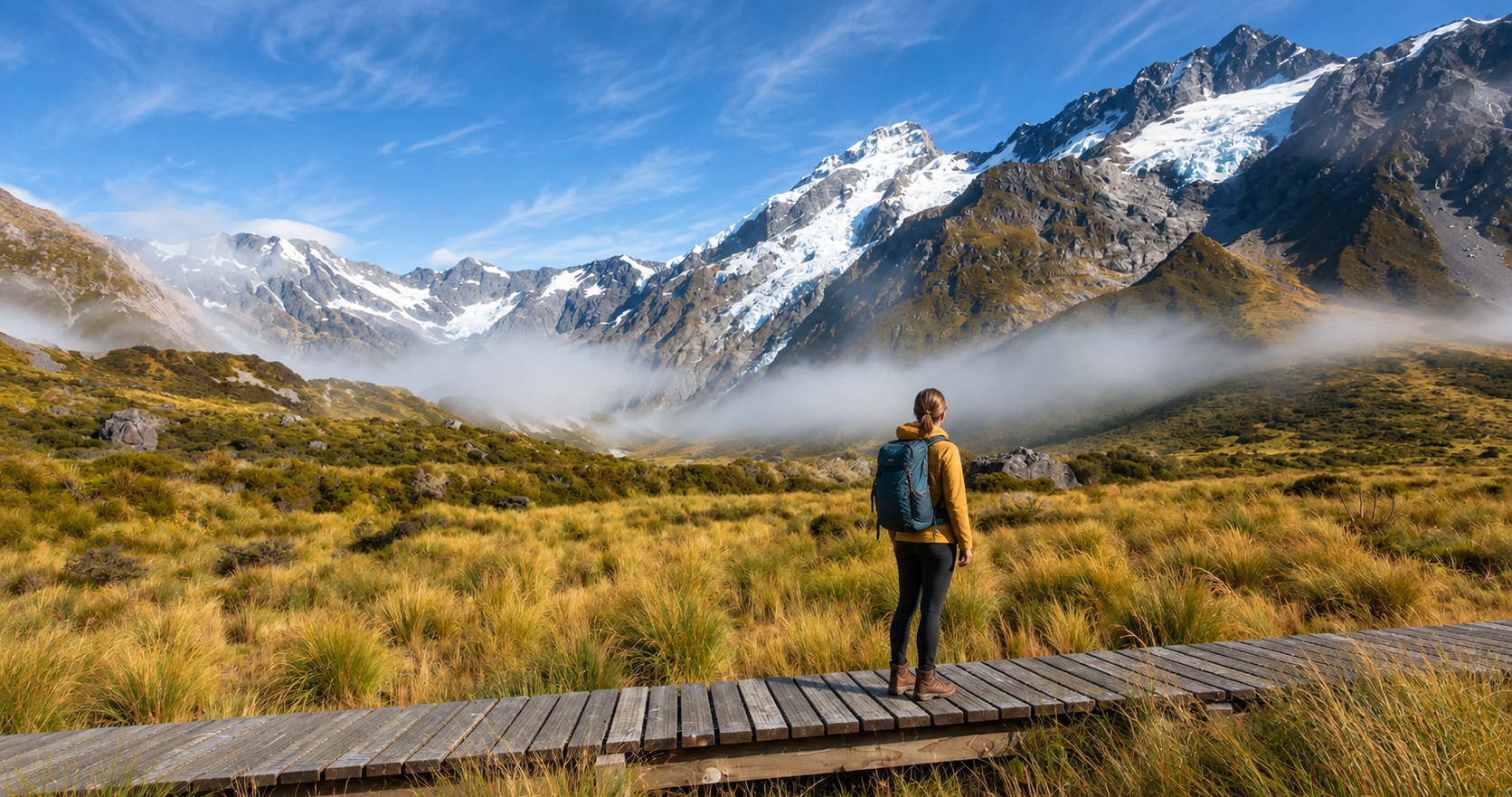
Best Time to Visit New Zealand: A Month-by-Month Guide
Best Time to Visit New Zealand: A Month-by-Month Guide
Choosing the best time to visit New Zealand sounds simple until you start planning properly.
Summer seems like the obvious answer. The days are long, beaches are at their best and almost every outdoor activity is running. Then you discover that January is also one of the busiest times of the year, accommodation can be expensive and New Zealanders themselves are travelling for the summer holidays.
Autumn brings fewer visitors, often settled weather and beautiful colour around places such as Arrowtown and Central Otago. Winter turns Queenstown, Wānaka and the Central Plateau into snow destinations. Spring brings green landscapes, snow still sitting on the mountains and fewer people on many popular routes.
The truth is that there is no single bad month to visit New Zealand. The country can be travelled year-round, but the experience changes enormously depending on when you come. Tourism New Zealand divides the seasons into summer from December to February, autumn from March to May, winter from June to August and spring from September to November. Its broad national averages put summer daytime temperatures around 20–25°C, autumn around 17–21°C, winter around 12–16°C and spring around 16–19°C, although those figures hide enormous regional differences.
That last point is important. New Zealand's weather is heavily influenced by mountains and the surrounding ocean. The far north can feel almost subtropical while alpine areas of the South Island experience severe mountain conditions at exactly the same time. The Southern Alps also create enormous rainfall differences between the wet West Coast and much drier regions only a relatively short distance away.
So rather than asking simply, “When is the weather best?”, I think it is more useful to ask:
What kind of New Zealand trip do you want?
If your dream involves beaches, hiking and long road-trip days, your ideal month will be very different from somebody coming to ski. If you want Queenstown adventures without the height of the summer crowds, the shoulder seasons may actually be better. If Fiordland is the priority, waiting for a completely dry season is probably going to be a very long wait.
This guide goes through every month of the year, with the advantages, drawbacks and the destinations I would prioritise in each one.
The New Zealand Seasons at a Glance
Before going month by month, this is the simplest way I would think about the year.
December to February is the classic summer road-trip season. It is best for beaches, hiking, kayaking, cycling, camping and long daylight hours, but it is also the busiest time.
March to May is autumn and probably my favourite overall period for travellers who want outdoor activities without peak summer crowds. Early autumn can still feel very warm, while April brings particularly attractive autumn colours to parts of the South Island.
June to August is winter. It is the obvious time for skiing and snowboarding around Queenstown, Wānaka and the Central Plateau, while geothermal areas and hot pools suddenly become even more appealing.
September to November is spring. The days become longer, higher mountains remain snow-covered and visitor numbers are often lower than in summer, but spring weather can also be unpredictable. Tourism New Zealand similarly describes the shoulder seasons as periods when travellers can often find better availability and rates.
If somebody asked me to choose one month without knowing anything about their itinerary, I would probably say March.
If they wanted summer conditions, I would look closely at February.
For autumn scenery, April.
For skiing, July or August.
And for a quieter spring road trip before summer properly begins, November is very difficult to overlook.
Here is why.
January – Peak New Zealand Summer
January is New Zealand at its most summery and its busiest.
If your idea of a New Zealand holiday involves beaches, lakes, hiking, kayaking and long evenings outside, January certainly delivers. The days are long, temperatures are generally at their warmest and almost everything in the visitor economy is operating at full pace.
Northland, the Bay of Islands, Coromandel and Abel Tasman are particularly appealing at this time of year. This is the month when having a beach as part of the itinerary feels completely natural rather than something you squeeze between mountain destinations.
The South Island is equally attractive. Queenstown and Wānaka are alive with hiking, mountain biking, rafting, skydiving and lake activities. Aoraki/Mount Cook has long daylight hours for exploring, while Fiordland's walking season is well underway.
The disadvantage is popularity.
January falls within the New Zealand summer holiday period, so you are not just competing with international visitors for accommodation and campsites. New Zealanders are travelling too. Tourism New Zealand describes December through February as the country's most popular visitor period, with local Christmas and summer holidays adding to demand.
That does not mean I would avoid January. It simply means I would plan differently.
This is not the month to arrive in Queenstown at 6pm and begin wondering where you might stay that night. Popular accommodation, campervans, rental cars and major activities deserve advance planning.
I would also try to stay longer in each destination. Traffic around popular holiday areas can be heavier, and moving accommodation every night becomes even more tiring when everywhere is busy.
Who I think January suits best
January is excellent for families tied to school holiday dates, beach-focused travellers, campers, hikers and anyone who wants the greatest amount of daylight for a road trip.
If you dislike crowds and are completely flexible about travel dates, I would probably wait a little longer.
My January picks: Bay of Islands, Coromandel, Abel Tasman, Wānaka, Queenstown and Fiordland.
February – One of the Best Summer Months
If you want a New Zealand summer holiday but have some flexibility, I would seriously consider February over January.
The weather is still firmly summer-like, the days remain long and the ocean and lakes have had plenty of time to warm. Yet once New Zealand schools and workplaces settle back into their normal rhythm, some destinations begin to feel slightly less frantic than they did over Christmas and January.
That makes February particularly attractive for road trips.
You can still comfortably build an itinerary around kayaking in Abel Tasman, hiking around Aoraki/Mount Cook, cruising Milford Sound, exploring Queenstown and Wānaka or spending time around Northland's beaches.
For adventure travellers, almost everything is on the table. Skydiving, bungy, rafting, jet boating, scenic flights and cruises operate extensively during summer, while the long evenings mean it is easier to combine an activity with something free later in the day.
February can still be busy, particularly in famous destinations, so I would not treat it as a secret low-season month. Popular accommodation and activities are worth booking.
But if somebody told me they wanted warm weather, long days and a classic first New Zealand road trip, February would be one of the first months I suggested.
There is another reason I like it: summer has had time to establish itself. January can occasionally feel like the country is still settling into peak season after Christmas. February often feels more relaxed.
Aotearoa Adventures Tip
If beaches and mountains are equally important to you, February is one of the easiest months for combining them in one itinerary.
You could spend time around Abel Tasman or Northland and still have excellent summer opportunities around Queenstown, Wānaka and Fiordland.
My February picks: Abel Tasman, Bay of Islands, Queenstown, Wānaka, Aoraki/Mount Cook and the West Coast.
March – My Pick for the Best All-Round Month
If I had to recommend one month for a first-time New Zealand road trip, March would probably win.
You still get many of the advantages of summer without quite the same intensity of peak season.
Early March can feel very summery. Beach days are still realistic in many regions, hiking conditions can be excellent and most seasonal adventure activities are operating normally. At the same time, crowds tend to begin thinning and accommodation can become easier to find.
Tourism New Zealand specifically describes autumn as an excellent period for travellers wanting sunshine with fewer crowds, with relatively warm conditions continuing early in the season.
That combination makes March particularly good for people trying to do a little bit of everything.
You can kayak Abel Tasman, road-trip through the South Island, hike around Wānaka, cruise Milford Sound and spend time on the beaches of the North Island without feeling as though you have chosen the wrong season for any of them.
The evenings are noticeably shorter than in January, but not enough that I think it damages a normal road-trip itinerary.
For adventure activities, March is excellent. Queenstown is still in full summer-adventure mode, rafting rivers remain active, scenic flights have plenty of daylight and the major hiking destinations are generally within their main warm-season period.
This is also when I think New Zealand begins feeling a little less like a country in summer-holiday mode and more like somewhere you can explore at your own pace.
If you are a couple travelling without children, a solo traveller or anyone with freedom over annual leave, March deserves very serious consideration.
My March picks: Queenstown, Wānaka, Fiordland, Abel Tasman, Taupō, Rotorua and Aoraki/Mount Cook.
April – Autumn Colours and Cooler Adventures
April changes the look of parts of New Zealand considerably.
The most obvious difference appears around Central Otago, Queenstown and Arrowtown, where deciduous trees bring gold, orange and red into landscapes that are otherwise dominated by mountains, lakes and dry hills.
Arrowtown in particular seems made for autumn.
The historic streets, surrounding hills and river trails suit the season perfectly, and I think April is one of the best times of year for combining Queenstown's adventure activities with a slower Central Otago road trip.
Temperatures become cooler, particularly in the South Island, but daytime conditions can still be very comfortable for walking and cycling. There is something quite pleasant about beginning a hike in cool autumn air rather than immediately becoming overheated twenty minutes after leaving the car park.
The main thing I would watch is daylight. The days shorten quickly through autumn, so ambitious road-trip plans need a little more thought than they did in January.
Easter can also create a short burst of domestic travel demand when it falls in April, so accommodation around that period is worth checking early.
For hikers, April can be excellent, but it also sits close to the transition into winter conditions on higher tracks. DOC notes that many of the southern alpine Great Walks have their main Great Walk season through the warmer months and become substantially more demanding outside it. Current guidance for tracks such as the Routeburn specifically warns that winter conditions require alpine skills, experience and equipment.
That is an important distinction. An easy autumn walk around a lake is not the same thing as heading high into the mountains late in the season.
Who I think April suits best
April is excellent for couples, photographers, hikers who prefer cooler temperatures and travellers who care more about atmosphere than swimming.
If your dream is spending every afternoon at the beach, I would come earlier.
If autumn colours around Queenstown and Central Otago appeal to you, this could be your month.
My April picks: Arrowtown, Queenstown, Wānaka, Central Otago, Christchurch and Aoraki/Mount Cook.
May – Quiet, Cool and Often Overlooked
May is one of the more overlooked months in the New Zealand travel calendar.
Summer has clearly finished, autumn is moving towards winter and ski season has not properly begun. That means many travellers skip straight past May when comparing dates.
That can actually make it appealing.
Visitor numbers are generally lower than during the summer peak, accommodation can be easier to find and major destinations have a quieter feel.
The landscape can still be beautiful, particularly early in the month when autumn colour remains in parts of the South Island.
Temperatures are cooler and daylight is shorter, so this is not a month where I would design an itinerary around enormous late-afternoon adventures. Instead, I would slow the trip down.
Queenstown and Wānaka are enjoyable without needing to ski. Rotorua's geothermal landscapes and hot pools make even more sense in cooler weather. Taupō can be crisp and clear, and the lower visitor numbers can make normally busy attractions feel much more relaxed.
May is also where I would become increasingly cautious about high alpine hiking. Snow and ice can begin changing mountain tracks very quickly, and some routes that are ordinary summer tramps become serious winter outings.
DOC's advice is very clear that colder-season travel on several alpine Great Walks involves additional hazards including snow, ice and avalanche terrain.
That does not mean outdoor adventure ends.
It means choosing the right adventure for the conditions.
Scenic cruises, jet boats, geothermal attractions, lower-level walks, cycling and many commercial activities remain excellent choices.
Would I visit in May?
Yes, especially if crowds bother you.
I probably would not recommend it as the first choice for somebody dreaming of a classic beach-and-hiking summer holiday.
But for a quieter road trip with cooler weather and lower demand, May can be surprisingly enjoyable.
My May picks: Rotorua, Taupō, Queenstown, Wānaka, Christchurch and the West Coast.
June – The Beginning of Winter
June marks the official beginning of winter, and the atmosphere changes quickly in the South Island and central North Island.
Snow begins becoming a significant part of the mountain landscape, winter tourism starts gathering momentum and Queenstown and Wānaka begin shifting towards ski season.
The days are much shorter than in summer, which changes how I would plan a road trip. In January, you can arrive somewhere late and still have hours of daylight. In June, driving until dinner may mean arriving well after dark.
That is not necessarily bad.
It simply encourages a slower itinerary.
Queenstown in June can be beautiful. Snow begins settling on the surrounding peaks, cafés and restaurants feel inviting and hot pools become much more appealing than they did in midsummer.
Rotorua works extremely well at this time of year too. Geothermal steam is particularly atmospheric on cold mornings and soaking in hot water feels considerably more purposeful when the air temperature has dropped.
This is also when I would start paying much more attention to road conditions. Inland and alpine parts of the South Island can experience frost, ice and snow. NIWA notes that snow is concentrated particularly in New Zealand's mountain areas and that frosts can occur throughout the country under suitable conditions.
If you are renting a vehicle, understand what winter driving may involve before heading across mountain routes.
June is also a transitional skiing month. Some ski areas may begin operating during June when snow and conditions allow, but if skiing is the entire reason for your holiday, I would personally look more towards July or August rather than relying on early-season conditions.
My approach to June
Come for winter atmosphere rather than demanding perfect deep-snow conditions from day one.
It can be a fantastic time for Queenstown, Wānaka, Rotorua and scenic South Island travel.
My June picks: Queenstown, Wānaka, Rotorua, Taupō and Aoraki/Mount Cook.
July – The Heart of Winter
July is the month I would choose if snow is central to the trip.
Queenstown and Wānaka are fully focused on winter, while the Central Plateau around Ruapehu offers the North Island's best-known alpine environment.
Tourism New Zealand identifies July and August as the strongest months for visitors who specifically want skiing and snowboarding.
Queenstown becomes particularly lively. Skiers and snowboarders fill the town, snow sits across the surrounding mountains and the entire region has a completely different energy from summer.
Wānaka offers the same seasonal appeal with a slightly more relaxed base, and the drive between the two can be spectacular when conditions are good.
July is also typically New Zealand's coldest month overall, according to NIWA's national climate overview.
That does not mean the entire country turns into Antarctica.
Auckland and Northland remain much milder than inland Otago, and snow at sea level is unusual in much of New Zealand. The difference between regions is enormous.
This is why packing for a July trip depends heavily on the route.
Auckland winter and a morning near Aoraki/Mount Cook are not the same thing.
July also contains New Zealand school holidays, which can increase demand around family ski destinations. If Queenstown accommodation, ski lessons or certain activities matter to you, I would not leave everything until the final moment.
What about non-skiers?
I would still consider July.
You can enjoy snow-covered landscapes, scenic flights, hot pools, wineries, geothermal areas, cruises and lower-level walks without putting skis on once.
Queenstown in winter is an experience even if you never go near a chairlift.
My July picks: Queenstown, Wānaka, Central Plateau, Rotorua and Aoraki/Mount Cook.
August – Snow, Mountains and Longer Winter Days
August remains firmly winter, but the increasing daylight makes it an appealing month for travellers who want snow scenery without visiting during the darkest part of the season.
For skiing and snowboarding, this remains one of the main months I would target.
Queenstown and Wānaka are obvious bases, and the surrounding mountains usually have a much more established winter appearance than they did early in June.
For photographers, August can be excellent because the South Island landscapes have strong contrast. Snow-covered peaks sit above darker valleys and bright blue lakes, particularly around Queenstown, Wānaka and the Mackenzie Country.
Scenic flights can also be spectacular when the weather cooperates. Flying around Aoraki/Mount Cook, Wānaka or Queenstown with extensive winter snow is very different from seeing the same mountains in midsummer.
You still need winter road awareness, particularly early in the morning when frost and ice are possible.
And I would continue to treat high alpine hiking as a specialist activity rather than simply a colder version of summer walking.
If you do not ski, August can still make an excellent South Island road trip for somebody who prefers scenery, photography, food and shorter outdoor activities.
The biggest compromise remains daylight and temperature.
You will not have the endless summer evenings of January.
But you get mountains that look exactly the way many international visitors imagine New Zealand mountains should look.
My August picks: Queenstown, Wānaka, Aoraki/Mount Cook, Mackenzie Country and Rotorua.
September – Spring Arrives, but Winter Has Not Completely Left
September is one of New Zealand's most interesting transition months.
Spring officially begins, but the mountains have not received the message that winter is finished.
Snow remains on alpine ranges, ski seasons may still be running and lower valleys begin becoming noticeably greener.
That combination can look fantastic.
You can have snow-covered mountains behind fresh spring vegetation, particularly through parts of the South Island.
The days are getting longer as well, which makes road trips increasingly practical.
The trade-off is unsettled weather.
Spring has a reputation for variability, and Tourism New Zealand specifically notes the increased likelihood of rainfall and changeable conditions during the season.
I would not let that stop me travelling.
I would simply pack properly.
September is particularly good for somebody who likes the idea of a quieter road trip and does not need every day to look like a summer postcard.
Rotorua and Taupō work well. Queenstown and Wānaka retain their mountain snow while moving gradually out of peak ski season. Christchurch and Canterbury can be attractive as spring begins changing gardens and rural landscapes.
For hiking, caution is still important in alpine areas. DOC notes that snow, ice, high rivers and avalanche conditions can continue through spring on some mountain routes.
This is not the month to see a sunny Instagram photograph of an alpine trail and assume conditions will be identical when you arrive.
Who should choose September?
Travellers who like fewer crowds, spring landscapes and the possibility of combining late snow with a broader road trip.
If completely predictable outdoor conditions are important, I would move later into spring.
My September picks: Queenstown, Wānaka, Rotorua, Taupō, Christchurch and Hawke's Bay.
October – Longer Days and a Country Waking Up
October is when New Zealand starts feeling much more obviously like it is moving towards summer.
The evenings stretch out, temperatures gradually rise and outdoor travel becomes easier.
It is still very much spring, though.
One day can be warm and calm.
The next can remind you that Antarctica is not actually that far away.
That unpredictability is part of October travel.
For me, this is a good month for travellers who value space and scenery more than guaranteed warmth.
The major destinations are active without yet feeling like peak summer. Road trips become easier with longer daylight hours, and spring landscapes are green throughout much of the country.
The South Island mountains can still hold plenty of snow, creating excellent scenery around Queenstown, Wānaka and Aoraki/Mount Cook.
October is also around the period when some of New Zealand's seasonal multi-day hiking infrastructure begins transitioning towards its main summer operations, although the exact Great Walk season differs by track and year. DOC advises checking the current track page and conditions rather than assuming every alpine Great Walk is in normal summer mode at the same time.
That is advice I would apply to every outdoor activity in spring.
Do not plan from historical weather averages alone.
Check what is actually happening.
Aotearoa Adventures Tip
October is a good month for keeping the itinerary flexible rather than empty.
Book accommodation and the activities that matter, but have a second option ready when a mountain day does not cooperate.
My October picks: Rotorua, Taupō, Queenstown, Wānaka, Kaikōura and Nelson Tasman.
November – One of My Favourite Shoulder-Season Months
November might be the month I would choose for somebody who wants a summer-style New Zealand trip but would rather arrive before the main summer rush.
The days have become long.
Temperatures are warmer.
Most outdoor tourism is operating strongly.
Yet the major Christmas and January holiday period has not begun.
That is a very useful combination.
You can hike, cycle, kayak, raft, jet boat and cruise while enjoying considerably more daylight than earlier in spring.
In the South Island, snow often remains on the higher mountains, meaning places such as Queenstown, Wānaka and Aoraki/Mount Cook can look spectacular even while the valleys are warming.
Abel Tasman begins making much more sense as a beach-and-kayaking destination too.
November weather can still be changeable, and I would never promise someone three weeks of uninterrupted sunshine.
But that is New Zealand.
Even January cannot make that promise.
What November gives you is opportunity.
You have long enough days to make road trips enjoyable and fewer peak-season pressures than you are likely to encounter a month or two later.
For active travellers, this is one of my favourite months.
November or March?
This is a difficult comparison.
I would choose March if I wanted warmer water, the settled feeling of late summer and early autumn.
I would choose November if I wanted spring landscapes, snow still prominent on the mountains and the feeling that summer is arriving rather than leaving.
Both are excellent.
My November picks: Abel Tasman, Queenstown, Wānaka, Aoraki/Mount Cook, Fiordland, Rotorua and Kaikōura.
December – Summer Begins and New Zealand Comes Alive
December begins quite differently from how it ends.
Early December can be an excellent time to travel. Summer has officially arrived, the days are extremely long and the huge Christmas/New Year travel period is still ahead.
Then the second half of the month becomes considerably busier.
Schools finish.
New Zealanders begin their summer holidays. International visitors arrive. Beach towns, campsites and major visitor destinations fill up. That means your experience of December depends enormously on your dates.
If somebody offered me the first two weeks of December, I would be very interested.
You get summer daylight and widespread outdoor activity without necessarily experiencing the full January crowd level.
If somebody offered me the Christmas-to-New-Year period, I would still happily travel, but I would book accommodation and transport much more carefully.
Christmas in New Zealand also feels different for visitors from the Northern Hemisphere.
There is no dark winter evening and snow-covered town unless you have somehow misunderstood the season.
Christmas can mean beaches, barbecues and staying outside until late in the evening.
For a road trip, December is fantastic.
Just remember that the roads become busier as the holiday period begins.
Where would I go in December?
Almost anywhere.
That is the strength of it.
Northland and the Coromandel are beginning their proper beach season. Abel Tasman is excellent. Queenstown and Wānaka offer enormous amounts of adventure, and Fiordland's hiking and cruising season is well underway.
My December picks: Bay of Islands, Coromandel, Abel Tasman, Queenstown, Wānaka and Fiordland.
So, What Is the Best Month to Visit New Zealand?
For the broadest range of travellers, my answer is:
March
It gives you much of the warmth and outdoor opportunity of summer while usually avoiding the intensity of the Christmas and January peak.
You can still build a trip around beaches, mountains, hiking and adventure activities.
That makes it incredibly versatile.
But I would not call March objectively better than every other month.
If you want the warmest summer experience, choose January or February.
For autumn colour, choose April.
For skiing and winter scenery, choose July or August.
For spring scenery and fewer crowds, look at October or November.
For a quiet, cool trip, May can be excellent.
The best month depends on what you want to do once you arrive.
The Best Time to Visit the North Island
The North Island can be explored year-round, but I particularly like February through April and October through November.
Those periods give you a good balance for places such as Rotorua, Taupō, Tongariro, Auckland and Northland.
Summer is naturally excellent for the Bay of Islands and other beach destinations, while autumn can be brilliant for road trips through the central North Island.
Winter should not be dismissed either.
Rotorua's geothermal attractions and hot pools work beautifully in cold weather, while Taupō can have crisp winter days with snow visible towards the Central Plateau.
Tongariro is where the seasonal distinction becomes much more serious. Summer-style hiking and winter mountaineering are not interchangeable activities. Snow and ice dramatically alter the required skills and equipment, and DOC warns that winter travel around the Tongariro alpine environment involves additional alpine hazards.
The Best Time to Visit the South Island
If you want a classic South Island road trip with hiking, lakes and outdoor activities, I would choose somewhere between November and April.
February and March would probably be my favourites.
The days are long, mountain areas are more accessible and the range of activities is enormous.
For autumn landscapes around Queenstown, Arrowtown and Central Otago, April is particularly attractive.
If skiing is the priority, choose July or August.
The South Island is also where regional climate differences become particularly dramatic. NIWA notes that the mountain ranges create a major rainfall divide, with the West Coast among the country's wettest areas while places immediately east of the ranges can be much drier.
That means an app saying “South Island weather” tells you very little.
Franz Josef, Queenstown and Christchurch can all experience completely different conditions on the same day.
When Is the Best Time for a New Zealand Road Trip?
For a general road trip, I would choose February, March, November or early December.
You have good daylight hours and excellent access to outdoor activities without necessarily hitting the absolute height of summer demand.
March would be my first choice if I wanted the easiest balance.
November would be my first choice if I wanted a little less pressure around bookings and liked the idea of spring scenery.
Winter road trips can still be fantastic, but the planning changes. You need to think more about daylight, road conditions, frost and snow.
I would also deliberately reduce daily driving distances in winter.
If a journey goes wrong or weather slows you down, having spare time suddenly becomes far more valuable.
When Is the Best Time for Hiking?
For most ordinary visitors wanting to tackle New Zealand's popular alpine day hikes and multi-day tracks, the warmer months are the easiest period to work with.
I would generally look at November through April, while still checking the individual track and current conditions.
That does not mean every walk is safe every day during those months.
New Zealand's mountains can receive cold weather, heavy rain and strong winds even in summer.
Some of the major Great Walks also have defined Great Walk seasons when huts, services and track management differ from winter operations. For the 2026/27 season, for example, the Routeburn's official Great Walk season runs from 1 November to 30 April, while DOC warns that the colder period requires alpine skills, equipment and experience.
Popular multi-day tracks also need early planning. DOC reported that many Great Walk huts were at or close to capacity during peak periods and staggered the 2026/27 booking openings because demand is so high.
For casual walkers, though, do not feel that missing a Great Walk booking ruins the trip.
New Zealand has an enormous number of excellent day hikes where no hut reservation is required.
When Is the Best Time for Skiing and Snowboarding?
If skiing or snowboarding is the reason for the trip, I would aim for July or August.
June can work as the season begins and September can still offer skiing at some fields, but the middle of winter gives you the best chance of building a trip genuinely centred around snow.
Queenstown and Wānaka are the obvious South Island bases.
Both give you access to ski areas while still offering restaurants, adventure activities and plenty to do on a non-ski day.
The Central Plateau provides the North Island alternative.
If you have never visited Queenstown in winter, it is worth remembering that the town does not shut down once summer hiking season ends.
Quite the opposite.
Winter is one of its major personalities.
When Is the Best Time for Beaches?
For swimming, kayaking and coastal travel, I would focus on January through March, particularly around Northland, the Bay of Islands, Coromandel, Nelson Tasman and Abel Tasman.
February would probably be my favourite.
The summer weather is established and the water has had time to warm.
March can remain surprisingly good as well, particularly in the upper North Island.
If beaches are only one part of a wider New Zealand trip, you have considerably more flexibility.
Abel Tasman can still be beautiful outside midsummer, and coastal walks do not suddenly become pointless because swimming is no longer the main attraction.
When Is the Best Time for Adventure Activities?
For the six major adventure activities we focus on heavily at Aotearoa Adventures — skydiving, bungy jumping, white-water rafting, jet boating, scenic cruises and scenic flights — there is no single season when everything stops or starts.
Many operate throughout the year.
The difference is the experience around them.
Skydiving above Queenstown in winter gives you snow-covered mountains.
Summer gives you long daylight and easier road-trip conditions.
Rotorua rafting operates in a completely different environment from alpine South Island adventures and can be excellent across the year.
Scenic cruises such as Milford Sound can actually become particularly atmospheric in poor weather because rain produces waterfalls across the cliffs.
For scenic flights, the bigger issue is usually the weather on the day rather than the month itself.
That is why I recommend booking weather-sensitive experiences early in your stay.
Give yourself another chance if the first departure cannot operate.
When Is New Zealand Cheapest to Visit?
The quietest periods can offer better value, but I would be careful about chasing the absolute cheapest month without considering what you lose.
Tourism New Zealand points out that shoulder-season travel can bring better accommodation and activity availability and sometimes better rates.
For a general traveller, I would therefore look at periods such as May, September, October and parts of November.
March and April can also give you a better balance than the summer peak.
The most expensive periods tend to coincide with high demand, particularly Christmas, New Year, January and major holiday periods in popular destinations.
Ski areas have their own winter demand patterns.
The bigger lesson is that cheap does not automatically mean good value.
Saving money on accommodation is less useful if you have chosen a month when the activity that motivated the trip is unavailable.
I would first choose a suitable season.
Then look for value within it.
When Should You Visit Milford Sound?
Whenever your New Zealand trip takes you there.
I would not try to find a mythical dry month.
Fiordland is wet because that rainfall is part of what created the landscape you are travelling to see.
A blue-sky Milford day is spectacular.
A rainy Milford day can create waterfalls across almost every cliff.
The experience changes rather than simply becoming worse.
Summer provides long days and easier road-trip conditions, while winter can bring snow to the surrounding mountains.
The more important issue is the Milford Road, so always check current road conditions before travelling, particularly in colder months.
When Should You Visit Queenstown?
There are really two Queenstowns.
Summer Queenstown is about hiking, mountain biking, bungy jumping, jet boating, lake activities and long evenings.
Winter Queenstown is about skiing, snow-covered mountains, warm restaurants, après-ski atmosphere and alpine scenery.
I like both.
For a first adventure trip where skiing is not the priority, I would choose February, March or November.
For an autumn trip, April is excellent when you combine Queenstown with Arrowtown and Central Otago.
For skiing, July and August are the obvious choices.
There is very little point asking when Queenstown is best without first deciding which Queenstown you want.
When Should You Visit Wānaka?
Wānaka follows a similar pattern to Queenstown but feels slightly calmer.
Summer is fantastic for hiking, biking and lake activities.
Autumn changes the surrounding region beautifully.
Winter brings skiing and snow-covered peaks.
Spring offers excellent mountain scenery while the town gradually transitions back towards summer.
If hiking was my priority, I would choose February or March.
For a mixed road trip involving outdoor adventure and sightseeing, November or March.
For skiing, July or August.
When Should You Visit Aoraki/Mount Cook?
For most first-time visitors, I would choose the warmer months between roughly November and April.
That gives you the easiest access to the normal range of valley walks and outdoor experiences, although mountain weather can change at any time.
Winter is spectacular visually, and scenic flights over heavily snow-covered mountains can be extraordinary.
But do not assume summer hiking information applies to winter conditions.
Snow and ice can fundamentally change an alpine route.
If scenic photography rather than long hiking is the priority, I would happily visit Aoraki/Mount Cook in almost any season.
What Month Would I Personally Choose?
If I were planning a three-week New Zealand road trip for myself and could choose any month, I would probably begin in early March.
I would get the warmth and outdoor accessibility of late summer while gradually moving into quieter autumn conditions.
The North Island could still include coastal time.
Abel Tasman would still make sense.
Queenstown and Wānaka would be in full adventure mode.
Fiordland would have long enough daylight for road-trip days.
And the major hiking areas would still be within their normal warm-season window.
My second choice would probably be November.
The mountains still look fantastic with spring snow, the days are becoming very long and you arrive before the biggest summer holiday rush.
But those are my choices because I enjoy road trips, hiking and adventure activities.
Someone planning a skiing holiday should completely ignore them and come in winter.
That is why the “best time” question needs context.
The Months I Would Choose for Different Travellers
If you want a classic first-time New Zealand road trip, I would aim for February or March.
If you want summer beaches, choose January or February.
If you want fewer crowds without giving up too much warmth, choose March.
If you want autumn photography, choose April.
If you want a quiet and potentially better-value trip, consider May or October.
If you want skiing, choose July or August.
If you want spring landscapes and summer-style activities without peak summer crowds, choose November.
And if school or work commitments mean you can only come at another time?
Come anyway.
New Zealand is far too varied to become a bad destination simply because you chose the “wrong” month.
What Should You Pack for Each Season?
The answer is more similar than you might expect.
Bring layers.
Even in summer, I would carry a light warm layer and waterproof jacket if I were travelling through mountainous areas.
New Zealand's climate can change quickly, and NIWA notes that altitude has a significant effect on temperature — roughly 0.7°C lower for every 100 metres of elevation on average.
That is why the weather beside Lake Wānaka tells you surprisingly little about what you may experience higher in the mountains.
In winter you will obviously need genuinely warm clothing, particularly around the South Island and Central Plateau.
In summer, sun protection becomes especially important. NIWA notes that New Zealand's summer UV levels are often very high and can become extreme in northern and mountainous areas.
Do not let a cool breeze convince you that sunscreen is unnecessary.
New Zealand sunlight can be considerably more enthusiastic than the temperature suggests.
Do You Need to Worry About Rain?
You need to prepare for it.
You do not need to fear it.
New Zealand receives rainfall throughout the year, and the country's mountain geography means there are huge regional differences. The West Coast of the South Island is particularly wet, while locations east of the Southern Alps can be dramatically drier.
That is why I would not choose a whole New Zealand holiday based on which month has a slightly lower national rainfall average.
There is no useful national weather button.
Your actual experience depends on where you are.
Fiordland rain can improve the waterfalls.
Rain around Rotorua may simply mean changing the order of your geothermal and hot-pool day.
Heavy alpine rain can make a hike a terrible idea.
The important skill is adapting rather than expecting everything to remain dry.
Should You Avoid Peak Season?
Not necessarily.
Peak season is popular because it is good.
There is nothing wrong with visiting New Zealand in January.
The beaches are beautiful, the days are long and the entire country feels active.
You simply need to accept that other people also had the same idea.
Book important accommodation.
Reserve activities you would genuinely hate to miss.
Expect popular destinations to be busy.
If crowds bother you enough that they would affect the holiday, shift the trip to February, March or November instead.
I would not sacrifice the season you actually want purely so you can proudly say you travelled “off peak”.
When Should You Book Your New Zealand Trip?
For summer travel, I would organise the important parts well ahead, particularly if the trip includes Queenstown, Aoraki/Mount Cook, Fiordland, popular holiday parks or limited-capacity activities.
Great Walks need even more attention.
DOC's 2026/27 bookings opened on staggered dates in May, and the department warns that the most popular tracks can fill quickly during high-demand periods.
You do not need to book every ordinary day walk or tourist attraction months ahead.
Focus on the things that would materially change the itinerary if you missed them.
That might be:
a Great Walk,
your campervan,
key accommodation,
Milford or Doubtful Sound,
or the one adventure activity you have been talking about since you booked the flights.
Then let some of the smaller decisions happen once you arrive.
Final Thoughts: When Is the Best Time to Visit New Zealand?
The best time to visit New Zealand is not necessarily the month with the highest average temperature or the lowest chance of rain. It is the month that gives you the best chance of having the trip you actually want.
If your ideal New Zealand holiday involves long evenings, beaches, kayaking and summer hiking, come between December and February and accept that you will be sharing the country with plenty of other travellers.
If you want the same outdoor focus with a little less pressure, I think March is extremely difficult to beat. The days are still useful, temperatures remain pleasant and the summer crowds have begun to ease. For me, it offers the best overall balance for a first-time road trip.
April is the month I would choose for autumn colour and a slower South Island journey, particularly around Queenstown, Arrowtown and Central Otago. May is quieter again and suits travellers who value space more than warmth.
If skiing, snowboarding and snow-covered mountains are the reason you are coming, embrace winter rather than treating it as something to avoid. July and August give Queenstown and Wānaka an entirely different personality and can produce some of the most beautiful alpine scenery of the year.
Spring is perhaps the most underrated option. September remains transitional, October brings longer days and November is one of my favourite periods for people who want an active road trip before peak summer properly arrives.
Whatever month you choose, I would avoid building the holiday around the expectation of perfect weather.
New Zealand does not work like that.
Cloud may cancel the scenic flight you had planned.
Rain may arrive in Milford Sound and turn the cliffs into walls of waterfalls.
A cold front may change tomorrow's hike.
Then the following morning can be completely different.
That variability is part of travelling through a country where ocean, mountains and weather are so closely connected.
Choose your season carefully, but once you arrive, give the trip some flexibility.
Spend longer in the places that matter.
Have another option ready when the mountains disappear behind cloud.
And do not let a little rain convince you that the day is wasted.
Some of New Zealand's most memorable landscapes are at their best when the weather becomes interesting.
Ready to Plan Your New Zealand Trip?
Once you have chosen when you want to visit, the next step is working out what sort of trip fits that season.
NEW ZEALAND TRAVEL GUIDE FOR FIRST-TIME VISITORS
NORTH ISLAND VS SOUTH ISLAND – WHICH SHOULD YOU VISIT?
PLANNING AN ADVENTURE HOLIDAY IN NEW ZEALAND