

Driving in New Zealand: What Visitors Need to Know
Driving in New Zealand: What Visitors Need to Know
Driving is one of the best ways to experience New Zealand, particularly if you want to travel beyond the main cities and see the landscapes the country is famous for. A rental car gives you the freedom to stop beside a lake because the light suddenly looks incredible, take a short walk that was never part of the original plan or spend longer in a small town simply because you like it there.
For many first-time visitors, that freedom becomes one of the best parts of the holiday.
But driving in New Zealand can also be quite different from driving elsewhere. The country may look small on a map, yet roads often wind around mountains, lakes and coastlines rather than travelling directly between destinations. Outside the major cities, many highways have only one lane in each direction. You will also encounter one-lane bridges, steep hills, narrow sections of road, changing weather and occasional gravel roads.
NZ Transport Agency specifically warns overseas visitors that travel times can be longer than expected because many New Zealand roads are narrow, winding and sometimes steep.
None of this should put you off hiring a car. For most visitors who are confident drivers, I still think self-driving is the best way to explore New Zealand. You simply need to understand a few differences before setting off.
This guide covers the important things you need to know, from driving on the left and using an overseas licence to speed limits, one-lane bridges, winter roads, parking, fuel and planning realistic driving days.
Is Driving the Best Way to Explore New Zealand?
For most first-time visitors, I would say yes.
Public transport works well in some cities, and organised tours can reach many famous attractions, but New Zealand becomes much easier to explore once you have your own vehicle.
The biggest advantage is flexibility.
A road trip between Queenstown and Wānaka is not simply about getting from one town to another. You may stop at viewpoints over the Crown Range, take a detour through Cardrona or decide to spend longer somewhere because the weather has suddenly cleared.
The same applies almost everywhere.
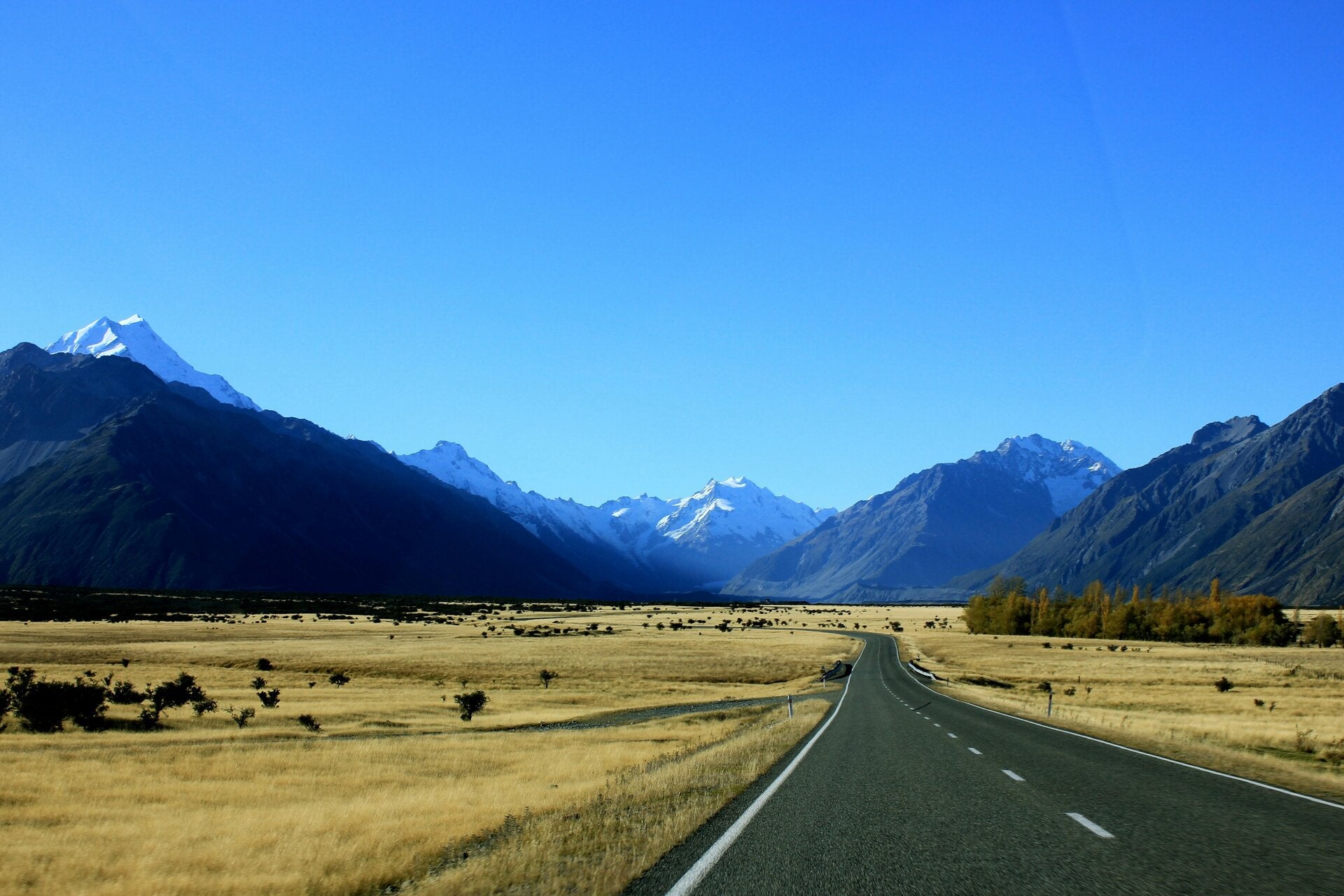
Driving towards Aoraki/Mount Cook beside Lake Pūkaki is part of visiting Mount Cook. The road from Te Anau to Milford Sound is one of the most scenic journeys in Fiordland. The West Coast is full of waterfalls, beaches, bush walks and viewpoints that are far easier to reach when you can stop whenever you like.
That is why I would think of the car as more than transport.
It is what allows the spaces between your major destinations to become part of the holiday.
New Zealand Drives on the Left
The first thing international visitors need to remember is that New Zealand drives on the left-hand side of the road.
If you are visiting from Australia or the United Kingdom, this will already feel normal. If you come from North America, much of Europe or another country where vehicles drive on the right, it can take a little time for your instincts to adjust.
The most important moments are often not when you are driving along a busy highway. They are when you pull out of a petrol station, leave a quiet car park or turn onto an empty rural road.
When there are other vehicles around, it is obvious which side everyone is using.
When the road is completely empty, old habits can return.
I would make a deliberate effort during the first few days to remind yourself to keep left, particularly every time you begin driving again after a stop.
Roundabouts can also feel unfamiliar at first because traffic travels clockwise around them. Give yourself extra time rather than following the vehicle in front and hoping everything makes sense.
After a day or two, most confident drivers settle into it surprisingly quickly.
Can Visitors Drive in New Zealand With an Overseas Licence?
In most cases, yes.
To drive in New Zealand without obtaining a New Zealand licence, you need a current and valid overseas driver licence or permit and you must meet the relevant NZTA conditions. If your licence is not in English, you also need an accurate English translation or appropriate International Driving Permit, and you must carry your overseas licence with you while driving.
There is also a change visitors should be aware of.
At the time of writing in September 2026, overseas car licence holders can currently drive for up to 18 months from their last date of entry. From 1 November 2026, that period reduces to 12 months. Motorcycle and truck licences have different conditions, so anyone staying long-term should check the current NZTA requirements directly.
For an ordinary two- or three-week holiday, the time limit is unlikely to matter.
What does matter is arriving with the correct documents.
Do not assume a photograph of your licence on your phone will be enough.
Bring the licence you are legally required to carry and check the requirements before leaving home, particularly if the licence is not written in English.
New Zealand Roads Can Take Longer Than You Expect
This might be the most important piece of advice in the entire article.
Do not plan New Zealand driving days using distance alone.
A road that is 200 kilometres long does not necessarily mean two hours of driving.
Many roads outside the major urban areas are two-lane highways that follow the landscape rather than cutting straight through it. They twist around lakes, climb hills and mountain passes, cross rivers and travel through small towns.
Some sections are narrow.
Some are steep.
Some are unsealed.
NZTA specifically advises visitors that distances can look short on a map while the actual journey takes much longer because of the road conditions.
Then there are the stops.
And you will stop.
There will be a lake that looks much better in person than it did on Google Maps.
There will be a waterfall sign.
There will be a lookout.
There will probably be a bakery.
The journey that a navigation app calls three hours can easily take four once you actually travel like somebody on holiday rather than somebody trying to set a delivery record.
I would build that time into the itinerary from the beginning.
Do Not Plan Too Much Driving in One Day
One of the most common mistakes I see in New Zealand itineraries is having a major drive almost every day.
It can look efficient while planning from home.
Auckland to Rotorua.
Rotorua to Taupō.
Taupō to Wellington.
Wellington to somewhere else.
Then another hotel.
Then another suitcase.
By the middle of the trip, the holiday starts feeling like a logistics exercise.
I would alternate larger travel days with days where the car barely moves.
Drive somewhere.
Stay two or three nights.
Explore.
Then move again.
For example, if you travel from Queenstown to Te Anau, spend the night there rather than immediately continuing to Milford Sound and returning to Queenstown in one enormous day unless you have a good reason.
The slower approach also gives you room for weather.
If tomorrow's hike gets cancelled, you have another opportunity rather than discovering that you absolutely must drive five hours somewhere else because the accommodation has already been booked.
Speed Limits in New Zealand
Speed limits are shown clearly on road signs, and you should always follow the posted limit rather than assuming what the limit should be.
On some open roads the maximum speed for a light vehicle is 100 km/h, but many roads have lower limits. Towns, built-up areas, temporary roadworks and high-risk sections may have limits such as 30, 50, 60, 70 or 80 km/h depending on the road. NZTA emphasises that the posted speed limit is the maximum legal speed under good conditions, not a target you are expected to maintain regardless of weather or road conditions.
That distinction matters enormously in New Zealand.
A mountain road may technically have a relatively high posted limit, but that does not mean it is safe to approach every bend at that speed.
If it is raining, icy, windy, foggy or simply unfamiliar, slow down.
You should feel completely comfortable driving below the speed limit when conditions require it.
The important part is also being considerate of the traffic behind you.
If You Are Driving Slowly, Let People Pass
This is something international road-trippers should understand early.
Local drivers may know a road very well.
You may be seeing it for the first time.
There is absolutely nothing wrong with driving more slowly because you are unfamiliar with the bends.
The problem comes when ten vehicles are stuck behind you for twenty kilometres.
NZTA says that drivers travelling below the speed limit with vehicles following should keep as close to the left as practical and pull over when it is safe to allow following traffic to pass.
New Zealand has passing lanes and slow-vehicle bays on many roads, and they are worth using.
Do not feel pressured to suddenly drive faster simply because someone has appeared behind you.
Keep driving safely.
Then use the next appropriate place to let them through.
There is also one behaviour I would avoid completely: driving slowly through the bends and then accelerating hard when you reach the one straight section where the vehicle behind finally has an opportunity to pass.
Let them go.
Everybody's day becomes easier.
Roundabouts in New Zealand
Roundabouts are extremely common in New Zealand, so overseas visitors should understand how they work before collecting a rental car.
You travel around a roundabout to the left, which means traffic flows clockwise.
When entering, you generally give way to vehicles that will cross your path from your right. At a single-lane roundabout, slow down, be prepared to stop and give way to traffic approaching from the right that you would otherwise cross in front of.
Signalling also matters.
If you are taking the first exit to the left, signal left as you approach. If you are travelling more than halfway around the roundabout, signal right on approach and then signal left before leaving. If you are travelling straight through, you normally do not signal when approaching but should signal left as you pass the exit immediately before your own.
It can sound complicated when written down.
After you have driven through a few, it becomes much more natural.
The main thing is not arriving at your first large multi-lane roundabout straight from an international flight with no idea what any of the arrows mean.
Give Way Rules Are Worth Understanding Before You Arrive
Most road rules will feel familiar to experienced international drivers, but it is worth reading through the basic New Zealand give-way rules before your trip.
At intersections, vehicles turning generally give way to traffic continuing straight. A vehicle turning right gives way to an oncoming vehicle turning left, and at uncontrolled situations where no other give-way rule applies, traffic gives way to the right.
You do not need to memorise an entire road-code textbook before taking a holiday.
But spending a little time familiarising yourself with New Zealand signs, intersections and roundabouts will make those first few driving days considerably less stressful.
NZTA provides its official Road Code online, and its visitor driving information is specifically designed for people who are unfamiliar with New Zealand roads.
One-Lane Bridges
One-lane bridges are one of those distinctly New Zealand road features that can surprise overseas drivers.
You will find them in rural parts of both islands, and they are particularly common on some scenic and less heavily travelled roads.
Only one direction of traffic can cross at a time.
The signs tell you which direction has priority.
If you see the round sign with a red border and opposing arrows, you must give way to traffic coming from the other direction. If you see the blue rectangular sign with a large white arrow, traffic coming from the opposite direction should give way to you. Even when you technically have priority, slow down and make sure the bridge is clear before entering.
After you have crossed a few, they become straightforward.
The important thing is not treating the blue priority sign as permission to drive onto the bridge without looking.
Some bridges are long.
Another vehicle may already be on it.
And occasionally somebody coming the other way may not have interpreted the sign correctly.
Being right is not particularly useful if both vehicles meet in the middle.
Railway Crossings
Visitors should also pay attention at railway level crossings.
Not every crossing in New Zealand has lights, bells or barrier arms. NZTA specifically notes that some railway crossings do not have active warning systems.
That means you may encounter a rural crossing where you need to slow down, look carefully and obey the signs rather than waiting for flashing lights to tell you whether a train is coming.
It is another example of why rural New Zealand driving needs a little more attention than simply following the vehicle ahead.
Overtaking on New Zealand Roads
Long stretches of highway can make visitors impatient when they find themselves behind a campervan, truck or slower vehicle.
Do not rush an overtake.
Use designated passing lanes whenever possible and only overtake elsewhere when you have a clear, legal and genuinely safe distance to complete the manoeuvre.
New Zealand roads can be deceptive because a section that looks straight from your position may quickly disappear over a crest or around a bend.
If you are the slow vehicle, make overtaking easier.
If you are the vehicle behind, be patient.
Another passing opportunity will come.
Saving two minutes is not worth turning a scenic road trip into something considerably less enjoyable.
Seatbelts Are Compulsory
Everyone travelling in a vehicle should wear a seatbelt where one is provided.
The driver is responsible for ensuring passengers under 15 are appropriately restrained, while passengers aged 15 and over are responsible for wearing their own seatbelt correctly. Children under seven generally need an approved child restraint, while seven-year-olds must use one if it is available.
If you are renting a car with young children, organise child seats as part of the vehicle booking rather than assuming one will magically appear at the rental desk.
If you are travelling with your own seat, check airline and New Zealand requirements beforehand.
Using a Mobile Phone While Driving
New Zealand's phone rules are another area visitors should understand before setting off.
Using a handheld mobile phone while driving is illegal except for very limited emergency circumstances. That also applies while you are stopped in traffic or waiting at an intersection. Mounted or hands-free phones can legally be used for limited functions such as navigation, audio and calls, but NZTA advises minimising interaction and setting everything up before beginning the journey.
The easiest solution is simple.
Put the phone in a proper mount.
Set the destination before you leave.
Use voice directions.
If something needs changing, let a passenger do it or pull over somewhere safe.
This also makes driving on unfamiliar roads much easier because you can keep your attention where it belongs.
Drink-Driving Laws
New Zealand takes drink-driving seriously.
Drivers under 20 have a zero-alcohol limit. For drivers aged 20 and over, the legal maximum is 250 micrograms of alcohol per litre of breath or 50 milligrams per 100 millilitres of blood.
However, I would not try to turn those numbers into a calculation about how many glasses of wine you can safely drink.
NZTA itself notes that alcohol affects people differently and recommends not driving if you have been drinking.
This is particularly worth thinking about in places such as Marlborough, Hawke's Bay, Waiheke Island and Gibbston, where wineries are part of the attraction.
If wine tasting is the plan, book a tour, arrange transport or nominate a driver.
That is considerably easier than spending the afternoon trying to perform mathematics on your lunch.
Driving Tired Can Be One of the Biggest Risks
For overseas travellers, fatigue may be more important than any unfamiliar road rule.
New Zealand is a long flight from much of the world.
It can be tempting to arrive at Auckland or Christchurch Airport, collect the rental car immediately and begin a four-hour drive because the itinerary says you should be somewhere else that evening.
I would think very carefully about doing that.
NZTA advises visitors to rest before driving after arriving in New Zealand because fatigue increases crash risk, and it recommends allowing plenty of time and taking regular breaks on journeys.
If you have just spent twelve or fifteen hours on an aircraft, there is nothing wrong with staying nearby for the night.
Have dinner.
Sleep.
Start the road trip properly the following morning.
That first night's accommodation may be one of the best safety decisions you make on the entire holiday.
Jet Lag and Left-Hand Driving Are Not a Great Combination
Jet lag deserves a little more attention because people often underestimate how disorientating it can be.
You are learning an unfamiliar road system at exactly the moment your body thinks it should be asleep.
That is not the ideal time to begin driving through Auckland traffic.
If you must drive shortly after arriving, keep the first journey short.
Avoid planning a mountain road or long rural journey for day one.
And if you begin feeling tired, stop.
A coffee and twenty minutes out of the vehicle is far more useful than trying to convince yourself that you are nearly there.
Gravel and Unsealed Roads
Most major New Zealand tourist routes are sealed, but gravel roads still exist, particularly when you head into more remote areas.
They require a different driving style.
Slow down.
Leave more space behind the vehicle in front.
Avoid sudden steering and braking.
And be aware that the car may move around more than you expect on loose gravel.
You should also check your rental agreement before heading onto remote unsealed routes.
Some companies restrict where their vehicles may be driven, and insurance conditions can differ on particular roads.
Having an SUV does not automatically mean the rental company has given you permission to take it anywhere you can physically fit it.
Driving in Winter
Winter driving is where New Zealand roads can become significantly more challenging.
Snow, ice, frost, rain and fog can affect roads in the Central Plateau and mountainous parts of the South Island, and conditions may change quickly.
NZTA recommends checking both weather and road conditions before travelling in winter, slowing down for the conditions and using headlights when visibility is poor because of rain, ice, snow or darkness.
The biggest thing I would watch is black ice.
A road can look perfectly normal but still be icy, particularly early in the morning, in shaded areas or around alpine passes.
Do not assume a clear blue sky means the road surface is safe.
If the temperature has been very low overnight, give the morning some time and drive conservatively.
Do You Need Snow Chains?
Sometimes.
Road authorities can impose restrictions during winter conditions, including requiring chains on particular sections of road. NZTA's winter guidance notes that road status can change between open, restricted and closed, and restricted conditions may include a requirement for vehicles to use chains.
If your rental company provides snow chains, make sure you know how to fit them before standing beside a snowy road trying to understand the instructions.
That is not the ideal moment to discover you have never actually opened the bag.
This is especially relevant if your winter itinerary includes alpine areas such as Queenstown, Wānaka, Aoraki/Mount Cook, Arthur's Pass or Milford Road.
Driving the Milford Road in Winter
The road between Te Anau and Piopiotahi/Milford Sound deserves special attention.
It is spectacular, but it is also a genuine mountain road affected by snow, ice and avalanche risk.
NZTA advises drivers on Milford Road to carry chains during relevant winter conditions, follow the road-condition signage and consider taking a coach from Te Anau if they are not comfortable driving in winter. Between June and November there may be times when chains are required, and the road can close when conditions become unsafe.
If you are an experienced winter driver, self-driving can be fantastic.
If you have never driven on snow or ice before, Milford Road does not need to become the place where you decide to learn.
Take the coach.
You still get the scenery.
And somebody else worries about the road.
Check Road Conditions Before Long Drives
Weather is not the only thing that can affect New Zealand roads.
Roadworks, slips, flooding, crashes and major weather events can all cause delays or closures.
Before a significant driving day, particularly through mountainous or remote areas, I would check NZTA's current journey information rather than relying entirely on whatever route a navigation app has calculated. NZTA provides live traffic, roadwork, delay and closure information through its journey-planning services.
This matters especially on roads where there is no convenient alternative.
A closure in Auckland may mean choosing another street.
A closure through a mountain pass can mean the alternative is hundreds of kilometres away.
Give yourself room to adjust.
Rain Changes More Than Visibility
New Zealand is a wet country in many regions, particularly around the West Coast and Fiordland.
Heavy rain reduces visibility and grip, but it can also create surface water, slips and flooding.
Drive more slowly and increase the space between you and the vehicle ahead.
Mountain roads can also become much harder to read when cloud lowers and visibility disappears.
The scenery will still be there tomorrow.
There is no reason to keep the exact same driving speed because the sign technically says 100.
Remember: the speed limit is the maximum in good conditions.
It is not a challenge.
Choosing the Right Rental Car
For most first-time visitors, I would choose a normal small or medium-sized rental car.
You generally do not need a large four-wheel drive to visit Queenstown, Rotorua, Taupō, Wānaka, Aoraki/Mount Cook or most other major destinations.
A smaller vehicle has several advantages.
It uses less fuel, is easier to park and feels more comfortable on narrow roads.
If there are four people travelling with large suitcases, however, I would move up a size.
There is a point where saving money on the smallest rental car stops feeling clever when everyone spends three weeks with luggage around their knees.
Choose based on comfort and luggage space, not because an SUV looks more adventurous in the photograph.
Automatic or Manual?
If you are from a country that drives on the right and you have the choice, I would probably rent an automatic.
You are already adjusting to sitting on the opposite side of the vehicle, using unfamiliar roads and driving on the left.
There is no great advantage in adding gear changes with the opposite hand unless you genuinely prefer a manual.
Make the first few driving days as simple as possible.
You can challenge yourself elsewhere.
New Zealand has plenty of bungy jumps available if the holiday becomes too easy.
Rental Car Insurance
This is one of those boring sections that becomes extremely interesting if something goes wrong.
Rental vehicles usually come with some form of standard insurance or damage liability, but the amount you may need to pay following an accident can vary considerably depending on the company and the cover you choose.
Read what you are buying.
Look at the excess, not simply the daily rental price.
Check whether windscreens, tyres, underbody damage and towing are covered.
And check whether your travel insurance or credit card already includes rental-vehicle cover before paying for the same thing twice.
I am not saying everybody needs the most expensive insurance package.
I am saying you should know what would happen financially if the car was damaged.
Discovering the answer while standing beside a broken windscreen is slightly late.
Check the Vehicle Before You Leave
Before leaving the rental depot, spend a few minutes getting comfortable with the car.
Adjust the seat and mirrors.
Find the headlights.
Know how the windscreen wipers work.
Connect the phone.
Understand the handbrake.
Check where the fuel cap opens.
If you have been given snow chains, find out where they are stored.
I would also photograph any existing damage to the vehicle, particularly scratches, dents or wheel damage.
Most rental companies have proper inspection systems anyway, but having your own record takes very little effort.
Then sit in the car for a minute before moving.
Remind yourself:
keep left.
There is no rush to make your first driving manoeuvre the most exciting one of the holiday.
Driving a Campervan Is Different
A campervan requires more care than an ordinary car.
It is wider.
It is higher.
It takes longer to accelerate.
It takes longer to stop.
And depending on the model, you may be driving something considerably larger than anything you normally use at home.
New Zealand's narrow mountain roads make those differences important.
Do not feel pressured to maintain the same pace as the small car behind you.
Drive comfortably and use slow-vehicle areas when they appear.
You should also pay attention to height clearances around car parks, fuel stations and covered areas.
A campervan is brilliant when it suits your trip.
But the road does not become wider simply because you rented one.
Fuel in New Zealand
Fuel is straightforward to find in most populated areas, but I would become more conservative once travelling through remote parts of the country.
Do not drive past several petrol stations with a nearly empty tank because you are convinced the next town will be cheaper.
There are stretches of Fiordland, the West Coast and rural South Island where services become much more widely spaced.
My approach is simple.
If I am heading somewhere remote and the tank is getting low, I fill it.
The few dollars you might save by waiting are not worth discovering that the next fuel station closed an hour before you arrived.
Some smaller fuel stations may also have limited opening hours, although pay-at-pump facilities have made this less of an issue.
Plan ahead when travelling away from the main centres.
What About Electric Cars?
An electric rental car can work very well in New Zealand if the route suits it.
Charging infrastructure continues to expand, and major centres and popular routes have charging options.
The difference is that an EV requires slightly more deliberate route planning, especially in remote areas.
You need to think about where you will charge, how long it will take and whether another charger is available if your first choice is busy or unavailable.
For visitors who already drive electric vehicles at home, this may feel completely normal.
For somebody attempting an EV road trip for the first time while also learning New Zealand roads, I might keep things simpler unless there is a particular reason to choose one.
New Zealand Has Toll Roads, but Not Many
Visitors from countries with extensive toll motorway networks may be surprised by how few tolled roads New Zealand has.
As of September 2026, there are three existing toll roads: the Northern Gateway Toll Road north of Auckland, Tauranga Eastern Link and Takitimu Drive in Tauranga. Free alternative routes are available.
If you are using a rental vehicle, check how the rental company handles tolls.
Some companies process them for you, while others expect you to pay them directly.
The tolls themselves are relatively small, but administration charges can become less small if everyone assumes somebody else has dealt with them.
Parking
Parking is generally easy outside the main cities and busiest visitor destinations.
Auckland, Wellington and Queenstown are where I would think about it more carefully.
Central Queenstown in particular is one place where having a car can be extremely useful for the wider region and slightly irritating once you return to town.
Accommodation with parking can therefore be worth paying a little more for.
If you are spending a couple of nights in Auckland or Wellington before beginning a road trip, you could also delay collecting the rental car until the day you leave.
Why pay rental fees and city parking for a vehicle that spends two days sitting outside the hotel?
The same logic works at the end of the holiday.
Return it once you no longer need it.
Parking at Scenic Viewpoints
One thing I would be careful about is stopping for photographs.
New Zealand will give you many reasons to want to stop immediately.
That does not mean you should.
Do not suddenly brake in the traffic lane because you saw a mountain.
Look for a proper pull-off, rest area or safe place to stop.
Some scenic roads have dedicated viewpoints for exactly this reason.
If you miss one, keep going.
There will almost certainly be another photograph.
The mountains are unlikely to disappear because you travelled another kilometre.
Driving Around Cyclists
New Zealand has a growing network of cycle trails, but cyclists also use ordinary roads.
Be patient when approaching them, particularly on narrow rural routes.
Only pass when you have enough room and clear visibility.
Some roads used by visitors are also popular cycling routes, particularly around places such as Queenstown, Wānaka, Taupō and Central Otago.
The fact that you want to reach your accommodation before dinner does not make the cyclist ahead any narrower.
Wait until it is genuinely safe.
Wildlife and Animals on the Road
New Zealand does not have the large wild-animal road hazards found in places such as Canada or Australia, but rural driving still requires awareness.
Sheep or cattle may occasionally be moved along rural roads, and wildlife can appear unexpectedly.
Birds are particularly common around rural roads and coastal areas.
If you encounter stock being moved, slow right down and follow the instructions of the farmer or person managing the animals.
Do not try to force your way through because the navigation app has decided your arrival time is now three minutes later.
That is simply part of travelling through rural New Zealand.
Is Night Driving a Good Idea?
It is certainly possible.
I just would not build too much of your holiday around it.
When you drive during daylight, you can see the bends, the mountains, the weather and the reasons you came to New Zealand in the first place.
At night, a scenic road becomes a dark road with headlights coming towards you.
Rural routes may also have limited lighting, and unfamiliar corners become harder to read.
In winter, shorter daylight hours make some night driving unavoidable.
I would simply plan shorter days and try to arrive before dark when practical, particularly when heading somewhere unfamiliar.
There is also very little point driving one of the world's most beautiful roads entirely at night.
Should You Drive Auckland to Queenstown?
You can.
Whether you should is a different question.
A full road trip through both islands can be fantastic if you have three or four weeks and genuinely want to visit the places between Auckland and Queenstown.
You could explore Rotorua, Taupō, Tongariro, Wellington, take the Cook Strait ferry and continue through Marlborough, Kaikōura, Christchurch and the central South Island.
That would be an excellent holiday.
If you have ten days and Queenstown is the destination you actually care about, fly.
Driving an enormous distance purely because you believe a New Zealand holiday is supposed to be a road trip does not automatically make the experience better.
Drive where driving adds something.
Fly where the distance simply gets in the way.
Some Drives Are Worth Making Part of the Trip
There are certain roads in New Zealand where I would deliberately leave more time because the journey itself is one of the attractions.
The road towards Aoraki/Mount Cook beside Lake Pūkaki is one of them. The closer you get to the national park, the more impressive the view becomes.
The Queenstown to Glenorchy Road is another. It follows Lake Whakatipu with mountain views appearing throughout the journey.
The route between Wānaka and the West Coast through Haast Pass changes dramatically as you move from dry inland landscapes towards rainforest.
The Milford Road between Te Anau and Piopiotahi/Milford Sound deserves an entire day when combined with the cruise.
These are roads where I would add time rather than trying to remove it.
Stop at the viewpoints.
Take the walks.
Have lunch somewhere.
Let the drive become part of why you remember the day.
Should You Use Google Maps for Driving Times?
Use it.
Just do not worship it.
Navigation apps are excellent for finding the route and estimating travel times, but they cannot know how often you are going to stop for photographs or how comfortable you will be driving an unfamiliar mountain road.
They also cannot guarantee that tomorrow's weather, roadworks or traffic will match today's estimate.
I would use the navigation time as the minimum practical driving component, then add whatever buffer makes sense for the route.
For an ordinary short journey, perhaps you barely need any.
For a major scenic road-trip day, I might add hours.
That is not wasted time.
That is the trip.
Aotearoa Adventures Tip: Aim for Fewer Bases
If you want an easier driving holiday, one of the best things you can do is reduce the number of places where you stay.
Instead of:
Queenstown one night, Wānaka one night, Mount Cook one night, Christchurch one night,
consider:
Queenstown three nights, Wānaka two nights, Mount Cook two nights.
You drive less.
You unpack less.
You have more flexibility.
And when the weather turns poor one afternoon, it does not feel as though the entire trip has been ruined because you are leaving at 7am tomorrow.
New Zealand road trips become far better when the itinerary has room in it.
Driving With Children
Families can benefit enormously from having their own vehicle because you control when and where you stop.
That flexibility is particularly valuable on long journeys.
I would plan shorter driving days than I might for adults travelling alone and choose a few proper stops rather than expecting children to admire the scenery for five hours.
New Zealand has plenty of short walks, playgrounds, lakeside areas and small towns that can break up the journey.
Remember the child-restraint rules as well. Children under seven generally need an approved child restraint, while seven-year-olds need to use one when available.
Arrange the correct restraint before collecting the vehicle.
Driving as a Solo Traveller
Solo driving gives you complete freedom, but it also means nobody else can share the driving.
That matters on long routes.
A couple can swap drivers after two hours.
A solo traveller cannot.
I would therefore be even more conservative about driving distances, particularly after long flights or physically tiring activities.
If you have just completed a major hike, rafting trip or full day outside, think about whether adding several hours of night driving really improves the itinerary.
Sometimes staying another night is the smarter option.
Should You Drive After an Adventure Activity?
Usually there is no problem driving after an ordinary tour or activity if you are rested and capable of doing so.
But think about the day as a whole.
A full-day hike followed by a four-hour drive is a very different proposition from a short jet-boat trip followed by an hour on the road.
Skydiving, rafting, hiking, skiing and other activities can be mentally or physically tiring.
Build the transport around the experience rather than pretending every hour of a day is equally usable.
If you have just walked for eight hours, perhaps the evening does not also need to contain a cross-island road trip.
What Should You Do if You Break Down?
If you are travelling in a rental vehicle, follow the rental company's roadside-assistance procedure.
Keep the contact details somewhere easy to find rather than buried inside twenty booking emails.
If the vehicle develops a problem on a busy road, move somewhere safe if possible and keep yourself away from traffic.
Remote New Zealand roads may have weak or nonexistent mobile coverage, so this is another reason not to let fuel or vehicle problems become unnecessarily serious.
For true emergencies involving Police, Fire or Ambulance, New Zealand's emergency number is 111.
Common Mistakes Visitors Make When Driving in New Zealand
The biggest mistake is probably underestimating the roads.
Visitors see that two destinations are only a few hundred kilometres apart and assume the journey will feel like a motorway trip at home.
It often does not.
Another mistake is trying to drive too soon after arriving on a long-haul flight.
Then there is the temptation to stare at the scenery.
New Zealand's roads are extremely good at putting the thing you want to photograph directly beside a bend you need to concentrate on.
Let the passenger take the photograph.
Or stop somewhere safe.
People also sometimes become embarrassed about driving slowly and allow traffic to build behind them.
There is no need.
Drive at a safe speed and let other vehicles pass when you can.
And finally, do not plan a route that requires everything to go perfectly.
Roadworks happen.
Weather changes.
You will stop more than expected.
The café will take longer.
Someone will want another photograph of Lake Pūkaki.
Leave room for New Zealand to behave like a real place rather than an itinerary.
My Advice for Your First Day of Driving
Keep it easy.
If you arrive from overseas, spend the first day close to the airport or in the city if possible.
When you collect the car, take the time to set everything up before leaving the rental depot.
Sit in the driver's seat.
Adjust the mirrors.
Find the controls.
Put your navigation system on.
And remind yourself which side of the road you need to be on.
Then make the first journey relatively short.
By day two, everything will already feel more familiar.
There is no reason the first hour of the holiday needs to involve rush-hour traffic, a mountain pass and three roundabouts simply because you managed to fit them all into the spreadsheet.
Is Driving in New Zealand Difficult?
Generally, no.
But parts of it require more concentration than visitors sometimes expect.
If you are a confident driver, take your time and understand the basic rules, there is no reason you should be frightened of driving here.
The major tourist routes are used by international visitors every day.
The important thing is respecting the roads rather than assuming that a beautiful country must also have easy roads everywhere.
New Zealand's mountains, coastlines and rivers are exactly what make the scenery so good.
They are also why the highway occasionally has to go around something.
Is a New Zealand Road Trip Worth It?
Absolutely.
For me, the freedom a vehicle gives you is one of the strongest reasons to travel New Zealand independently.
It allows the itinerary to change.
You can spend longer somewhere you love.
You can leave somewhere earlier than expected.
You can visit a viewpoint at sunrise, stop in a tiny town for lunch or turn down a side road simply because you are curious.
That independence is hard to reproduce with scheduled transport.
The best road trips are not simply journeys where you successfully reach every hotel on time.
They are the ones where the country between those hotels becomes memorable too.
Final Thoughts: Driving in New Zealand
Driving around New Zealand is not difficult for most confident visitors, but it is worth approaching it with a little more thought than simply collecting the keys and following your phone.
Drive on the left, take time to understand the road signs and give-way rules, and remember that the posted speed limit is a maximum rather than something you need to achieve on every section of road. Let faster vehicles pass when it is safe, slow down around one-lane bridges and give yourself much more time than the straight-line distance between destinations might suggest.
Most importantly, do not turn your road trip into an endurance test.
New Zealand is a country where the journey genuinely matters. The lake beside the road, the mountain pass, the short forest walk and the unplanned stop in a small town are often just as memorable as the famous attraction at the end.
Drive fewer kilometres when you can.
Stay longer in the places you care about.
Check the weather and road conditions before heading into the mountains, particularly in winter, and never feel embarrassed about changing the plan when conditions do not look right.
If you have just arrived after a long international flight, sleep before beginning the big drive. If you are uncomfortable on an icy mountain road, take the coach. If the traffic behind you knows the road better than you do, let it pass.
There is no prize for completing New Zealand quickly.
The point of having your own vehicle is the exact opposite.
It gives you the freedom to slow down.
And that is usually when a New Zealand road trip starts becoming really good.
Continue Planning Your New Zealand Trip
Once you are comfortable with the basics of driving, these guides will help you put the rest of your trip together:
NEW ZEALAND TRAVEL GUIDE FOR FIRST-TIME VISITORS
CAMPERVANNING NEW ZEALAND: COMPLETE BEGINNER'S GUIDE
BEST TIME TO VISIT NEW ZEALAND
NORTH ISLAND VS SOUTH ISLAND: WHICH SHOULD YOU VISIT?
HOW MUCH DOES A NEW ZEALAND HOLIDAY COST?