

How Much Does a New Zealand Holiday Cost? A Realistic Guide to Planning Your Budget
How Much Does a New Zealand Holiday Cost? A Realistic Guide to Planning Your Budget
New Zealand is not usually described as a cheap travel destination, and if you are planning a first visit, it is worth being realistic about that from the beginning. Flights can be expensive simply because of where the country sits in the world, accommodation in places such as Queenstown and Aoraki/Mount Cook can quickly eat into a budget, and New Zealand has an impressive ability to place an activity costing several hundred dollars in front of you just as you have convinced yourself you are going to have a quiet day.
That does not mean you need an enormous budget to have a great New Zealand holiday.
One of the best things about travelling here is that some of the experiences people remember most cost very little. Walking beside an alpine lake, visiting Huka Falls, driving through the Mackenzie Country, exploring a beach, hiking a Department of Conservation track or watching the sunset over the mountains may cost nothing beyond the transport that got you there.
The trick is finding the right balance.
I would rather travel relatively simply for most of the trip and spend money on two or three experiences that genuinely add something than try to turn every day into a paid tour. A Milford Sound cruise, a skydive over the Southern Alps or a scenic flight around Aoraki/Mount Cook can be worth budgeting for because they give you an experience you cannot simply reproduce by driving to another viewpoint.
This guide will help you work out what a New Zealand holiday realistically costs, where your money is likely to go and where I think it is worth spending a little more.
All figures below are in New Zealand dollars (NZD) and should be treated as planning ranges rather than fixed prices. Accommodation, rental vehicles, airfares and activities can change considerably according to season, destination and how far ahead you book.
How Much Does a Two-Week New Zealand Holiday Cost?
For a couple travelling for two weeks, I would broadly expect a comfortable self-drive holiday to fall somewhere around NZ$6,000–NZ$10,000 for two people before international flights, depending heavily on accommodation and activities.
That could include a rental car, fuel, mostly mid-range accommodation, supermarket breakfasts and lunches mixed with restaurant meals, and several major paid experiences.
It is absolutely possible to spend less. Staying in hostels, holiday parks or simple motels, cooking regularly and concentrating on free walks could bring the total down considerably.
It is equally easy to spend much more.
Upgrade the accommodation in Queenstown, add a glacier helicopter flight, Milford Sound experience, skydive, bungy jump and several restaurant dinners, and the budget can rise surprisingly quickly.
That is why I would decide on your big experiences first and build the rest of the budget around them.
International Flights Will Be One of Your Biggest Variables
For overseas visitors, flights may be the largest single cost before the holiday even begins.
Unfortunately, it is also one of the hardest things to put a meaningful fixed price on. A return ticket from Sydney is completely different from travelling from London, Toronto or New York, and airfares change significantly according to season and how far ahead you book.
Christmas, January and other high-demand periods usually require more planning, particularly if your dates are fixed.
Rather than building your New Zealand budget around somebody else's airfare, I would search your own route first and treat that as a completely separate part of the budget.
Once the international flights are paid for, the rest of the trip becomes much easier to estimate.
Don't Forget Entry Costs
Depending on your nationality, there may also be costs before you even board the plane.
Many visitors from visa-waiver countries travel using an NZeTA. As of September 2026, an NZeTA costs NZ$17 when requested through the official mobile app or NZ$23 through the online form. Most travellers who need an NZeTA also pay New Zealand's NZ$100 International Visitor Conservation and Tourism Levy (IVL) at the same time. Visa requirements and costs vary by nationality, so always check Immigration New Zealand before travelling.
That means an eligible traveller using the app may be paying around NZ$117 for the NZeTA and IVL before considering flights, travel insurance or anything else.
It is not an enormous part of a multi-week holiday, but it is still worth including in the budget rather than discovering it unexpectedly at the end of your planning.
Accommodation: Usually One of the Biggest Costs
Accommodation is where a New Zealand budget can change enormously.
You can stay in a hostel dormitory for relatively little, rent a simple cabin at a holiday park, book a comfortable motel room or spend several hundred dollars a night on a boutique hotel or lodge.
For most Aotearoa Adventures readers planning a road trip, I think motels, apartments and well-located mid-range hotels offer the best balance.
New Zealand motels are particularly practical for self-drive travellers because parking is often included and many rooms have kitchen facilities. That can save money in another part of the trip because you can make breakfast or cook an occasional dinner rather than eating out every time you are hungry.
As a broad planning range, I would allow around NZ$140–220 per night for basic-to-comfortable accommodation for two people, perhaps NZ$200–350 for a stronger mid-range choice, and considerably more for premium accommodation in high-demand destinations.
Queenstown is one of the obvious places where prices can climb.
Aoraki/Mount Cook is another because accommodation supply around the village is limited compared with demand.
Te Anau, Wānaka and some popular coastal destinations can also become expensive during summer.
This is where booking ahead can make a meaningful difference.
You Don't Need Expensive Accommodation Every Night
One thing I would not do is automatically book the same standard of accommodation throughout the entire holiday.
Some destinations are worth paying more for location.
If you are spending three nights in Queenstown, being within walking distance of town may save you parking, driving and time.
In another destination where you are simply arriving in the evening and leaving after breakfast, a basic motel might be perfectly adequate.
I like mixing the two.
Spend more where the accommodation actually improves the experience and save on the nights where you mainly need somewhere comfortable to sleep.
That approach can save hundreds of dollars without making the trip feel particularly budget-focused.
SEARCH NEW ZEALAND ACCOMMODATION
Hostels and Budget Accommodation
New Zealand has a well-established hostel and backpacker network, particularly in places such as Auckland, Rotorua, Taupō, Wellington, Nelson, Christchurch, Wānaka and Queenstown.
For solo travellers, hostels can make a huge difference to the budget because ordinary hotel rooms are rarely priced for one person.
Private hostel rooms are also worth considering for couples who want lower prices without staying in a dormitory.
Holiday parks can provide another useful option.
Many have cabins and small accommodation units as well as campsites, and shared kitchens mean you can keep food costs down.
For a budget road trip, I would look at the entire range rather than limiting yourself to traditional hotels.
You Don't Need Expensive Accommodation Every Night
One thing I would not do is automatically book the same standard of accommodation throughout the entire holiday.
Some destinations are worth paying more for location.
If you are spending three nights in Queenstown, being within walking distance of town may save you parking, driving and time.
In another destination where you are simply arriving in the evening and leaving after breakfast, a basic motel might be perfectly adequate.
I like mixing the two.
Spend more where the accommodation actually improves the experience and save on the nights where you mainly need somewhere comfortable to sleep.
That approach can save hundreds of dollars without making the trip feel particularly budget-focused.
SEARCH NEW ZEALAND ACCOMMODATION
Hostels and Budget Accommodation
New Zealand has a well-established hostel and backpacker network, particularly in places such as Auckland, Rotorua, Taupō, Wellington, Nelson, Christchurch, Wānaka and Queenstown.
For solo travellers, hostels can make a huge difference to the budget because ordinary hotel rooms are rarely priced for one person.
Private hostel rooms are also worth considering for couples who want lower prices without staying in a dormitory.
Holiday parks can provide another useful option.
Many have cabins and small accommodation units as well as campsites, and shared kitchens mean you can keep food costs down.
For a budget road trip, I would look at the entire range rather than limiting yourself to traditional hotels.
Rental Cars: What Should You Budget?
Car-rental prices are extremely seasonal, so I would avoid building your holiday around one advertised daily figure.
A basic small car during a quieter period can be reasonably affordable.
The same vehicle over Christmas or during January may cost substantially more.
Larger SUVs and people movers naturally cost more again.
For a two-week road trip, I would personally set aside a healthy several-hundred-to-low-thousands budget for the rental itself, then price your exact travel dates before finalising anything else.
The number that matters is not just the rental rate.
Check the complete price including insurance, one-way fees, additional drivers and any optional extras you actually need.
Sometimes a rental company advertising the cheapest daily rate becomes far less cheap once everything else is added.
Rental-Car Insurance Can Change the Price Significantly
This is one of the easiest costs to overlook.
The lowest rental-car rate may come with a large damage excess.
Reducing that liability can add a significant daily amount to the booking.
I would compare the total rental including the level of cover you are comfortable with, not simply the large number shown on the search-results page.
Also check whether your travel insurance or credit card provides suitable rental-vehicle cover.
If it does, you may not need to buy every optional protection product at the rental counter.
But read the conditions carefully.
Saving money because you genuinely have alternative cover is sensible.
Saving money because you never checked what the insurance does is slightly different.
Fuel Costs
Fuel is another expense that becomes more noticeable on a road trip.
New Zealand distances are not enormous compared with countries such as Australia or the United States, but a two- or three-week itinerary can still involve thousands of kilometres of driving.
A smaller car will obviously use considerably less fuel than a large campervan.
The route matters too.
A trip around Auckland, Rotorua and Taupō is different from driving across the South Island through Queenstown, Fiordland, Haast Pass, the West Coast and Arthur's Pass.
I would rather slightly overestimate the fuel budget than spend the holiday trying to save a few dollars by driving past every petrol station in rural Southland.
For a longer self-drive trip, fuel is simply part of the experience.
The better way to save money is usually reducing unnecessary kilometres, not obsessing over finding the cheapest service station.
That means avoiding backtracking and using one-way car rentals when they genuinely improve the route.
Domestic Flights Can Actually Save Money
Flying sounds like an extra expense, but occasionally it saves money when you consider the entire trip.
Imagine you want to visit Rotorua and Taupō before spending the second half of your holiday in Queenstown and Fiordland.
You could drive all the way through the North Island, cross Cook Strait and continue through the South Island.
That could be fantastic if you want to see everything between those places.
If you do not, you are paying for several extra days of rental car, fuel, accommodation and food purely to connect the route.
A domestic flight can sometimes replace all of that.
This is particularly true on shorter trips.
I would not automatically choose the cheapest individual transport ticket.
Choose the option that makes the whole itinerary better value.
Food Costs in New Zealand
Food is one of the easiest areas to control because you can change your spending from day to day.
A restaurant breakfast, café lunch and restaurant dinner every day will obviously add up quickly.
Buying supermarket breakfast ingredients, making sandwiches for lunch and going out for dinner creates a completely different budget.
For a rough planning guide, I would expect a simple café breakfast or lunch to often fall somewhere around NZ$15–30 per person, while an ordinary restaurant main meal may commonly sit around NZ$25–45 or more depending on where and what you eat.
Add drinks, desserts and particularly nicer restaurants, and the bill climbs quickly.
I would probably budget NZ$50–80 per person per day for food if mixing supermarkets with cafés and restaurants.
If eating out regularly, I would move closer to NZ$100 or more per person per day.
If cooking nearly everything yourself, the figure can be substantially lower.
These are intentionally broad estimates because Auckland fine dining and a supermarket sandwich in Tūrangi are obviously not the same financial event.
Supermarkets Can Save You a Lot of Money
You do not need to become someone who eats instant noodles beside a campervan every night in order to save money on food.
Even making breakfast yourself helps.
Breakfast for two at a café every morning may easily become one of those expenses you never notice until you add it up over fourteen days.
Buy fruit, cereal, yoghurt, bread and coffee from the supermarket and suddenly the same money can go towards a rafting trip.
Lunch works similarly.
I like keeping some food in the car during New Zealand road trips because it saves money and gives you much more freedom.
If you arrive beside Lake Pūkaki at lunchtime, eating there might be far more memorable than driving another forty minutes because your itinerary says you need to find a restaurant.
Then have a proper dinner somewhere good later.
Budget travel does not need to mean eating badly.
Is Eating Out Expensive?
It can be.
Particularly in heavily visited destinations where restaurants have high costs and strong demand.
Queenstown is an obvious example.
But there are still ways to eat well without turning every evening into a major expense.
New Zealand bakeries are excellent road-trip territory. A good pie and something sweet can provide a very respectable lunch without much damage to the budget.
Food trucks, cafés and casual restaurants also give you plenty of choice.
I would save the expensive dinners for places where the meal itself is something you are looking forward to.
A random Tuesday night because everybody was too tired to go to the supermarket does not necessarily need to become the gastronomic event of the holiday.
Tipping in New Zealand
Visitors from North America are often pleasantly surprised by this.
Tipping is not generally expected in New Zealand in the same way it is in the United States or Canada.
If someone provides exceptional service and you genuinely want to leave something extra, that is completely fine.
But you do not need to calculate another 20 percent every time someone brings you dinner.
That makes restaurant prices easier to interpret when budgeting.
New Zealand's Goods and Services Tax is currently 15 percent and applies to most goods and services.
Adventure Activities Can Completely Change Your Budget
This is the section that matters particularly for Aotearoa Adventures readers.
New Zealand has an extraordinary range of paid adventure experiences, and it is very easy to accidentally create an itinerary containing a few thousand dollars of activities.
A bungy jump is not cheap.
A skydive is not cheap.
A glacier helicopter flight is definitely not cheap.
But that does not mean they are poor value.
The more useful question is whether the experience gives you something you could not otherwise have.
I would rather spend several hundred dollars on one genuinely unforgettable activity than spend smaller amounts on five attractions I only visited because they appeared on a list.
For planning purposes, I would think of many major adventure activities as costing somewhere from roughly NZ$150 into the NZ$500+ range per person, with premium scenic flights, heli-hikes and longer aviation experiences potentially going well above that.
That means the adventure budget deserves its own category.
Do not bury it inside “daily spending money”.
Choose the activities first and deliberately reserve the money for them.
How Many Paid Activities Do You Really Need?
Not many.
For a two-week trip, I think three or four major paid experiences can be plenty, particularly if you are also hiking, driving and exploring independently.
You might choose:
a Milford Sound cruise,
one major Queenstown adventure,
a Māori cultural experience in Rotorua,
and perhaps one scenic flight or wildlife tour.
Around those, you can build days that cost almost nothing.
That creates a much better balance than paying for something every morning simply because you feel you should be “doing” New Zealand.
I also think the bigger activities become more memorable when they are not constantly competing with one another.
If you bungy jump in the morning, raft after lunch and skydive the following day, there comes a point where your nervous system may request a quiet walk beside a lake.
Listen to it.
Skydiving
New Zealand is one of those places where a skydive makes a lot of sense because the scenery genuinely adds to the experience.
Queenstown, Wānaka, Taupō, Franz Josef and Aoraki/Mount Cook all offer very different landscapes.
It is a significant purchase, though.
If skydiving is on your bucket list, put it into the budget from the beginning rather than hoping there will be enough money left when you arrive.
I would also book it fairly early during a multi-night stay because weather can cause delays or cancellations.
6 BEST PLACES TO SKYDIVE IN NEW ZEALAND
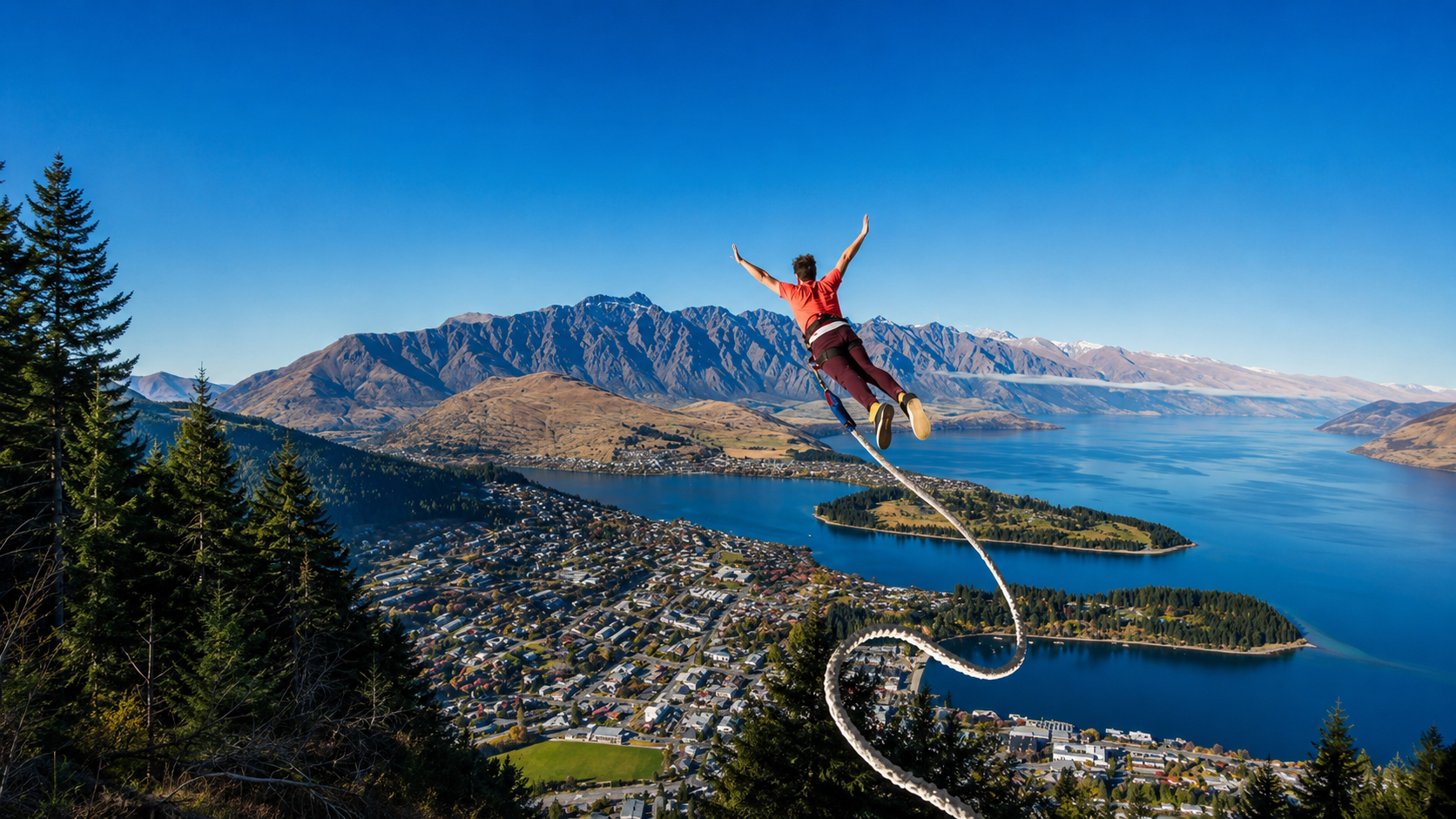
Bungy Jumping
Queenstown gives you several of New Zealand's most famous bungy experiences, including Kawarau and the enormous Nevis.
They are not inexpensive ways to spend a few seconds.
But nobody chooses a bungy because they calculated the cost per minute.
If it is something you genuinely want to do, it can become one of those experiences you talk about for years.
If you are only considering it because everybody else visiting Queenstown appears to have done one, keep the money.
There are plenty of other ways to experience the region.
Scenic Flights
Scenic flights are probably the activity where I would think most carefully about both budget and location.
They can be expensive.
But in places such as Aoraki/Mount Cook, the West Coast glaciers and Fiordland, flying gives you access to perspectives you simply cannot get from a road.
For me, that is exactly the kind of thing that can justify spending more.
If the budget allows one major splurge, I would rather choose one excellent flight in the right location than several smaller activities that feel more ordinary.
5 BEST SCENIC FLIGHTS IN NEW ZEALAND
Scenic Cruises
Cruises sit in a slightly easier part of the activity budget.
Milford Sound is the obvious example, and I would absolutely include a cruise rather than simply driving to Milford, taking a photograph of the car park and leaving again.
Doubtful Sound costs more because reaching it involves a much more complicated journey, but the remoteness is also what makes the experience special.
Lake Taupō, the Bay of Islands and Queenstown all have scenic cruise options at different price points.
Hiking Can Be Surprisingly Affordable
If you enjoy walking, New Zealand becomes much easier to travel on a reasonable budget.
Many excellent day walks are free to access.
That includes everything from short forest tracks to some extraordinary alpine landscapes.
The cost usually comes from transport, parking in some locations, equipment and occasionally shuttle services.
Multi-day walks can be different.
For the 2026/27 season, DOC's Great Walk hut prices vary by track and residency. International adults, for example, currently pay NZ$152 per night on the Milford Track during the summer season and NZ$132 per night on the Routeburn Track, while other Great Walks cost less.
That means a Great Walk is no longer automatically a very cheap multi-day holiday for an overseas visitor.
It can still be excellent value for the experience, but include the huts, transport and food in your planning.
How Much Should You Budget for a North Island Trip?
A North Island road trip can be slightly easier to keep under control because several major destinations sit relatively close together.
Auckland, Rotorua, Taupō and Tongariro can form an excellent route without enormous daily driving distances.
That means less fuel.
There is also a good mixture of free and paid activities.
You might spend on a Māori cultural experience or geothermal attraction in Rotorua, rafting around Rotorua or Tūrangi and perhaps a Taupō skydive.
Then balance those with Huka Falls, lakefront walks, Tongariro National Park and other free outdoor experiences.
For a budget-conscious first trip, the central North Island offers excellent value because you can experience a great deal without constantly relocating.
How Much Should You Budget for the South Island?
The South Island is where I would allow a little more money.
Not necessarily because everyday life is always more expensive, but because it contains a dangerous concentration of things you may want to pay for.
Queenstown alone can offer you a bungy jump, skydive, jet boat, rafting trip, scenic flight and lake cruise before you have even considered skiing.
Then Fiordland appears.
Then the West Coast glaciers.
Then Aoraki/Mount Cook.
It is remarkably easy to create a fantastic and financially ambitious itinerary.
The answer is prioritisation.
I would choose the activities that best fit each destination rather than doing everything everywhere.
In Queenstown, perhaps that means bungy and jet boating.
In Fiordland, spend the money on the cruise.
At Aoraki/Mount Cook, perhaps the scenic flight becomes the major splurge.
Then use hiking, cycling and road-trip days to balance the cost.
Does the Time of Year Affect the Cost?
Absolutely.
Travel during Christmas, New Year and January and you are competing with both international visitors and New Zealanders on summer holidays.
Rental vehicles and popular accommodation can be in high demand.
Queenstown also experiences strong winter demand during the ski season.
If you are flexible, the shoulder seasons can offer much better value.
I particularly like March, April, October and November for this reason.
You still have excellent opportunities for outdoor travel but may avoid some of the strongest peak-season pressure.
I would not choose dates based entirely on price, though.
There is no point saving money by visiting in May if the whole reason you wanted to come was a particular summer hike.
Choose the right season first.
Then look for value within it.
Solo Travellers Need a Different Budget
Solo travel can be more expensive per person because nobody is sharing the room or rental car.
A NZ$200 motel room costs a couple NZ$100 each.
For a solo traveller, it costs NZ$200.
The same applies to rental-car costs and fuel.
This is where hostels, buses and strategic use of domestic flights can become much more attractive.
You could also rent a car only for the sections where it genuinely improves the trip.
There is no rule saying a New Zealand holiday requires having the same vehicle sitting outside your accommodation for three weeks.
A solo traveller might spend several days without a car in Auckland, fly to Queenstown, use activity transfers around town and then rent a vehicle only for Wānaka and Aoraki/Mount Cook.
That can make much better financial sense.
Couples Often Get Better Value
New Zealand road trips work particularly well financially for couples.
Accommodation and vehicle costs are shared while still giving you complete independence.
That is one reason I think a rental car plus motels or apartments can be such a strong option for two people.
If you occasionally cook, avoid moving accommodation every night and prioritise a handful of major activities, you can build a very comfortable trip without pushing into luxury budgets.
Families Need to Think About the Whole Cost
Families may pay more for larger accommodation and vehicles, but some costs become relatively efficient because the car and room are shared among more people.
Food is usually where I would pay attention.
Eating restaurant meals three times a day with several children can become expensive very quickly.
Apartments, holiday parks and motel rooms with kitchen facilities suddenly become extremely valuable.
You can have breakfast before leaving, make lunch for the road and save restaurants for evenings when everybody actually wants one.
Also look carefully at child pricing for activities.
Some attractions, cruises and DOC facilities offer reduced youth rates, although ages and conditions differ.
For example, DOC's standard accommodation and campsite pricing often includes lower youth rates, while Great Walk pricing has separate child rules depending on residency and season.
Travel Insurance Belongs in the Budget
Travel insurance is not the most exciting part of planning a holiday, but I would include it.
New Zealand trips often involve expensive bookings.
International flights.
Rental vehicles.
Scenic flights.
Adventure activities.
Accommodation.
Weather-sensitive tours.
If something changes, those costs can become significant.
The price of insurance depends on your country, age, trip length and activities, so there is no useful universal figure.
The important thing for adventure travellers is checking what the policy actually covers.
Do not automatically assume skiing, mountain biking, hiking, rafting or other adventure activities are included simply because you are on holiday.
Read the details.
Don't Forget Parking
Parking is not generally a huge issue throughout New Zealand, but there are destinations where it belongs in the budget.
Central Auckland, Wellington and Queenstown are the obvious examples.
A cheaper hotel becomes less impressive when you add paid parking every night.
This is why I often value accommodation that includes parking during a road trip.
National parks and visitor attractions can also have their own parking arrangements, which may change over time.
Check the current situation when planning rather than assuming every trailhead in New Zealand provides unlimited free parking.
Laundry Is a Real Travel Cost
This is not going to bankrupt anyone.
But longer trips accumulate lots of small expenses.
Laundry.
Coffee.
Parking.
Airport transfers.
Road tolls.
SIM cards.
Luggage storage.
ATM or foreign-transaction fees.
Snacks.
The bottle of sunscreen you apparently managed to lose after three days.
None of these matter individually.
Together, they are why I always build a buffer into the budget.
If your entire holiday only works financially when every day costs exactly what the spreadsheet predicted, the budget is too tight.
Give yourself some room.
How Much Emergency Money Should You Allow?
I like having at least 10–15 percent beyond the planned trip budget available.
You may never need it.
That is ideal.
But perhaps weather changes the route and you need another night's accommodation.
Perhaps the rental vehicle costs more than expected.
Perhaps you discover an activity you genuinely want to do.
Or perhaps Queenstown achieves its remarkable ability to turn a quiet afternoon into a financial event.
The buffer prevents those things from becoming stressful.
It is not necessarily money you intend to spend.
It is permission for the trip not to unfold perfectly.
Cards and Cash in New Zealand
Cards are widely accepted throughout New Zealand, and most travellers will be able to pay electronically for almost everything.
I would still carry a small amount of cash.
It can be useful for markets, small rural businesses or unusual situations where electronic payment is unavailable.
I would not carry enormous amounts, though.
If your bank charges international transaction fees, check those before travelling because several weeks of card payments can create another unnecessary expense.
A travel card or fee-friendly bank account may save more money than repeatedly hunting for slightly cheaper cafés.
Where I Would Save Money
I would save on the things that do not materially affect the experience.
I do not need a luxury hotel if I am going to leave at 7am and return at 8pm.
I do not need a restaurant breakfast every day.
I do not need the largest rental car.
I do not need a guided tour for something I can safely and easily explore independently.
I also would not move accommodation simply to tick another town off the itinerary.
Fewer bases often save money because you reduce fuel, cleaning fees, parking and the temptation to buy food while constantly travelling.
Where I Would Spend More
I would spend where the money gives me access, time or a genuinely better experience.
A Milford Sound cruise gives you access to the fiord.
A scenic flight gives you access to alpine landscapes you cannot reach from the road.
A rafting guide gives you access to a river you could not safely experience independently.
A well-located hotel can save you from driving and parking every time you want to walk into town.
A one-way rental fee may save an entire day of backtracking.
Those are the expenses I find easiest to justify.
Spending more is not automatically wasteful.
It becomes wasteful when you do it without knowing what you are getting in return.
Aotearoa Adventures Tip: Choose Your Splurge Before You Arrive
If there is one thing I would recommend for keeping a New Zealand travel budget under control, it is deciding on your one or two major splurges before the trip begins.
Perhaps you have always wanted to skydive.
Budget for it.
Perhaps flying over Aoraki/Mount Cook is the experience that made you choose New Zealand.
Put the money aside.
Perhaps you would rather spend it on an overnight Doubtful Sound trip.
Excellent.
Once those experiences are protected in the budget, everything else becomes easier to judge.
When another expensive activity appears, you can ask whether you actually want it more than the things you already chose.
That is much more effective than arriving in Queenstown with no plan and discovering that apparently you now need to do six different adventure activities because all of them have excellent photographs.
A Realistic Budget for Two Weeks: Budget Traveller
For one person travelling simply, I would probably start with a working budget of roughly NZ$2,000–NZ$3,000 for two weeks excluding international flights, then adjust according to transport.
That would require some discipline.
Hostels or low-cost accommodation would be important.
Food would come largely from supermarkets.
Bus transport, shared vehicle costs or carefully chosen rental days would make more sense than hiring an expensive vehicle alone for the entire trip.
Most activities would be hiking, beaches, sightseeing and other low-cost experiences, with perhaps one or two paid highlights.
This style of trip is completely possible.
And because New Zealand has so much free outdoor scenery, it does not need to feel like the cheap version of the country.
A Realistic Budget for Two Weeks: Mid-Range Traveller
For a couple, I would probably begin around NZ$6,000–NZ$8,000 combined before international flights and see how the itinerary develops.
That would allow comfortable motels or apartments, a rental vehicle, a mix of supermarket and restaurant food and several good paid activities.
You would still need to make choices.
It is not a luxury budget.
But it is enough to travel comfortably without constantly checking whether buying another coffee has destroyed the holiday finances.
For many first-time Aotearoa Adventures readers, I think this is the most realistic category.
A Realistic Budget for Two Weeks: Adventure-Focused Couple
If you want comfortable accommodation and several of New Zealand's major adventure experiences, I would look more towards NZ$8,000–NZ$12,000 or more for two people, excluding international flights.
That could allow for a good rental car, comfortable accommodation and perhaps a combination of experiences such as rafting, bungy jumping, Milford Sound, scenic flights or skydiving.
It can go higher very easily.
Premium accommodation and aviation activities are where the numbers start moving fastest.
That is not necessarily a problem.
If this is a once-in-a-lifetime trip and you have deliberately saved for it, spend on the things you care about.
The important word is deliberately.
How to Make New Zealand Cheaper Without Ruining the Trip
You do not need to strip all the enjoyable parts out of the holiday to reduce the cost. The biggest savings usually come from the structure of the trip rather than tiny day-to-day sacrifices.
Travel just outside peak season if your dates are flexible. Spend more nights in fewer destinations rather than constantly relocating. Choose accommodation with a kitchen and parking. Buy breakfast and road-trip lunches from supermarkets, then enjoy restaurant dinners when you genuinely want them. Use a smaller rental vehicle rather than automatically upgrading to an SUV, and consider domestic flights when they allow you to remove several days of unnecessary driving and accommodation.
Most importantly, mix paid experiences with free days. A morning hike followed by an afternoon beside a lake can be just as good as a day containing three commercial tours.
That combination is where I think New Zealand offers its best value.
Is New Zealand Expensive Compared With Other Destinations?
That depends largely on where you are coming from.
Visitors from countries with strong currencies may find some costs fairly manageable.
Others may find accommodation, restaurants and activities expensive.
New Zealand is also geographically isolated, which affects the cost of goods and travel.
Rather than comparing everything directly with home, I think it helps to look at what you are getting for the money.
A hotel room is simply a hotel room.
But the expensive part of a New Zealand holiday is often not ordinary life.
It is the temptation to do extraordinary things.
You are not spending several hundred dollars because lunch costs several hundred dollars.
You are spending it because somebody offered to put you in a helicopter and land you on a glacier.
There is a difference.
Is a New Zealand Holiday Worth the Cost?
I think it can be, particularly if you avoid trying to buy every experience available.
The landscapes themselves do an enormous amount of the work.
You do not need a tour to appreciate Lake Wānaka.
You do not need an admission ticket to see Aoraki/Mount Cook from the road.
You do not need to pay somebody to walk beside Lake Taupō.
What commercial activities do is give you access to experiences you cannot easily create yourself.
That is where I would focus the money.
Spend deliberately.
Let the free days be genuinely free.
And do not judge the quality of the holiday by the number of bookings in your email.
Final Thoughts: How Much Money Do You Really Need for New Zealand?
There is no perfect New Zealand holiday budget because there is no single way to travel here.
A backpacker can spend several weeks exploring the country relatively cheaply by staying in hostels, cooking meals and building the itinerary around walks and public transport. At the other end of the scale, somebody can spend more on one Queenstown helicopter trip than another traveller spends during several days on the road.
Most visitors will sit somewhere between those extremes.
For a first trip, I would start by paying for the things that cannot easily be changed: international flights, entry requirements, transport and the key accommodation you need. Then decide which experiences would genuinely make the holiday special for you.
Perhaps that is Milford Sound.
Perhaps it is rafting the Kaituna River.
Maybe it is a Queenstown bungy jump or a scenic flight around Aoraki/Mount Cook.
Give those experiences proper space in the budget.
Then build the rest of the holiday around New Zealand's greatest financial advantage: a lot of the country itself is free to enjoy.
Some of your best days may cost very little. You might walk a track in the morning, eat lunch beside a lake, take a scenic road somewhere you had not planned to visit and finish the evening watching the mountains change colour.
The next day might be the expensive one.
That balance is exactly how I would plan it.
I would also leave some money unallocated. New Zealand weather changes, itineraries evolve and there is a very good chance you will discover something after arriving that never appeared in the original plan.
A good travel budget should give you enough control to know what the holiday is costing without making you feel guilty every time you change your mind.
Save where the difference does not matter.
Spend where it does.
And remember that the goal is not to come home having spent the smallest possible amount.
It is to come home feeling that the money you did spend gave you the trip you wanted.
Continue Planning Your New Zealand Trip
Once you have an idea of what your budget looks like, I would continue with:
NEW ZEALAND TRAVEL GUIDE FOR FIRST-TIME VISITORS
BEST TIME TO VISIT NEW ZEALAND
PLANNING AN ADVENTURE HOLIDAY IN NEW ZEALAND