

South Island Alpine Adventure
South Island Alpine Adventure – 10 Days
Christchurch → Lake Tekapo → Aoraki/Mount Cook → Wānaka → Queenstown → Fiordland
If you want one South Island road trip that captures the version of New Zealand many people travel halfway around the world to see, this would be very high on my list. In ten days you move from Christchurch into the Mackenzie Country, follow turquoise lakes towards Aoraki/Mount Cook, cross the high country to Wānaka, spend time in New Zealand's adventure capital and finish beneath the enormous mountains and waterfalls of Fiordland.
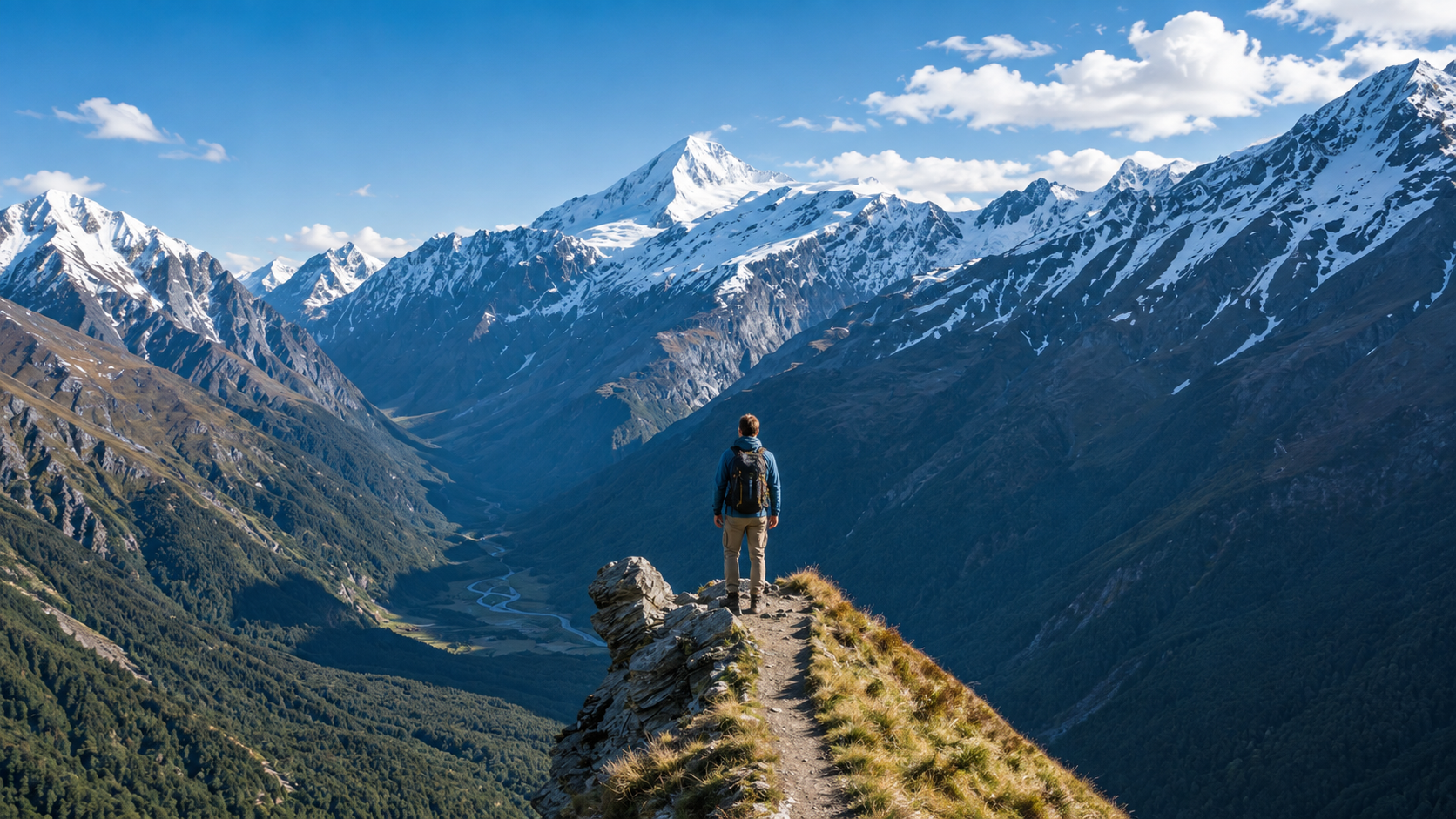
What I particularly like about this route is that the scenery becomes more dramatic as the trip progresses. Lake Tekapo gives you open high-country landscapes and incredible night skies. Aoraki/Mount Cook puts you right beneath the Southern Alps. Wānaka combines mountains with a calmer lakeside atmosphere, while Queenstown adds the adrenaline side of the trip. Then Fiordland completely changes the mood again, replacing dry alpine landscapes with rainforest, deep valleys and Piopiotahi/Milford Sound.
Ten days is enough to make this work without turning every day into a long drive, but I would resist adding too much more. There will always be another place you could squeeze in. The West Coast, Kaikōura and Central Otago are all tempting, but they deserve their own time rather than being reduced to hurried detours.
This is how I would plan the South Island Alpine Adventure.
Day 1 – Arrive in Christchurch
I would keep the first day fairly relaxed, particularly if Christchurch is where you have arrived after a long international flight. There is no real benefit in collecting a rental car, immediately heading into unfamiliar roads and trying to reach the mountains before sunset.
Christchurch is worth spending some time in anyway. The central city has changed enormously over the past decade, and areas around the Avon River, Riverside Market and the Botanic Gardens make an easy introduction to the trip. You do not need to fill the entire day with sightseeing. Walk around, have something good to eat and give yourself a chance to adjust before beginning the road trip properly.
If you already feel rested and have arrived early from elsewhere in New Zealand, you could collect the rental car during the afternoon. Otherwise, I would wait until the following morning. Paying for a rental car and hotel parking when you are not actually using the vehicle rarely makes much sense.
The important thing is starting the road trip feeling awake rather than beginning one of the most scenic drives of the holiday while thinking only about sleep.
Stay: Christchurch
Day 2 – Christchurch to Lake Tekapo
Today is when the South Island road trip properly begins.
Leave Christchurch and head inland towards the Mackenzie Country. The drive to Lake Tekapo takes around three hours without long stops, but I would allow more because the landscape becomes increasingly interesting as you move away from the city.
The Canterbury Plains gradually give way to rolling farmland and then increasingly open high-country scenery. By the time you reach Tekapo, the mountains have begun taking over the horizon.
Lake Tekapo itself is famous for its vivid blue water, created by fine glacial sediment suspended in the lake. On a clear day, the colour can almost look artificial in photographs, but it is even better when you see it properly from the shoreline.
Spend the afternoon around the lake rather than immediately treating Tekapo as somewhere to sleep between Christchurch and Mount Cook. Walk along the waterfront, visit the Church of the Good Shepherd area and take time to enjoy the open landscapes around the village.
If you enjoy walking, there are short options around the area that give you wider views over the lake and surrounding mountains.
But one of Tekapo's best experiences happens after dark.
The Mackenzie region is renowned for its exceptionally dark skies, and if the weather cooperates, I would make time for stargazing. You can join an organised experience or simply step outside somewhere away from bright lights and look up.
It is a very good way to begin an alpine South Island trip.
Stay: Lake Tekapo
Aotearoa Adventures Tip: Do not arrive in Tekapo late in the evening and leave again first thing the next morning. It is an easy place to rush through because Mount Cook is waiting farther down the road, but the lake and night sky deserve their own time.
Day 3 – Lake Tekapo to Aoraki/Mount Cook
This is one of the driving days I would deliberately make longer than the distance requires.
From Tekapo, head towards Twizel before turning onto State Highway 80 towards Aoraki/Mount Cook. Once Lake Pūkaki appears, the journey becomes one of the highlights of the entire itinerary.
On a clear day, the lake is an extraordinary turquoise colour, with Aoraki and the Southern Alps rising in the distance. The road follows the western side of Lake Pūkaki, and the closer you get to the national park, the larger the mountains become.
Do not rush it.
There are viewpoints along the way where it is worth stopping safely, and this is exactly the kind of New Zealand drive where an estimated journey time tells you very little about how long you will actually want to spend travelling.
Once you reach Aoraki/Mount Cook Village, keep the first afternoon fairly flexible. You could take a shorter walk, explore the Tasman Valley or simply enjoy being surrounded by mountains.
The Tasman Glacier area is particularly worthwhile because it gives you a completely different perspective from the Hooker Valley. Short walks lead to viewpoints over the Tasman Valley and glacier lake, and it is easy to understand the scale of the landscape once you are there.
I would definitely stay overnight rather than returning to Tekapo or Twizel.
Aoraki/Mount Cook feels different once many of the day visitors have gone, and staying nearby gives you the flexibility to use tomorrow properly.
Stay: Aoraki/Mount Cook
Day 4 – Aoraki/Mount Cook Adventure Day
This is one of the days I would protect most carefully.
For most first-time visitors, the Hooker Valley Track is the obvious place to begin. The full track is open again following the opening of its new second suspension bridge in July 2026. The 189-metre bridge is now New Zealand's longest suspension bridge, and the track continues through the valley to Hooker Lake beneath Aoraki/Mount Cook.
It is popular for a reason.
The walk gives you glacier views, river crossings, mountain scenery and increasingly impressive views towards Aoraki as you move deeper into the valley. You do not need technical climbing skills for an ordinary walk in suitable conditions, but you are still in a mountain environment, so check the weather and arrive prepared.
I would start reasonably early, partly for quieter conditions and partly because it leaves the afternoon free.
If you still have energy afterwards, you could explore another shorter track or return to the Tasman Valley.
If the budget allows for one major splurge on this road trip, Aoraki/Mount Cook is also one of the places where I think a scenic flight can genuinely add something. The scale of the Southern Alps is difficult to understand from the road. Seeing glaciers and high alpine terrain from the air gives you a completely different view of the region.
Weather will decide whether that is possible, which is another reason staying two nights is useful.
If a flight or hike is important to you, having only one afternoon at Mount Cook leaves very little room when cloud rolls in.
Stay: Aoraki/Mount Cook
Day 5 – Aoraki/Mount Cook to Wānaka
Leave Mount Cook and retrace the road along Lake Pūkaki before continuing through Twizel and towards the Lindis Pass.
This is another beautiful travel day, but the scenery changes significantly.
The enormous alpine peaks gradually give way to drier high-country landscapes, tussock-covered hills and wide valleys. The Lindis Pass is particularly distinctive and is worth treating as part of the journey rather than something to simply cross.
Eventually the road brings you towards Wānaka.
After several days of travelling through dramatic mountain country, Wānaka feels like a good place to slow down. The town sits beside Lake Wānaka with mountains surrounding the water, but the atmosphere is generally more relaxed than Queenstown.
Once you arrive, I would not immediately book another major activity.
Walk along the lakefront.
Explore the town.
Find somewhere for dinner.
If the weather is good, simply spending the evening beside the lake is enough.
This is one of the reasons I like putting Wānaka in the middle of the itinerary. It acts as a natural breathing point between Mount Cook and Queenstown while still being one of the South Island's strongest outdoor destinations.
Stay: Wānaka
Day 6 – Wānaka Adventure Day
Give Wānaka a full day.
Exactly how you use it depends on what kind of trip you want.
If hiking is the priority, there are several excellent options around the region, ranging from relatively easy walks to much more demanding alpine routes. Choose according to the conditions and your ability rather than simply selecting the walk that appears most often on social media.
If you prefer cycling, Wānaka has some excellent trails around the lake and surrounding countryside.
For something bigger, you could skydive above the region or take a scenic flight towards Mount Aspiring National Park. The combination of Lake Wānaka, Lake Hāwea and the surrounding Southern Alps makes this one of New Zealand's most impressive places to see from the air.
I would still avoid filling the entire day with bookings.
Part of Wānaka's appeal is that it gives you room to simply enjoy the landscape. Go for a walk in the morning, have lunch in town and leave the afternoon flexible.
If tomorrow's Queenstown itinerary is going to be full of adrenaline, a slightly slower Wānaka day can be exactly what the trip needs.
Stay: Wānaka
Aotearoa Adventures Tip: If you are choosing between a Wānaka skydive and Queenstown skydive, I would normally pick one rather than automatically doing both. They are both excellent, but using the money for a completely different experience elsewhere gives the trip much more variety.
Day 7 – Wānaka to Queenstown
The drive between Wānaka and Queenstown is short enough that you have plenty of flexibility.
One option is travelling over the Crown Range, one of New Zealand's highest sealed roads. In suitable weather, the route gives you huge views across the surrounding mountains and valleys before descending towards Arrowtown and Queenstown.
Take your time, particularly if you are unfamiliar with steep or winding roads.
You could stop in Cardrona on the way or spend part of the day in Arrowtown, the historic settlement near Queenstown. Arrowtown makes a particularly nice contrast with the big alpine scenery of the previous few days, with heritage buildings, walking trails and cafés giving you an easy place to spend a few hours.
Then continue into Queenstown.
Your first impression is hard to beat. The town sits beside Lake Whakatipu, surrounded by the Remarkables and other mountain ranges, and almost every direction looks as though someone deliberately designed it for a travel photograph.
I would use the first afternoon to get your bearings rather than immediately running towards the nearest bungy platform.
Walk the lakefront, explore the centre and perhaps head up towards the Skyline area for elevated views.
Tomorrow can be the big adventure day.
Stay: Queenstown
Day 8 – Queenstown Adventure Day
This is where you choose how adventurous you actually want the road trip to become.
Queenstown gives you an almost ridiculous number of options.
You can bungy jump, skydive, jet boat, raft, mountain bike, take a scenic flight or spend the day doing something much calmer on Lake Whakatipu.
For a first trip, I would choose one major adventure rather than trying to complete Queenstown in a single day.
If you want something genuinely intimidating, bungy jumping is difficult to ignore. The Kawarau Bridge gives you the history of commercial bungy in New Zealand, while the Nevis takes the whole idea considerably further.
If jumping from a platform is not for you, a jet-boat ride gives you plenty of excitement without the moment where somebody asks you to step into empty space.
Skydiving is another option, particularly if you did not do it in Wānaka.
Then leave part of the day free.
Walk through Queenstown Gardens, enjoy the lakefront or have a slower afternoon in town. Adventure activities are fun, but Queenstown becomes much more enjoyable when you give yourself time to actually experience the place around them.
I would also avoid booking three major activities back-to-back simply because you technically can.
A holiday does not become more successful according to the number of waiver forms you signed.
Stay: Queenstown
BEST BUNGY JUMPS IN NEW ZEALAND
BEST JET BOATING IN NEW ZEALAND
BEST PLACES TO SKYDIVE IN NEW ZEALAND
Day 9 – Queenstown to Te Anau and Fiordland
Today the road trip changes character again.
Leave Queenstown and travel south towards Te Anau, the gateway to Fiordland National Park.
The journey normally takes around two hours without significant stops, which means you do not need to leave at dawn. After several activity-heavy days, I would enjoy a slower morning and arrive in Te Anau around lunchtime.
Te Anau sits beside the largest lake in the South Island and is a much quieter base than Queenstown.
Use the afternoon to slow the pace.
Walk along the lakefront, explore part of the surrounding area or simply prepare for tomorrow's Milford Sound journey.
If you want another organised experience, the Te Anau Glowworm Caves can fit nicely into this part of the trip because they offer something completely different from the mountains and adventure activities you have already experienced.
But I would not overload the day.
Tomorrow deserves an early start and plenty of time.
Stay in Te Anau rather than trying to drive straight from Queenstown to Milford Sound and back again. It turns the Milford experience into a proper Fiordland day instead of a marathon journey.
Stay: Te Anau
Day 10 – Te Anau to Piopiotahi/Milford Sound
This is a very good place to finish the road trip.
The road from Te Anau to Piopiotahi/Milford Sound is not simply transport to the cruise terminal. It is one of the great drives in New Zealand.
The route moves beside lakes, through native forest and deeper into the mountains before reaching the Homer Tunnel and descending towards Milford Sound. NZTA says the direct one-way journey from Te Anau takes at least two hours without stops, but in reality I would allow considerably longer because there are so many worthwhile places along the road.
Leave early.
Stop when it is safe.
Let the road be part of the day.
Once you reach Milford Sound, I would absolutely take a scenic cruise.
Driving all the way into Fiordland and then only looking at the fiord from shore would miss most of the experience. The boat takes you beneath the mountains and waterfalls and gives you a proper sense of the scale of the place.
Do not panic if it rains.
Fiordland is famous for wet weather, and rain creates temporary waterfalls across the cliffs. A bright clear day gives you one version of Milford Sound; a wet, atmospheric day gives you another.
If you are travelling during winter or periods of alpine weather, the Milford Road needs to be taken seriously. Road conditions can change with snow, ice and avalanche risk, and NZTA advises checking conditions before leaving Te Anau. It also recommends that inexperienced winter drivers consider using coach transport rather than self-driving.
After the cruise, return to Te Anau for the evening.
If your next flight leaves from Queenstown, I would preferably travel back there the following morning rather than adding another two-hour drive after an already substantial Milford day.
Stay: Te Anau
EXPLORE MILFORD SOUND ACTIVITIES
BEST SCENIC CRUISES IN NEW ZEALAND
Why This South Island Road Trip Works
The strength of this route is that almost every destination earns its place.
Lake Tekapo is not simply somewhere between Christchurch and Mount Cook. It gives you the Mackenzie landscape and dark skies.
Aoraki/Mount Cook provides the major alpine walking section.
Wānaka lets the journey slow down without losing the mountains.
Queenstown delivers the adventure.
Te Anau and Milford Sound provide a completely different wilderness experience to finish the trip.
There is also relatively little backtracking.
You move naturally south and west through the island, with each section feeling different from the one before it.
That makes the itinerary feel like a journey rather than a collection of unrelated day trips.
How Much Driving Is Involved?
One of the reasons I like this route is that the driving is manageable for a ten-day trip.
The approximate main sections are Christchurch to Tekapo at around three hours, Tekapo to Aoraki/Mount Cook around an hour and a half, Mount Cook to Wānaka roughly two and a half to three hours, Wānaka to Queenstown around an hour to an hour and a half depending on route and conditions, and Queenstown to Te Anau around two hours.
The Milford Road is different.
While Te Anau to Milford Sound is at least two hours each way without stops, I would treat it as a full-day scenic journey rather than a simple transfer.
Do not build your itinerary around achieving the fastest possible driving times.
The roads are part of why you are here.
Do You Need a Rental Car?
For this itinerary, I think a rental car is easily the best option for most travellers.
It gives you freedom around Lake Tekapo and Mount Cook, lets you stop on the road beside Lake Pūkaki and makes Wānaka and Queenstown much easier to connect.
You do not need a large SUV for an ordinary summer road trip on the main highways.
A comfortable small or medium-sized car is usually more than enough and will use less fuel.
If you are travelling in winter, the situation changes. Mountain roads can be affected by snow and ice, and you need to understand local conditions, snow-chain requirements and your rental company's rules.
For Milford Sound in particular, there is nothing wrong with leaving the car in Te Anau and taking a coach if you would rather enjoy the scenery without worrying about the road.
When Is the Best Time for This Road Trip?
For a first trip, I particularly like November through April.
The days are longer, hiking opportunities are generally easier to incorporate and the road-trip experience feels more flexible.
January and February bring proper summer conditions but can also be busy, particularly around Queenstown and other major destinations.
March is one of my favourite months for this route because the weather can still feel summery while some of the peak holiday demand has eased.
April brings beautiful autumn colour around Wānaka, Queenstown and Central Otago, although the days become shorter and mountain conditions gradually cool.
Winter creates an entirely different trip.
Queenstown and Wānaka become ski destinations, the mountains can look spectacular under snow and Aoraki/Mount Cook can be extraordinary.
But winter is not simply summer with more attractive mountains in the background.
Road conditions, hiking access and daylight hours all need more consideration.
How Much Should You Budget?
This trip can be surprisingly affordable or extremely expensive depending on what you do in Queenstown and whether you add scenic flights.
The scenery itself costs very little.
Walking beside Lake Tekapo, driving beside Lake Pūkaki, spending time around Lake Wānaka and exploring much of the national park landscape does not require a huge activity budget.
The expensive part comes when you begin adding aviation and adventure activities.
A scenic flight around Mount Cook, Queenstown bungy, skydive, jet-boat ride and Milford cruise can transform the activity budget very quickly.
I would choose two or three major paid experiences and allow the rest of the trip to be about the landscapes.
For me, I would definitely budget for the Milford Sound cruise, choose one Queenstown adventure, and then decide whether the Mount Cook scenic flight is worth making the main splurge of the holiday.
That feels like a much better balance than paying for something significant every day.
Who Is This Road Trip Best For?
This is one of the strongest itineraries for first-time visitors who have come to New Zealand primarily for mountains, scenery and adventure.
It works especially well for couples, solo travellers and families with older children because you can adjust the activity level without changing the route.
One traveller could spend ten days hiking, bungy jumping, skydiving and taking scenic flights.
Another could follow exactly the same route but replace those activities with easier walks, scenic drives, lake cruises and time in the towns.
The landscapes remain the same.
You simply choose how adventurous you want the experience to become.
Aotearoa Adventures Tip: Don't Add the West Coast Just Because It Is Nearby
This is probably the temptation I would resist most.
Once you are in Wānaka, the West Coast does not look particularly far away on a map.
And it is excellent.
But adding Franz Josef, Hokitika, Punakaiki and another long loop to a ten-day itinerary changes the entire trip.
Suddenly you are moving almost every day and losing the extra nights that allow weather flexibility at Mount Cook, Wānaka and Fiordland.
If you have fourteen days, the West Coast becomes much easier to include.
If you have ten, I would keep this route focused.
There is nothing wrong with leaving part of the South Island for another trip.
South Island Alpine Adventure at a Glance
Day 1: Christchurch – arrive, recover and explore.
Day 2: Christchurch → Lake Tekapo – high-country scenery and stargazing.
Day 3: Lake Tekapo → Aoraki/Mount Cook – Lake Pūkaki and Tasman Valley.
Day 4: Aoraki/Mount Cook – Hooker Valley Track and optional scenic flight.
Day 5: Aoraki/Mount Cook → Wānaka – Lindis Pass and lakefront evening.
Day 6: Wānaka – hiking, cycling, skydiving or a scenic flight.
Day 7: Wānaka → Queenstown – Crown Range, Arrowtown and Queenstown lakefront.
Day 8: Queenstown – choose one major adventure and enjoy the town.
Day 9: Queenstown → Te Anau – relaxed journey into Fiordland.
Day 10: Te Anau → Milford Sound → Te Anau – scenic Milford Road and fiord cruise.
Final Thoughts
If I had ten days and wanted to show a first-time visitor why the South Island has such a strong reputation, this is one of the routes I would choose.
You get the turquoise lakes and open high country around Tekapo, the enormous mountain scenery of Aoraki/Mount Cook, a couple of nights beside Lake Wānaka, the energy and adventure of Queenstown and then a completely different landscape when you reach Fiordland.
More importantly, the itinerary gives those places enough room.
You are not arriving at Mount Cook, taking one photograph and immediately driving away.
You are not using Wānaka purely as somewhere to sleep before Queenstown.
And you are not treating Milford Sound as a box to tick during an exhausting drive from the other side of the region.
That slower approach is what makes the route work.
There will always be another place you could add to a South Island itinerary. The West Coast is waiting. So is Abel Tasman. Kaikōura, Central Otago and the Catlins could all justify another journey.
You do not need to see all of them this time.
Ten days spent properly exploring this alpine route will give you far more than ten days spent racing across the entire island.
The best part is that the trip keeps building.
The landscapes become larger, the mountains get closer and the road eventually delivers you into Fiordland, where Milford Sound provides exactly the kind of finish a South Island adventure deserves.