

10 Best Things to Do in New Zealand: Experiences Worth Building Your Trip Around
10 Best Things to Do in New Zealand: Experiences Worth Building Your Trip Around
Trying to narrow New Zealand down to only ten things is not particularly easy. The country may look relatively small on a map, but the experiences change dramatically as you travel from north to south. You can explore underground caves one day, walk through an active volcanic landscape the next, then fly above glaciers or cruise beneath waterfalls once you reach the South Island.
That variety is one of the main reasons New Zealand works so well as a first-time travel destination. You do not need to choose between adventure, wildlife, hiking, culture and scenery because it is possible to experience all of them during the same trip. The harder part is deciding what deserves your limited time.
For this list, I have deliberately avoided simply choosing ten famous places. Instead, these are ten experiences I think are genuinely worth building a New Zealand itinerary around. Some are adventurous, some are surprisingly peaceful, and several combine an unforgettable activity with one of the country's most impressive landscapes.
You certainly do not need to do all ten. In fact, unless you have several weeks, I would recommend that you don't try. Choose the experiences that appeal to you most and allow enough time to enjoy the destinations around them properly.
Here are my 10 best things to do in New Zealand.
1. Cruise Through Piopiotahi/Milford Sound
If I were choosing one experience that belongs on almost every first-time New Zealand itinerary, Milford Sound would be very close to the top.
Located deep within Fiordland National Park, Piopiotahi/Milford Sound is surrounded by steep mountains that rise almost directly from the water. Waterfalls drop from enormous cliffs, rainforest clings to the slopes and Mitre Peak creates one of the most recognisable landscapes in New Zealand.
The best way to experience it is from the water.
A scenic cruise takes you through the fiord rather than leaving you to admire it from the shore. Most cruises spend around two hours exploring Milford, giving you time to move between indoor and outdoor viewing areas while travelling beneath the cliffs and waterfalls. Milford cruises operate throughout the year, so this is not something that needs to be limited to a summer itinerary.
One thing I would not do is cancel Milford simply because rain appears in the forecast. Fiordland is one of the wettest parts of New Zealand, and the rain is a large part of what creates the landscape. After heavy rainfall, temporary waterfalls appear across the cliffs, sometimes turning the entire fiord into a wall of moving water.
A clear day gives you beautiful mountain reflections and long views. A rainy day gives you atmosphere and waterfalls. Both can be spectacular in completely different ways.
The journey to Milford also deserves time. If you are self-driving from Te Anau, allow enough of the day to stop along the Milford Road rather than treating it as transportation you need to get through as quickly as possible.
For me, Te Anau is the better base if Milford Sound is a major priority. Queenstown tours are certainly convenient, but they create a much longer day. Staying in Te Anau allows Fiordland itself to become part of the trip rather than simply a very long excursion.
Who Milford Sound is best for
Almost everyone. You do not need to be particularly adventurous or physically fit, and the landscape is impressive whether you are travelling as a couple, family, solo traveller or photographer.
Aotearoa Adventures Tip: If Milford Sound is one of the main reasons for your trip, give yourself at least two nights around Te Anau. That gives the experience much more room and leaves you closer to the Milford Road.
2. Have a Proper Adventure in Queenstown
Queenstown has built an international reputation around adventure, and in this case the reputation is deserved.
Sitting beside Lake Whakatipu and surrounded by mountains, the town manages to combine a dramatic setting with an almost ridiculous number of things to do. Bungy jumping, skydiving, jet boating, white-water rafting, mountain biking, paragliding, skiing and scenic flights are all available around the region. Tourism New Zealand describes Queenstown as the country's adventure capital and notes its important connections with the development of commercial bungy jumping and jet boating.
The danger is believing you need to do everything.
You don't.
I think Queenstown works best when you choose one or two major adventures and then leave enough time to experience the area without being attached to a harness for the entire visit.
For a first trip, I would probably choose something that feels uniquely Queenstown. The Kawarau Bridge Bungy has history behind it, while the 134-metre Nevis Bungy is for anyone looking for something considerably more intimidating. Shotover Jet gives you a fast canyon experience, and skydiving delivers the Southern Alps and lake scenery from a completely different perspective.
Then slow things down.
Walk around the lakefront, spend a morning on Queenstown Hill, visit Arrowtown or take a drive towards Glenorchy. Queenstown becomes much more enjoyable once you realise the town itself is not simply a waiting room between activities.
I would normally allow at least three or four nights, and longer is easy to justify if you are using Queenstown as a base for day trips.
Which Queenstown adventure would I choose?
If I wanted pure adrenaline, I would probably choose a bungy or skydive. If I wanted something that works for a wider range of people, jet boating would be easier to recommend. If I had already spent several days doing high-energy activities, I might choose a scenic flight or Lake Whakatipu cruise instead.
The point is not choosing what somebody else says is the most extreme.
Choose the experience that you are still going to be excited about when you think back on the trip several years later.
QUEENSTOWN COMPLETE TRAVEL & ADVENTURE GUIDE
BEST BUNGY JUMPS IN NEW ZEALAND
3. Walk Through the Volcanic Landscape of Tongariro National Park
Few places in New Zealand look quite like Tongariro National Park.
The landscape feels exposed and raw, with volcanic peaks, old lava flows and crater country replacing the forests, beaches and alpine lakes found elsewhere. Even if you have already spent several weeks travelling around New Zealand, arriving in Tongariro can feel like entering an entirely different country.
The Tongariro Alpine Crossing is the experience most visitors know about, and for good reason. It takes you through one of New Zealand's most distinctive volcanic environments and has become one of the country's most famous day hikes.
But its popularity can sometimes create the wrong impression.
This is still a challenging alpine walk.
Weather can change quickly, and DOC has repeatedly stressed that poor conditions can make the crossing dangerous. In March 2026, DOC even suspended one transport operator after it took visitors to the track despite an official hazardous-weather warning, highlighting how seriously conditions need to be treated.
I would therefore build some flexibility around this part of the trip. If the crossing is one of your major goals, stay nearby for more than one night so you are not dependent on the weather cooperating on one exact morning.
Tūrangi makes a practical base, while accommodation around National Park and Whakapapa can put you even closer to the volcanic landscape.
You also do not need to complete the entire Alpine Crossing to make Tongariro worthwhile. There are other walks and viewpoints throughout the national park, making it a destination worth visiting even if conditions are unsuitable for the main crossing.
Is the Tongariro Alpine Crossing worth it?
If you enjoy hiking and the conditions are appropriate, absolutely. The scenery is very different from the Southern Alps, which is exactly why I think Tongariro deserves space even on itineraries that spend most of their time in the South Island.
The important part is treating it like a mountain day rather than a casual tourist attraction.
EXPLORE TONGARIRO NATIONAL PARK
4. Stand Beneath Aoraki/Mount Cook
There are some New Zealand destinations where the journey is almost as memorable as arriving, and Aoraki/Mount Cook is one of them.
The drive towards the national park alongside Lake Pūkaki is extraordinary. The water can appear an almost unreal turquoise colour, while Aoraki and the surrounding Southern Alps gradually grow larger ahead of you.
Once you reach the village, the scale of the landscape becomes much more obvious.
This is not a place I would reduce to a quick photograph and another two hours in the car. Stay if you can.
One of the best ways to experience the national park is the Hooker Valley Track, which follows the valley towards Hooker Lake beneath Aoraki/Mount Cook. The full track is open again after a new 189-metre second suspension bridge opened in July 2026. DOC now describes it as New Zealand's longest suspension bridge. The walk passes glacier views, alpine terrain and several bridges before reaching the lake.
The Hooker Valley Track is only one option. The Tasman Valley gives you views towards New Zealand's largest glacier, while stronger walkers can look at routes such as Sealy Tarns when the conditions and their ability are appropriate.
Then there is the sky.
The Mackenzie region is famous for its dark nights, and staying around Mount Cook rather than leaving with the day-trippers gives you a chance to experience the mountains in a completely different atmosphere.
If your budget allows it, this is also one of the locations where I think a scenic flight becomes easier to justify. Seeing glaciers, ice fields and the Southern Alps from above reveals just how little of the landscape is visible from the road.
How long should you spend at Mount Cook?
I would stay at least one night and preferably two if hiking or a scenic flight matters to you. Weather changes quickly in the mountains, and an extra night gives you much more flexibility.
5. Experience Rotorua's Geothermal Landscapes and Māori Culture
Rotorua gives you something that you simply cannot replace by spending more time in the South Island.
Steam rises from the ground, mud bubbles beside walking tracks and geothermal water has shaped the way people have lived in the region for generations. Tourism New Zealand describes Rotorua as New Zealand's geothermal heartland and highlights the combination of volcanic landscapes, Māori cultural experiences and outdoor adventure found around the city.
For a first visit, I would combine one substantial geothermal experience with a Māori-led cultural experience rather than rushing between several thermal parks simply to say you visited them.
Places such as Te Puia combine geothermal features with Māori arts and cultural interpretation, while Whakarewarewa gives visitors the opportunity to learn about a living Māori village in a landscape where geothermal water has long been part of everyday life. Rotorua also has other cultural experiences built around storytelling, kai and traditional performance.
What I particularly like about Rotorua is that the experience does not need to end there. Once you have explored the geothermal and cultural side, the region also offers mountain biking, rafting, lakes, forest walks and hot pools.
You could spend the morning looking at geysers and boiling mud, raft the Kaituna River another day and then finish the evening soaking in geothermal water.
That variety makes Rotorua much more than a one-night stop.
How long should you spend in Rotorua?
I would allow at least two nights, with three being even better if you want to include adventure activities.
Trying to visit one geothermal park between Auckland and Taupō and then immediately leaving misses a large part of what makes the area worthwhile.
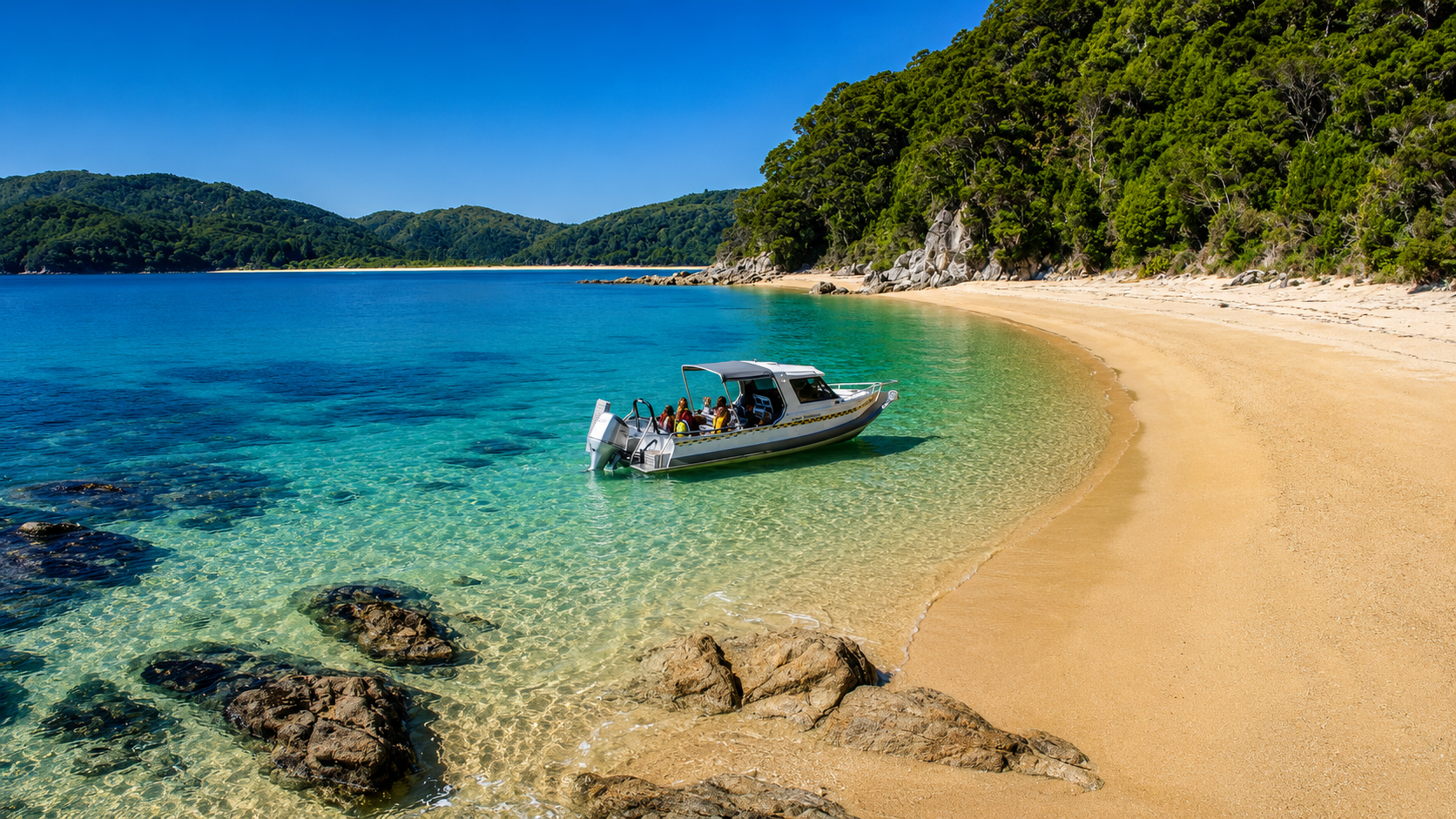
6. Kayak and Walk Through Abel Tasman National Park
New Zealand travel becomes heavily associated with mountains, so arriving in Abel Tasman National Park can feel like a complete change of pace.
Instead of glaciers and alpine valleys, you get golden beaches, forested headlands and clear coastal water.
The Abel Tasman Coast Track is one of New Zealand's Great Walks, but you do not need to walk the entire multi-day route to enjoy it. There is no charge simply to enter the national park or complete a day walk, and year-round water taxis make it particularly easy to travel into one part of the coastline, walk a section and get collected somewhere else.
That flexibility is one of the reasons I think Abel Tasman works so well for first-time visitors.
You could take a water taxi to a beach, spend several hours walking through native bush and along the coast and then return by boat later in the afternoon. Or you could make the water the main part of the experience and explore sections of the coastline by kayak.
Personally, I think combining kayaking and walking gives you the best version of Abel Tasman because the park looks completely different from the water.
If you are planning a multi-day walk, take the tidal crossings seriously. Sections such as Awaroa Inlet are only safely passable within specific windows around low tide, and DOC provides current tide information for planning the track.
For a simple day trip, the water-taxi and operator system removes much of that complexity.
Who will love Abel Tasman?
Travellers who want something active without it feeling intensely adventurous, couples, families, kayakers and anyone who needs a break from mountain driving.
It is also one of the best places to deliberately put a slower day into a busy itinerary.
7. See the Glowworms at Waitomo
Waitomo is one of those New Zealand experiences that sounds slightly strange until you actually understand what you are going to see.
Beneath the rolling Waikato countryside is an extensive limestone cave system filled with underground rivers, caverns and glowworms. At the famous Waitomo Glowworm Caves, visitors travel through part of the cave system before taking a boat ride beneath thousands of glowworms illuminating the darkness above.
It creates a completely different kind of New Zealand experience.
Most of this list is about huge open landscapes. Waitomo takes you in the opposite direction — underground, into darkness, where the attraction is tiny points of blue-green light across the ceiling.
For travellers who want something more adventurous, Waitomo has another personality as well.
The wider region contains hundreds of caves and has become famous for black-water rafting and caving experiences, where participants travel through underground waterways and cave systems using a mixture of walking, floating, climbing and abseiling depending on the trip. Tourism New Zealand highlights glowworms, black-water rafting and caving as the region's signature experiences.
That means Waitomo can work equally well for somebody who wants a peaceful guided cave tour and someone looking for something much more physical.
It also fits naturally into a North Island road trip between Auckland and the central North Island.
Which Waitomo experience should you choose?
For families or travellers who simply want to see the glowworms, I would choose the classic cave experience.
If adventure is a major reason for your New Zealand trip, I would look at one of the more active caving or black-water rafting options instead.
You still get the underground environment, but you become much more involved in exploring it.
8. Take a Scenic Flight Over the Southern Alps
This is probably the most expensive experience on this list, which means it deserves a little more thought before you book it.
A scenic flight is not something I think every traveller must do.
But if you are going to spend the money, New Zealand is one of the places where the experience can genuinely show you something that is almost impossible to understand from the ground.
The Southern Alps contain huge areas of glaciers, ice fields, peaks and valleys with very limited road access. When you fly above them, you suddenly see how enormous and undeveloped the interior of the South Island really is.
Aoraki/Mount Cook would probably be my first choice for a classic alpine scenic flight. From there, aircraft can take you across glacier country and high mountain landscapes, with some flights including alpine or snow landings.
Franz Josef and Fox Glacier are excellent alternatives on the West Coast because the combination of glaciers, rainforest and nearby ocean makes the landscape particularly unusual.
Wānaka gives you another strong option around Mount Aspiring National Park, while flights between Queenstown and Milford Sound can be particularly useful because they combine spectacular scenery with a journey that would otherwise involve many hours on the road.
I would choose the location based on where the flight adds the most to your itinerary rather than simply looking for the cheapest option.
Is a scenic flight worth the money?
For me, it makes the most sense if this is one of your major trip splurges.
Do not book one simply because a list told you it was compulsory.
But if mountains, glaciers and photography are major reasons you came to New Zealand, this is one of the experiences I would seriously consider spending more on.
Book it early during your stay if possible because flights are weather dependent. If conditions are unsuitable, having another day available gives you a chance to reschedule.
9. Go Whale Watching in Kaikōura
Kaikōura is one of the places where New Zealand's geography makes the wildlife experience possible.
The mountains rise almost directly behind the coast, giving the town a spectacular setting before you even head onto the water. Offshore, the deep Kaikōura Canyon supports a rich marine ecosystem that attracts whales and other wildlife.
Sperm whales can be seen around Kaikōura throughout the year, while other species appear seasonally. Tourism New Zealand describes Kaikōura as one of the world's leading whale-watching locations, with the deep offshore canyon creating a rich feeding environment.
The traditional experience is a boat-based whale-watching trip, but scenic flights also provide another way to see the animals and understand the scale of the coastline.
I like the boat because it gives you more time on the ocean and the possibility of encountering other marine life along the way. The local operator notes that tours may also encounter fur seals, dusky dolphins, albatross and other species depending on conditions and season.
If you are prone to seasickness, though, this is one activity where I would prepare before departure.
Kaikōura can also be enjoyed without a wildlife tour. The coastal walks are excellent, and the contrast between mountains and ocean makes the town worth stopping in regardless.
I would spend at least one night rather than treating it solely as a brief stop on the drive between Christchurch and Picton.
Who should put Kaikōura high on the list?
Wildlife lovers, photographers and travellers who want an experience that feels very different from the hiking and adventure activities elsewhere in the South Island.
10. Take a Proper New Zealand Road Trip
This may sound too broad to include as one of the ten best things to do, but I think the road trip itself is one of New Zealand's great experiences.
Having a car gives you access to the famous places, but the real value often appears between them.
You drive beside a lake and stop because the weather has cleared.
A sign points towards a waterfall you had never heard of.
You discover a small town around lunchtime and end up staying much longer than expected.
A drive that looked like a transportation day on the itinerary becomes one of the best days of the trip.
The South Island is particularly good for this. The road between Queenstown and Glenorchy follows Lake Whakatipu beneath the mountains. The approach to Aoraki/Mount Cook alongside Lake Pūkaki becomes more impressive with every kilometre. Haast Pass takes you between the drier landscapes around Wānaka and the rainforest of the West Coast, while the Milford Road feels like an attraction in its own right.
The North Island has a different road-trip character. You can travel from Auckland through geothermal Rotorua, continue towards Lake Taupō and reach the volcanic Central Plateau without needing enormous driving days. Go north instead and you move towards beaches, bays and subtropical landscapes.
The main mistake is trying to drive too much.
A proper New Zealand road trip is not about proving how much of the country you covered. It is about having enough flexibility to stop.
If your itinerary contains five hours of driving almost every day, remove something.
Stay an extra night.
Leave an afternoon free.
That is often where the best parts of the road trip appear.
DRIVING IN NEW ZEALAND: WHAT VISITORS NEED TO KNOW
Which of These 10 Experiences Would I Prioritise?
If this were my first New Zealand trip and I had around two weeks, I would not attempt all ten.
I would probably choose Milford Sound, Queenstown, Tongariro National Park, Rotorua and Aoraki/Mount Cook as the main anchors, then add activities that fit naturally around them.
That would give you geothermal landscapes and Māori culture in Rotorua, a completely different volcanic environment around Tongariro, then mountains, adventure and Fiordland once you reach the South Island.
If you had three weeks, Abel Tasman or Kaikōura could fit much more naturally without rushing.
Waitomo makes particular sense if your North Island route already passes through the Waikato, while a scenic flight is something I would add when the budget allows rather than force into every itinerary.
The important thing is that the ten experiences should help you choose, not become another checklist you feel pressured to complete.
The Best Things to Do for Adventure Travellers
If adrenaline is the main reason you are visiting, I would concentrate heavily on Queenstown, Rotorua, Taupō and Wānaka.
Queenstown provides the largest concentration of famous adventure activities, but Rotorua gives you excellent rafting and mountain biking alongside geothermal scenery. Taupō is particularly good for skydiving and jet boating, while Wānaka combines outdoor activities with access to some of the South Island's best alpine landscapes.
I would still include Milford Sound and Aoraki/Mount Cook, even if neither day involves doing anything extreme.
An adventure holiday becomes much better when every day does not require adrenaline.
Sometimes the most memorable part is simply being somewhere extraordinary.
The Best Things to Do for Nature and Wildlife
If wildlife and natural landscapes matter more than adrenaline, I would move Kaikōura, Abel Tasman and Fiordland higher on the list.
Kaikōura gives you the chance to see whales and other marine wildlife against an extraordinary mountain backdrop.
Abel Tasman combines beaches, native forest and the possibility of seeing kekeno/New Zealand fur seals around parts of the coastline.
Fiordland is less about searching for one particular animal and more about experiencing an enormous protected wilderness.
Add Rotorua for geothermal landscapes and Aoraki/Mount Cook for alpine country, and you can create an entire New Zealand trip without needing a single extreme adventure activity.
The Best Things to Do for Families
Families do not need a separate, watered-down version of New Zealand.
Several of the country's best experiences already work extremely well for different ages.
Milford Sound cruises are easy to enjoy as a family, Rotorua has an enormous variety of attractions and Waitomo's classic glowworm experience requires far less effort than the region's more adventurous cave trips.
Abel Tasman can also work beautifully because water taxis allow you to tailor the amount of walking to your family rather than committing to an enormous hike.
Jet boating can give older children a genuine adventure experience without needing the commitment of a bungy jump or skydive.
The key is building shorter travel days.
Children may not appreciate a six-hour scenic drive with quite the same enthusiasm as the adults in the front seats.
How Much Time Do You Need to Experience New Zealand Properly?
A week is enough for a very good trip if you choose one region.
Two weeks is where you can begin combining several of these experiences without constantly moving.
Three weeks is much better if you genuinely want to experience both islands.
For a first-time two-week trip, I would probably spend several days around the central North Island before using a domestic flight to move south. That gives you more time for Queenstown, Wānaka, Aoraki/Mount Cook or Fiordland instead of spending several days connecting everything by road.
If you have three or four weeks, a full two-island road trip becomes much more appealing.
The biggest thing I would avoid is planning the trip around the number of attractions rather than the amount of time you actually have.
New Zealand is not a country that benefits from being rushed.
When Is the Best Time to Do These Experiences?
If you want the greatest flexibility for road trips, hiking and outdoor activities, I would look at the warmer months between roughly November and April.
February and March are particularly attractive for a first trip. Summer conditions are well established, while March can be slightly quieter than the height of January.
Winter gives the South Island a completely different personality. Queenstown and Wānaka become ski destinations and the surrounding mountains can look spectacular under snow.
Rotorua, Waitomo, Milford Sound and Kaikōura can all be visited throughout the year, although the experience and conditions obviously change with the seasons.
There is no universal perfect month because the best time depends on which of these ten activities matters most to you.
How Much Should You Budget?
This list contains everything from free hikes to scenic flights costing several hundred dollars, so the answer depends on your choices.
I would not try to do all the expensive activities.
Choose perhaps two or three major splurges and balance them with the experiences that cost very little.
For example, you might pay for a Milford Sound cruise, a Queenstown bungy and a scenic flight. Then use hiking around Tongariro and Aoraki/Mount Cook, beaches, road-trip viewpoints and town days to balance the budget.
That gives you a mixture of once-in-a-lifetime experiences without turning every day into another expensive booking.
The result will probably feel more like a proper New Zealand trip as well.
Aotearoa Adventures Tip: Choose Experiences Before Filling the Map
When planning New Zealand, it is easy to choose destinations because their names keep appearing online.
I would do the opposite.
Choose the experiences you care about first.
If Milford Sound is non-negotiable, Fiordland needs time.
If seeing whales matters, Kaikōura becomes part of the route.
If the Tongariro Alpine Crossing is the dream, leave more than one possible hiking day around the Central Plateau.
If bungy jumping is the reason Queenstown first caught your attention, make sure you actually have enough time there rather than arriving late one afternoon and leaving again the next morning.
Once those priorities are clear, connect them into a sensible route.
That generally produces a much better itinerary than colouring in every famous destination on the map and hoping the driving somehow works out afterwards.
Final Thoughts: The Best Things to Do in New Zealand
The best experiences in New Zealand are not all the same, and I think that is exactly why travelling here is so enjoyable.
One day might involve walking across an exposed volcanic landscape in Tongariro National Park. A few days later you could be sitting quietly beneath thousands of glowworms underground at Waitomo. Head south and the country changes again, with glaciers, huge alpine lakes, whales, fiords and mountain roads replacing the geothermal and volcanic landscapes of the North Island.
You do not need to experience all ten things on this list to have a brilliant holiday.
In fact, I would rather choose five and give them enough time than rush through ten simply to say I had done them.
Cruise Milford properly rather than racing back to Queenstown.
Spend a few nights around Rotorua instead of visiting one geothermal attraction and leaving.
Allow Aoraki/Mount Cook enough time for the mountains to appear from behind the cloud.
Stay in Queenstown long enough that your entire experience is not confined to one adventure booking.
And leave some space between everything.
New Zealand's biggest strength is not simply that it contains famous attractions. It is that the country between those attractions is worth seeing too.
A great New Zealand trip usually contains a few things you planned months in advance, a few places you discovered while travelling and at least one day that did not unfold anything like you expected.
That is why I would use this list as inspiration rather than instructions.
Choose the experiences that make you genuinely want to come here.
Build your route around them.
Then give yourself enough time to discover what else New Zealand has waiting between them.
Continue Planning Your New Zealand Trip
NEW ZEALAND TRAVEL GUIDE FOR FIRST-TIME VISITORS
BEST TIME TO VISIT NEW ZEALAND